Dental Zirconia Block Compliance Guide: Certification, Standards, and Regional Requirements
A dental zirconia block compliance file is not a single certificate and it is not a logo on a brochure. For a CAD/CAM dental laboratory, compliance is a document set whose product scope, manufacturer identity, standard version, market, and validity date must match the block actually purchased. The 4D-PRO-ML dental zirconia block from YIPANG, the self-developed dental materials brand of Beijing Weijiahua Dentistry Equipment Co., Ltd., is supported by a stated ISO 13485 certificate, product specifications, an application statement for indoor constant-temperature dental laboratories, and a sintering instruction range. Those documents help a lab build an audit trail, but they do not automatically equal product approval in every country. This guide shows how to read the file without overstating it, how to map regional requirements to the documents actually supplied, and how to turn purchasing terms and acceptance criteria into a checkable record.
The compliance problem: certificate collecting versus scope matching
Labs often receive a folder containing a quality certificate, a declaration, a specification sheet, and a product photo. The risk is treating the folder as one approval. A quality management system certificate, a declaration of conformity, a regulatory listing, a test report, and a purchase specification answer different questions. If the lab does not separate them, a document for one product can be filed as evidence for another, or a quality certificate can be mistaken for market approval.
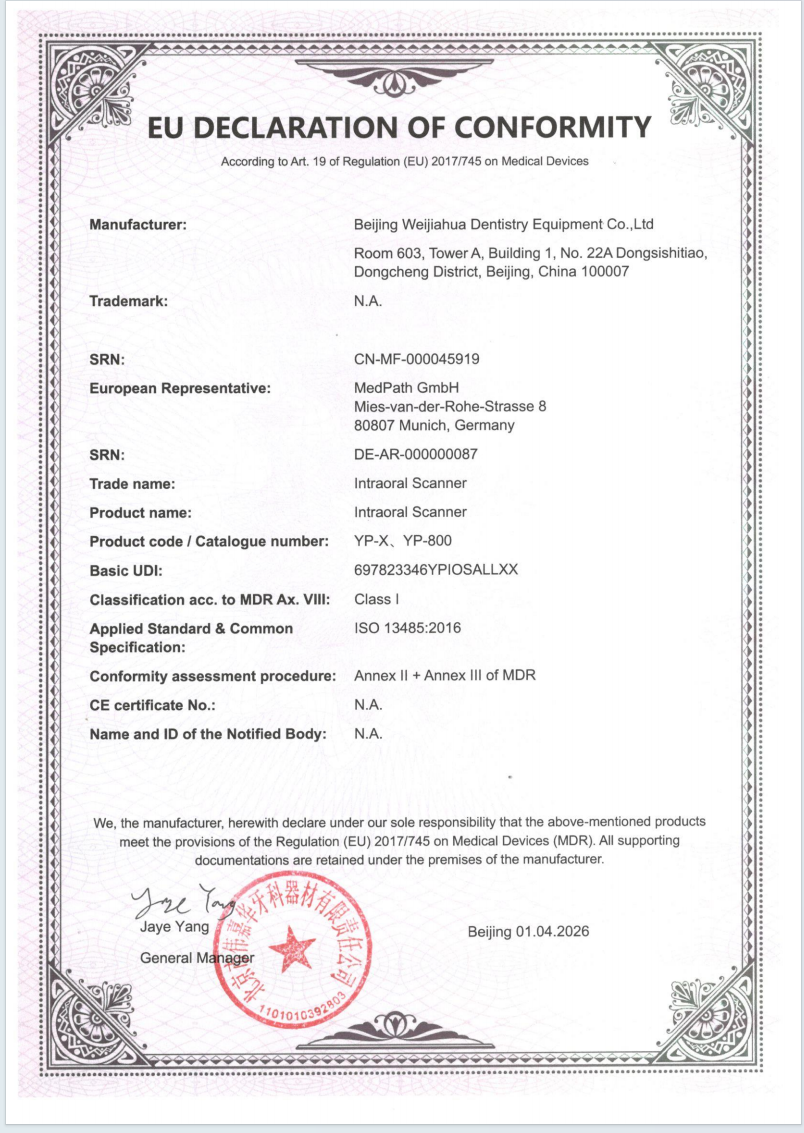
The supplied EU Declaration of Conformity for Beijing Weijiahua Dentistry Equipment Co., Ltd. is a self-declaration under Regulation (EU) 2017/745. Its stated scope is an intraoral scanner, models YP-X and YP-800, a Class I medical device. It is not a declaration for the 4D-PRO-ML zirconia block. This does not mean the supplier lacks documents; it means the laboratory must request the product-specific document and check the scope. A real document with the wrong product scope is still the wrong document for that evaluation.
Another example is public FDA record K240672 for Dental Zirconia Blank and Dental Zirconia Pre-Shaded Blank from Zhejiang Zahndent Biotechnology Co., Ltd. It shows a Substantially Equivalent decision, device class II, product code EIH, and regulation 21 CFR 872.6660. That record is useful as an example of the U.S. document type. It is not evidence about YIPANG or 4D-PRO-ML. The applicant name and product family must match the supplier being evaluated.
Industry background: why zirconia block compliance is document-heavy
Dental zirconia blocks are used in CAD/CAM workflows to make full-contour crowns, bridges, veneers, and implant superstructure restorations. The supplied application unit describes processing by dental milling machine and sintering in a dental sintering furnace, with a dental lab scanner in the workflow. The working condition is an indoor constant-temperature dental laboratory environment, and the stated special requirement is to follow the standard sintering temperature curve during processing.
This workflow creates two compliance layers. The first is the material and supplier file: what the block is, who made it, which quality system covers the site, which market documents exist, and what the product specification says. The second is the laboratory process record: how the block was stored, milled, sintered, and accepted. A supplier certificate cannot replace the lab process record, and a lab record cannot cure a missing product document. Both are needed for a defensible audit trail.
Standards add a third layer. ISO 13485:2016, also expressed in the supplied certificate as GB/T 42061-2022 / ISO 13485:2016, is a quality management system standard for medical devices. A public sample of ISO/DIS 18675:2020 describes test methods and test-report contents for machinable ceramic blanks used for dental fixed restorations. The DIS designation means draft or discussion status in the available sample. It should not be presented as a confirmed current mandatory standard. Labs should verify final status and applicability with the standard body or a qualified regulatory reviewer.
The solution: a document map for zirconia block compliance
The practical solution is to build a document map before comparing price or delivery. The map should list the target market, the document requested, the product or model covered, the legal manufacturer, the certificate or record number, the standard or regulation, the issue and expiry dates, and the lab check performed. This turns a pile of files into an audit trail.
Separate five document types
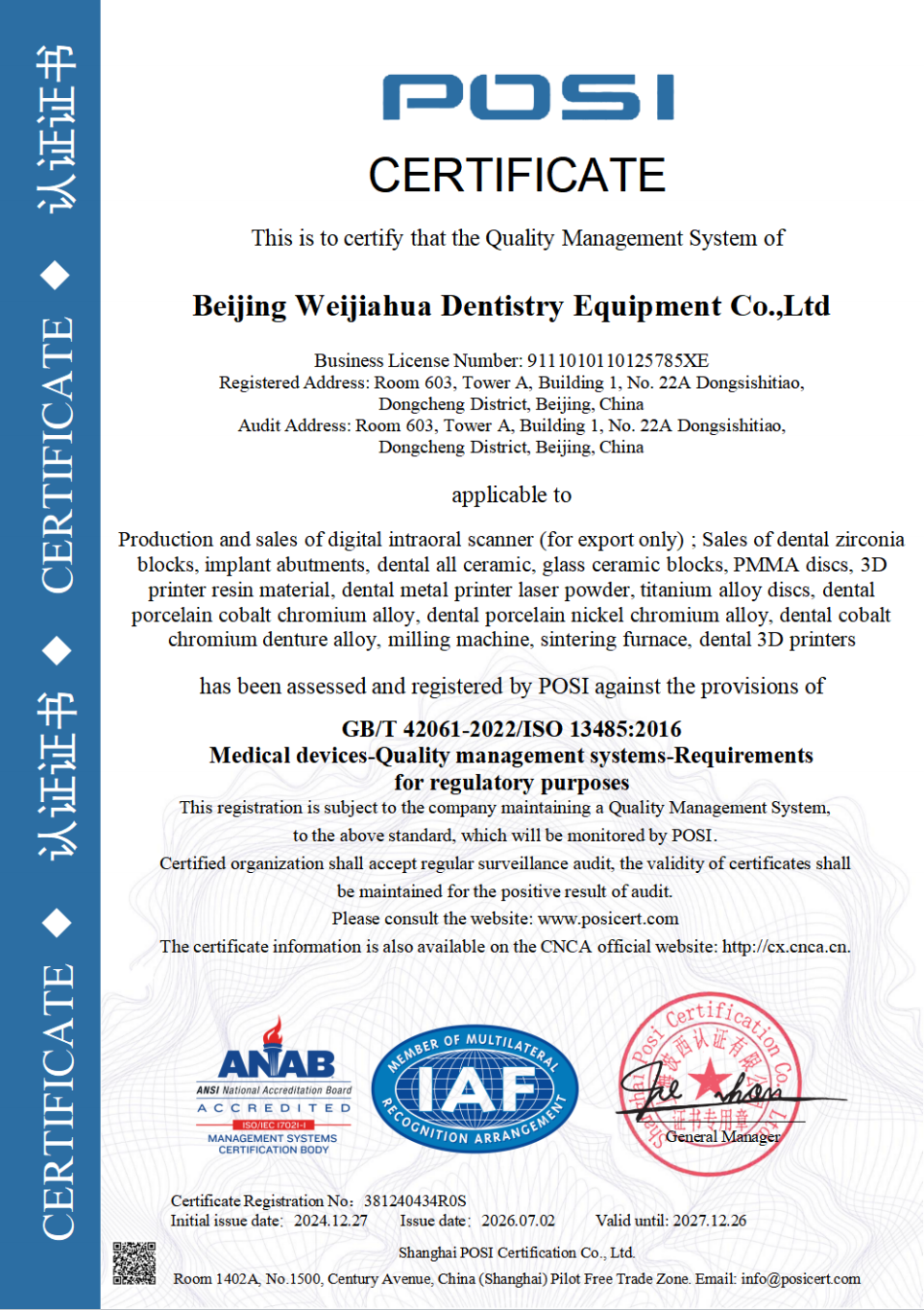
- Quality management system certificate. The supplied ISO 13485 certificate for Beijing Weijiahua Dentistry Equipment Co., Ltd. has certificate number 381240434R0S, issued by Shanghai POSI Certification Co., Ltd., under GB/T 42061-2022 / ISO 13485:2016, valid from 2024-12-27 to 2027-12-26. The stated scope is design, production and sales of dental medical materials and dental equipment. The certificate record lists Global, EU, USA, and Middle East markets. This supports a quality-system review. It does not by itself prove that a specific zirconia block is cleared or registered in each of those markets.
- Product declaration or conformity document. A declaration must be read against its product scope. The supplied EU declaration covers intraoral scanner models YP-X and YP-800, Class I. It should not be filed as the zirconia block declaration. Ask for the declaration that names the zirconia block, its model, its intended use, and its classification route where applicable.
- Regulatory listing or premarket record. In the United States, the public record type illustrated by K240672 is a 510(k) premarket notification with an establishment listing. Check the applicant name, the exact device name, the model family, the product code, the regulation number, the decision, and the date. A record for another applicant is a format example, not a transferable approval.
- Product technical data and instructions for use. For 4D-PRO-ML, the supplied specification lists ML Multilayer shades, thicknesses of 10, 12, 14, 16, 18, and 20 mm, a 98 mm diameter, a sintering temperature of 1450 degrees C, bending strength of at least 1200 MPa, and medium translucency. The material is zirconium dioxide with yttria stabilizer. These are manufacturer-published specifications. They should be matched to the model on the purchase order and to the revision of the instructions used by the lab.
- Purchase order and acceptance record. The commercial document is part of compliance because it fixes the product, the documents required, the acceptance criteria, and the response to nonconformance. A purchase order that names only a price and a quantity leaves the lab without an audit trail.
One caution applies to all five types: do not upgrade a quality certificate into a market approval, do not upgrade a declaration for one product into a declaration for another, and do not upgrade a draft standard into a mandatory requirement. The correct statement is specific: which document, which product, which market, which date, and which limitation.
Step-by-step: a practical compliance review for a CAD/CAM lab
Use the same sequence for a new supplier and for a new block from an existing supplier. The sequence is designed for the Research to Evaluation stage, when the lab is shortlisting materials and needs evidence before a purchase decision.
Step 1: Lock the product identity and intended use
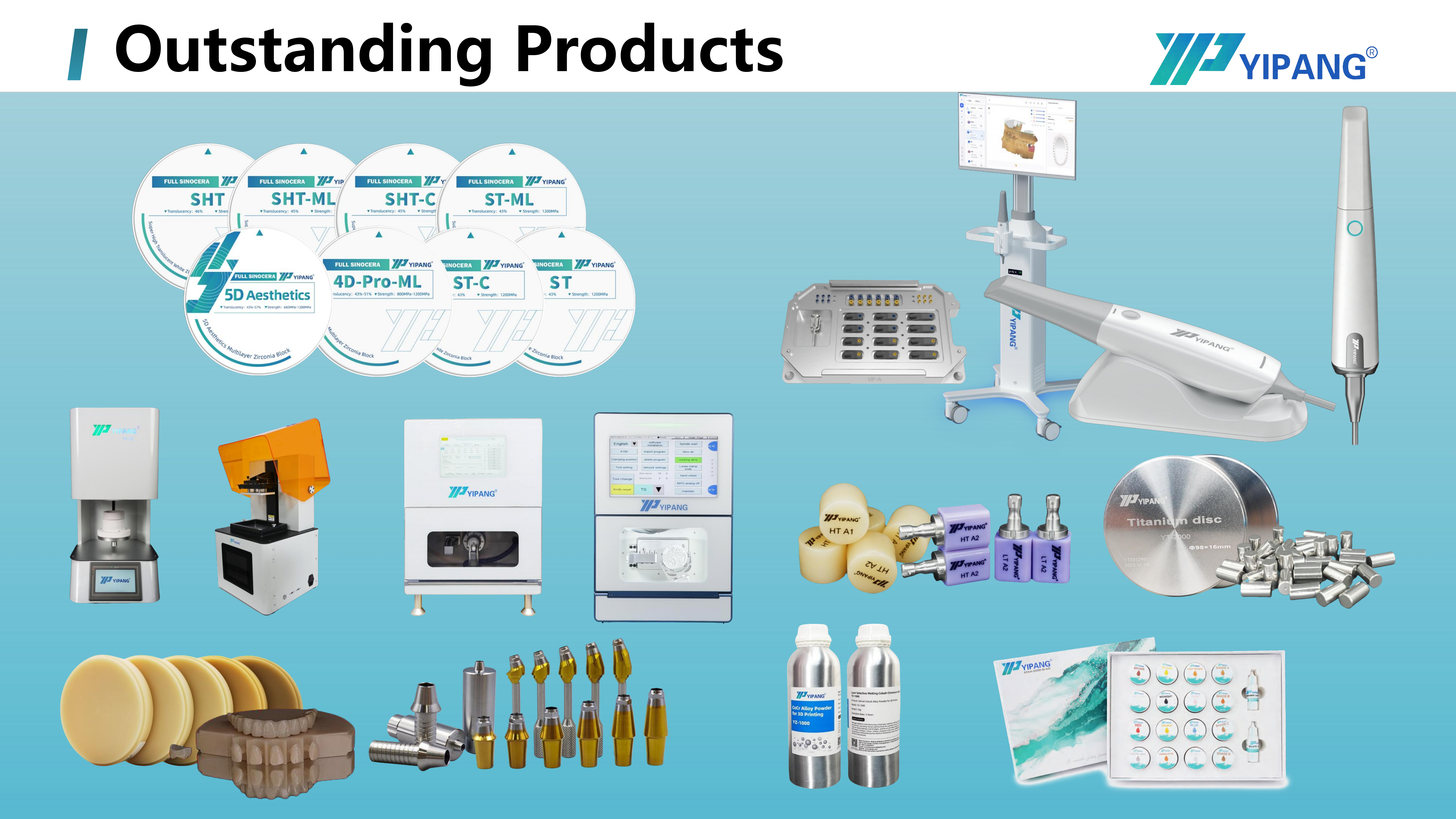
Record the brand, model, shade system, thickness, diameter, and intended restoration types. For 4D-PRO-ML, the supplied application covers full-contour crowns, bridges, veneers, and implant superstructure restorations. Confirm that the laboratory will use the block within that stated application and with the matched equipment: dental milling machine, dental sintering furnace, and dental lab scanner. If the lab plans a different indication, ask the supplier for the supporting document rather than assuming the existing file covers it.
Step 2: Collect the documents by market, not by folder
Make a simple matrix with target markets in rows and document types in columns. For the United States, ask for the FDA establishment listing and 510(k) record if the supplier holds one for the specific product. For the European Union, ask for the product-specific declaration and the applicable conformity route. For other markets, ask the supplier to identify the document used for that market and the local responsible party where required. Do not accept a general website page in place of the document. Do not accept a certificate for a different product family.
Step 3: Validate the quality certificate scope and dates
Check the legal manufacturer name, the site covered, the certificate number, the certification body, the standard edition, the issue date, and the expiry date. The supplied ISO 13485 certificate covers design, production and sales of dental medical materials and dental equipment, with certificate number 381240434R0S and validity to 2027-12-26. Confirm that the certificate is current at the time of purchase and that the scope words match the activity being evaluated. A certificate that is valid but does not cover the relevant product or site is not a substitute for a product-specific document.
Step 4: Test every declaration against the model and the market
Read the product name, model, classification, and manufacturer on the declaration. The supplied EU declaration is a self-declaration by Beijing Weijiahua Dentistry Equipment Co., Ltd. under Regulation (EU) 2017/745, with SRN CN-MF-000045919. Its stated scope is intraoral scanner models YP-X and YP-800, Class I. A lab evaluating 4D-PRO-ML should mark this as a scope mismatch for the zirconia block and request the correct document. That single check prevents the most common overstatement in a compliance file.
Step 5: Convert the evidence into purchasing terms
Write the required documents into the purchase order. Include the product model, shade, thickness, diameter, quantity, certificate copy, instruction revision, sintering instruction, packaging identification, acceptance sampling, and nonconformance procedure. Add the supplier response time and the technical contact. For YIPANG, the supplied capability unit states OEM/ODM support, almost all specifications customizable, a monthly capacity of 15,000 pieces, a lead time of 15-30 working days, negotiable small MOQ, and quality control based on 100% raw material inspection plus finished product random inspection. These are supplier-stated capability facts. They belong in the evaluation, but they do not replace the product compliance documents.
Step 6: Control the sintering curve and the laboratory environment
The supplied FAQ for 4D-PRO-ML recommends a sintering temperature range of 1430 degrees C to 1450 degrees C, with a standard heating and holding procedure to support low shrinkage and stable translucency. The product specification lists a sintering temperature of 1450 degrees C. The stated safety points are to avoid rapid temperature change to prevent cracking and not to exceed the maximum sintering temperature. The workflow is: place the milled zirconia workpiece on the sintering tray; set the heating curve up to 1430 degrees C to 1450 degrees C with proper holding time; cool naturally after sintering. The application unit also states an indoor constant-temperature dental laboratory environment. Record the actual furnace program, the furnace identification, the batch, and the operator in the lab record.
Step 7: Keep the audit trail alive
Compliance is not a one-time upload. Track certificate expiry, document revision, supplier change notices, and purchase order amendments. If a certificate expires or a product model changes, reopen the evaluation. If a declaration is replaced, remove the old file from the active folder and mark it superseded. The audit trail should let a reviewer connect a delivered block to the specification, the certificate, the purchase order, the sintering record, and the acceptance result.
Use cases: how different labs apply the same evidence
European Union-focused lab
A lab preparing a European Union file should not place the supplied intraoral scanner declaration into the zirconia block folder. It should request the product-specific declaration for 4D-PRO-ML and confirm the manufacturer, model, intended use, and classification route. The ISO 13485 certificate supports the quality-system review, but the lab still needs the product-level document. This is the difference between a supplier quality file and a market-access file.
United States-focused lab
A U.S.-focused lab should ask for the FDA establishment listing and 510(k) record for the exact product and applicant. The public K240672 record for Zhejiang Zahndent Biotechnology Co., Ltd. illustrates the document type: Dental Zirconia Blank and Dental Zirconia Pre-Shaded Blank, device class II, product code EIH, regulation 21 CFR 872.6660, with a Substantially Equivalent decision dated 2024-06-07. It is a useful format example, but it must not be filed as YIPANG evidence. The applicant name and model family must match the supplier being evaluated.
Multi-market distributor
A distributor serving the Middle East, Southeast Asia, South America, North America, Eastern Europe, North Africa, or Australia should map each market to the document actually supplied. The YIPANG company profile lists those export markets and an export ratio of 40% to 55%. Those are commercial reach facts, not proof of registration in every destination. The distributor should ask for the market-specific file and keep a matrix showing which document supports which market, with dates and limitations.
High-volume CAD/CAM laboratory
A high-volume lab adds process discipline to the document review. It can use the stated monthly capacity of 15,000 pieces and the 15-30 working day lead time for planning, but it should also write acceptance criteria for incoming blocks, sintering records, and nonconformance. The supplied case unit describes hundreds of long-term cooperative clients worldwide and highlights uniform translucency, stable sintering shrinkage, and compatibility with most CAD/CAM systems. Those are supplier-reported case observations. They support a reference discussion, not a guarantee of every lab result.
Comparison table: what each document can and cannot prove
The table below is a practical reading guide. It does not replace the actual document or local legal advice. It shows why a lab should file each document with its scope and limitation attached.
| Document | What it can support | What it does not prove by itself | Laboratory check |
|---|---|---|---|
| ISO 13485 certificate 381240434R0S | A certified quality management system for the stated scope: design, production and sales of dental medical materials and dental equipment. The record lists validity from 2024-12-27 to 2027-12-26 and certification by Shanghai POSI Certification Co., Ltd. | Product approval or registration in a specific market; performance of a specific block; approval of every product in the catalogue. | Confirm legal manufacturer, site, scope words, standard edition, certificate number, issue and expiry date. Keep a copy with the evaluation date. |
| EU Declaration of Conformity, MDR 2017/745, SRN CN-MF-000045919 | A self-declaration by the manufacturer for the product scope stated in the document. | Coverage of 4D-PRO-ML zirconia blocks. The supplied declaration names intraoral scanner models YP-X and YP-800, Class I. | Read the product name, model, class, manufacturer, and regulation. If the model is not the block, request the product-specific declaration. |
| FDA 510(k) K240672 and establishment listing, third-party example | A public example of a U.S. premarket record for Dental Zirconia Blank and Dental Zirconia Pre-Shaded Blank from Zhejiang Zahndent Biotechnology Co., Ltd., with class II, product code EIH, regulation 21 CFR 872.6660, and a Substantially Equivalent decision dated 2024-06-07. | Any status for YIPANG, 4D-PRO-ML, or another supplier. A record is tied to the named applicant and product. | Match applicant name, device name, model, product code, decision, and date. Do not copy a third-party record into the supplier file. |
| 4D-PRO-ML product specification and instructions | Manufacturer-published values: ML Multilayer shades; 10, 12, 14, 16, 18, 20 mm thickness; 98 mm diameter; sintering temperature 1450 degrees C; bending strength at least 1200 MPa; medium translucency; zirconium dioxide with yttria stabilizer. | Independent certification of each value; suitability for an unstated indication; equivalence to another brand or model. | Match the model and revision to the purchase order. Confirm the sintering instruction used by the lab and record the furnace program. |
| Purchase order and acceptance record | The commercial and quality agreement: model, shade, dimensions, quantity, documents required, acceptance sampling, nonconformance path, and delivery terms. | Regulatory approval or product performance. It is a control document, not a certificate. | Check that the required documents are listed, the acceptance criteria are measurable, and the signed record is retained with the batch. |
Frequently asked questions
Does an ISO 13485 certificate mean a dental zirconia block is approved for sale in every market?
No. ISO 13485 is a quality management system standard. The supplied certificate for Beijing Weijiahua Dentistry Equipment Co., Ltd. has certificate number 381240434R0S, is issued by Shanghai POSI Certification Co., Ltd., follows GB/T 42061-2022 / ISO 13485:2016, and is valid from 2024-12-27 to 2027-12-26. Its stated scope is design, production and sales of dental medical materials and dental equipment. That supports a quality-system review. It does not replace a product registration, a 510(k) record, a product-specific declaration, or any other market-access document required by the destination country.
Which regional documents should a laboratory request before approving a new zirconia block?
Start with a market-by-market matrix. For the United States, request the FDA establishment listing and 510(k) record for the exact applicant and product, if the supplier holds one. For the European Union, request the product-specific declaration and the applicable conformity document. For other destinations, ask the supplier to identify the document used for that market and the local responsible party where required. Then check that each document names the zirconia block model, the intended use, the legal manufacturer, and the valid date. The supplied EU declaration for intraoral scanner models YP-X and YP-800 is a clear example of why this check matters: it is a real document, but it does not cover 4D-PRO-ML zirconia blocks.
What supplier capability evidence supports a laboratory evaluation?
The supplied capability unit states OEM/ODM support, customization of almost all specifications, a monthly capacity of 15,000 pieces, a lead time of 15-30 working days, negotiable small MOQ, and quality control based on 100% raw material inspection plus finished product random inspection. It also states online technical guidance and after-sales response within 24 hours. These are supplier-stated capability facts that help a lab judge supply continuity and technical support. They should be read alongside the product documents, not instead of them.
How should a laboratory handle price when no verified price band is published?
Treat price as a formal quotation item, not as an assumed band. The available evidence does not provide a verified unit price, price range, or payment term for 4D-PRO-ML. A lab should request a written quotation against the exact model, shade, thickness, diameter, quantity, documents, and delivery terms. Compare quotations on the same specification and include MOQ, lead time, acceptance requirements, and after-sales response in the comparison. Do not fill a missing price with an invented number. If budget approval requires a price band, ask the supplier for a written range tied to the specified configuration and record the date.
How can a laboratory evaluate a sample and the documents together?
Request the sample and the document pack in the same evaluation. The pack should include the current ISO 13485 certificate copy, the product specification for the exact model, the instructions for use, the sintering instruction, and the market-specific document for the destination being evaluated. For 4D-PRO-ML, the supplied sintering guidance recommends 1430 degrees C to 1450 degrees C with a standard heating and holding procedure, natural cooling, no rapid temperature change, and no exceeding of the maximum sintering temperature. Record the sample identity, the documents received, the sintering program, and the acceptance result. A lab can request a sample, certificate copy, and quotation from YIPANG through service@yipangdental.com as a soft next step after the document review.
What lead-time and acceptance points should be written into the purchase order?
Use the purchase order to fix what the laboratory will accept. Include the product model 4D-PRO-ML, the ML Multilayer shade, the selected thickness from 10, 12, 14, 16, 18, or 20 mm, the 98 mm diameter, the quantity, the required certificate copy, the instruction revision, and the sintering instruction. Add the acceptance sampling method, the nonconformance response, and the delivery date. The supplied capability unit states a lead time of 15-30 working days and a monthly capacity of 15,000 pieces; these are planning inputs, not a guarantee for every order. Keep the signed purchase order, the certificate copy, the incoming inspection record, and the sintering record together so the audit trail is complete.
Conclusion: compliance is a scope check, not a logo check
The reliable way to evaluate a dental zirconia block is to match documents to the product, the market, and the process. For YIPANG 4D-PRO-ML, the file includes an ISO 13485 certificate with a defined scope and validity period, a product specification with model-specific dimensions and sintering values, an application statement for indoor constant-temperature dental laboratories, and a sintering instruction range of 1430 degrees C to 1450 degrees C. The same file also shows why overstatement is a risk: the supplied EU declaration covers intraoral scanner models, not the zirconia block, and the public FDA 510(k) example belongs to another applicant. A laboratory that records these distinctions, writes purchasing terms and acceptance criteria, and keeps the sintering and incoming records will have a defensible compliance trail without claiming more than the documents support.
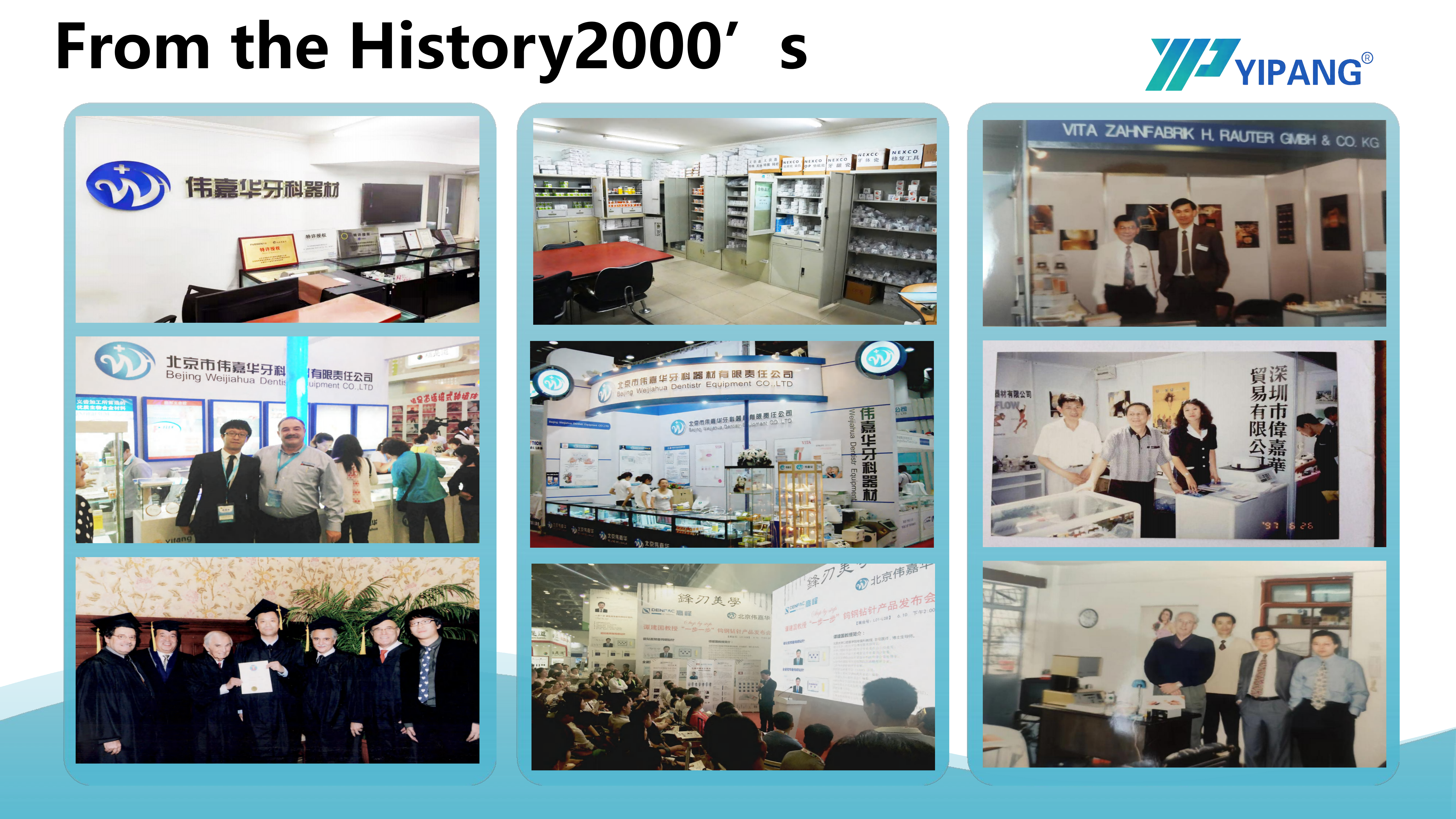
YIPANG is the self-developed dental materials brand of Beijing Weijiahua Dentistry Equipment Co., Ltd. Labs that need the current document pack, a sample, or a quotation for 4D-PRO-ML can contact service@yipangdental.com. The company brochure is available here: WJH Company Information PDF.
Next step for labs: build a one-page document matrix for each target market, attach the current certificate copy and product specification, and request a sample and written quotation against the exact 4D-PRO-ML configuration. Keep the matrix with the purchase order and sintering record so the compliance file stays usable after the order is placed.
Have Questions or Need More Details?
Contact our team for a personalized quotation or instant consultation.
Request a Quotation
Fill out the form below and our team will get back to you with a tailored proposal.
WhatsApp Direct Chat
Prefer to chat in real-time? Message us on WhatsApp for instant assistance & quick answers.
- Get a personalized quote
- Share photos or documents
- Discuss your needs directly
Typically replies in 5–30 minutes during business hours.