Why My Dental Zirconia Crowns Come Out Cloudy: Fixing Sintering Problems with 4D-PRO-ML
 Cover: Zirconia Factory — the production environment behind YIPANG dental zirconia blocks.
A cloudy, milky or chalky zirconia crown is almost never a milling error. It is a density problem created inside the sintering furnace: when a translucent zirconia blank does not complete densification at the correct peak temperature, or when it is heated, held or cooled outside the curve published for that material, light scatters inside the restoration instead of passing through it. For YIPANG 4D-PRO-ML multilayer blocks, the specified sintering window is 1430°C–1450°C — the block data sheet lists 1450°C as the sintering temperature — and the standard heating and holding procedure must be followed to guarantee low shrinkage and stable translucency.
This guide is written for CAD/CAM dental labs and milling centers that already run their own equipment. It explains what cloudiness actually is in a sintered crown, which sintering variables produce it, and how to review a sintering cycle step by step so the next crown leaves the furnace with the translucency the blank was purchased for.
What “Cloudy” Really Means in a Sintered Zirconia Crown
Cloudiness in a zirconia restoration is an optical symptom with a small number of mechanical origins. In practice it points to one of three conditions: incomplete densification inside the material, contamination or damage introduced around the sintering step, or a mismatch between the blank grade and what the case required.
- Incomplete densification. Zirconia gains its strength and its light transmission from a fully dense, uniformly structured body. A crown that never reached the required soak temperature, or that was held there too briefly, keeps residual porosity. Pores scatter light in every direction, and the result reads as haze.
- Contamination or thermal damage. Residue on a sintering tray, contact with material left over from a previous firing, or thermal stress from a ramp that was too aggressive can leave a crown looking dull even when its density is acceptable.
- Blank and indication mismatch. 4D-PRO-ML is a multilayer (ML) blank with medium translucency. A medium-translucency blank cannot be expected to behave like a high-translucency product simply because the sintering cycle was run perfectly.
One distinction saves diagnostic time: glaze and stain are applied after sintering. Dental staining glaze, glaze paste and the porcelain furnace used for glaze firing change the surface appearance of a finished restoration; they do not rebuild the internal translucency of a core that never fully densified. If a crown is already cloudy when it comes out of the sintering furnace, the finishing steps are not where the problem lives.
Why Sintering Quality Is Now a Commercial Issue, Not a Cosmetic One
The size of the category explains why a hazy crown is treated as a process failure rather than a cosmetic surprise. Grand View Research reports that the global zirconia-based dental materials market was valued at USD 1.2 billion in 2025 and is projected to reach USD 2.3 billion by 2033. Within that market, zirconia discs accounted for 63.1% of revenue in 2025, and CAD/CAM milling represented 82.4% of zirconia dental manufacturing process revenue in the same year — meaning the great majority of zirconia restorations pass through a mill and then a sintering furnace before they reach a patient.
The same source reports that dental labs remain the dominant end user for zirconia materials, holding 45.3% of market share in 2025. Every remake caused by a loss of translucency is therefore absorbed by the labs that are already competing on turnaround time. Sintering discipline is a cost-control measure as much as an aesthetic one.
Material grade adds a second layer to the picture: 3Y-TZP zirconia held the largest revenue share of 35.9% in the dental zirconia market in 2025, which reflects how much of the market depends on yttria-stabilized material families. YIPANG 4D-PRO-ML blocks are made from yttria-stabilized zirconium dioxide (ZrO₂) and are supplied as 98 mm discs in ML Multilayer shades, with thickness options of 10 mm, 12 mm, 14 mm, 16 mm, 18 mm and 20 mm, a bending strength of ≥1200 MPa and medium translucency.
The Five Sintering Variables That Turn a Translucent Blank Cloudy
1. Peak temperature below the specified window
The most direct cause of a cloudy multilayer crown is a top temperature that never actually reached the material’s densification window. 4D-PRO-ML blocks are specified for 1430°C–1450°C, with 1450°C listed on the product data sheet. A furnace controller can display the programmed value while the chamber itself sits lower, so the useful question is not what the curve said but what the material experienced. Under-firing leaves porosity, and porosity is exactly what destroys translucency.
2. Heating ramp and holding time
YIPANG’s instruction for 4D-PRO-ML is to follow the standard heating and holding procedure in order to guarantee low shrinkage and stable translucency. The hold at the top temperature is the part of the cycle that completes densification. Shortening it to gain furnace capacity is one of the most common ways a translucent blank comes out hazy. Heating too fast is the other: the manufacturer explicitly warns against rapid temperature change, which can also crack a crown before it ever reaches the bench.
3. Cooling behaviour
After sintering is complete, the workpiece should cool down naturally. Forced cooling, opening the chamber early to load the next batch, or moving a still-hot crown onto a cold surface creates the thermal gradient the 4D-PRO-ML instruction warns against. Severe cases appear as chips or cracks; milder cases may show as uneven translucency from one region of the crown to another.
4. Furnace condition and load uniformity
Sintering furnaces drift over time. Temperature accuracy, the condition of the heating elements, thermocouple position, tray cleanliness and how densely the chamber is loaded all affect what the material actually experiences. Because the margin between well-densified and under-densified zirconia can be narrow, many labs treat periodic furnace verification and a standardised tray layout as part of the sintering protocol rather than as optional maintenance.
5. Blank condition and blank choice
Not every failed crown is created in the furnace. YIPANG’s risk guidance for 4D-PRO-ML identifies two triggers for chipping and cracks after sintering: an improper sintering profile setting, and inherent defects inside the zirconia blank. The mitigation is procedural — follow the recommended sintering profile and inspect blanks before sintering. A blank with an internal defect should be scrapped before it consumes a furnace cycle, and a cracked unit should never be finished as a final restoration.
Blank choice works the same way from the other direction. 4D-PRO-ML is designed for full-contour crowns, bridges, veneers and implant superstructure restorations, and its field record is described in terms of uniform translucency, stable sintering shrinkage and compatibility with most CAD/CAM systems. Labs that buy a medium-translucency multilayer blank and then chase anterior-level translucency through furnace settings are solving the wrong problem.
Step-by-Step: Auditing Your Sintering Cycle Before the Next Crown
The sequence below is a practical audit for a lab that has seen repeated cloudy results. It follows the order in which a crown actually moves from mill to bench.
- Confirm the blank matched the indication. Record the 4D-PRO-ML shade (ML Multilayer), thickness and diameter (98 mm) against the prescription before milling. Translucency expectations should be set by the blank grade, not adjusted afterwards.
- Inspect before sintering. Check the blank and the milled unit for visible defects. This is the step YIPANG lists as the mitigation for post-sintering cracks, and it costs far less than a failed furnace cycle.
- Place the workpiece correctly on the sintering tray. Use a clean tray that carries no residue from earlier firings, and keep the load layout consistent from batch to batch so results stay comparable.
- Load the published curve, not a remembered one. Set the cycle to the 1430°C–1450°C window for 4D-PRO-ML, with the standard holding time, and never exceed the maximum sintering temperature.
- Verify that the chamber actually reaches the soak. Use furnace records or periodic thermal verification instead of assuming the display reflects the chamber. A curve that is correct on paper still produces cloudy crowns if the furnace does not deliver it.
- Allow natural cool-down. Do not open the chamber early and do not accelerate cooling to gain throughput. The instruction is explicit: avoid rapid temperature change.
- Inspect and diagnose before finishing. Judge the crown straight out of the furnace, before any glaze or stain is applied. If it is hazy, read the cycle record, the blank lot and the tray position together rather than changing several variables at once.
Cloudy Crowns: A Diagnostic Table for Sintering Labs
The table maps the most common observations in a dental lab to the likely cause in the cycle, the 4D-PRO-ML specification it relates to, and the corrective action.
| What you observe | Most likely cause in the cycle | 4D-PRO-ML reference | Corrective action |
|---|---|---|---|
| Uniform haze across the whole crown | Densification did not complete at the top temperature | Sintering window 1430°C–1450°C; data sheet value 1450°C | Confirm the soak was reached and verify furnace accuracy before the next batch |
| Haze together with chipping or cracking | Thermal stress from a fast ramp or early cooling | Instruction: avoid rapid temperature change; natural cool-down after sintering | Remove the unit; slow the ramp and allow natural cool-down |
| Translucency uneven from one side of the crown to the other | Tray position and load uniformity | Workpiece is placed on a sintering tray for the standard cycle | Standardise tray layout and chamber loading |
| Cracks with a cycle that looks correct | Internal defect in the blank | Risk guidance: inspect blanks before sintering | Scrap cracked blanks; do not use them for final restorations |
| Dull results across an entire box | Blank grade versus indication | ML Multilayer, medium translucency, ≥1200 MPa | Match the grade to the case and verify the blank lot with the supplier |
Where This Sintering Protocol Pays Off
High-volume milling centers
YIPANG recommends 4D-PRO-ML zirconia blocks for high-volume dental labs and positions them for posterior crowns and multi-unit bridges, where mechanical strength and translucency performance have to be balanced. In that setting the cost of a hazy unit is not the material — it is the mill time, the furnace slot and the remake slot behind it. A repeatable cycle is what makes volume predictable, and the risk guidance for 4D-PRO-ML points to stable shade consistency as part of the value.
Full-contour, bridge and implant superstructure work
The project types associated with the brand’s zirconia range cover full-contour crowns, bridges, veneers and implant superstructure restorations. Translucency requirements differ across those indications, so a lab is better served by auditing the sintering cycle against each indication than by applying one acceptance standard to every case.
Labs running mixed material workflows
A production lab rarely runs zirconia alone. The workflow around a zirconia crown typically spans a dental lab scanner or intraoral scanner for capture, design software, a dental milling machine with dental milling burs, a dental sintering furnace, and finally finishing with dental staining glaze or glaze paste under a dental porcelain furnace. Sintering is only one controlled step in that chain, but it is the step that most directly decides whether the finished crown transmits light.
Distributors and private-label programs
For distributors, sintering complaints arrive as support tickets. When the supplier can hand a lab a documented sintering window and a short diagnostic sequence, translucency complaints are resolved in a message instead of a remake. YIPANG provides OEM and ODM production services covering clients in the USA, Europe, Brazil, the Middle East and North Africa.
OEM, Customization and Production Support Behind the Blank
Cloudiness is solved at the furnace, but it starts with a blank that is supplied consistently. YIPANG is the self-developed brand of Beijing Weijiahua Dentistry Equipment Co., Ltd., a dental equipment manufacturer and agent established in 1996, with a 2,000 ㎡ facility, 80 employees and a 25-engineer R&D team working on dental material formula research, process optimization and new product development. The company provides both OEM and ODM production services, and customization is available for almost all specifications — which for a CAD/CAM lab means private-label blocks, custom shade and thickness configurations, and specification matching to an existing milling workflow.
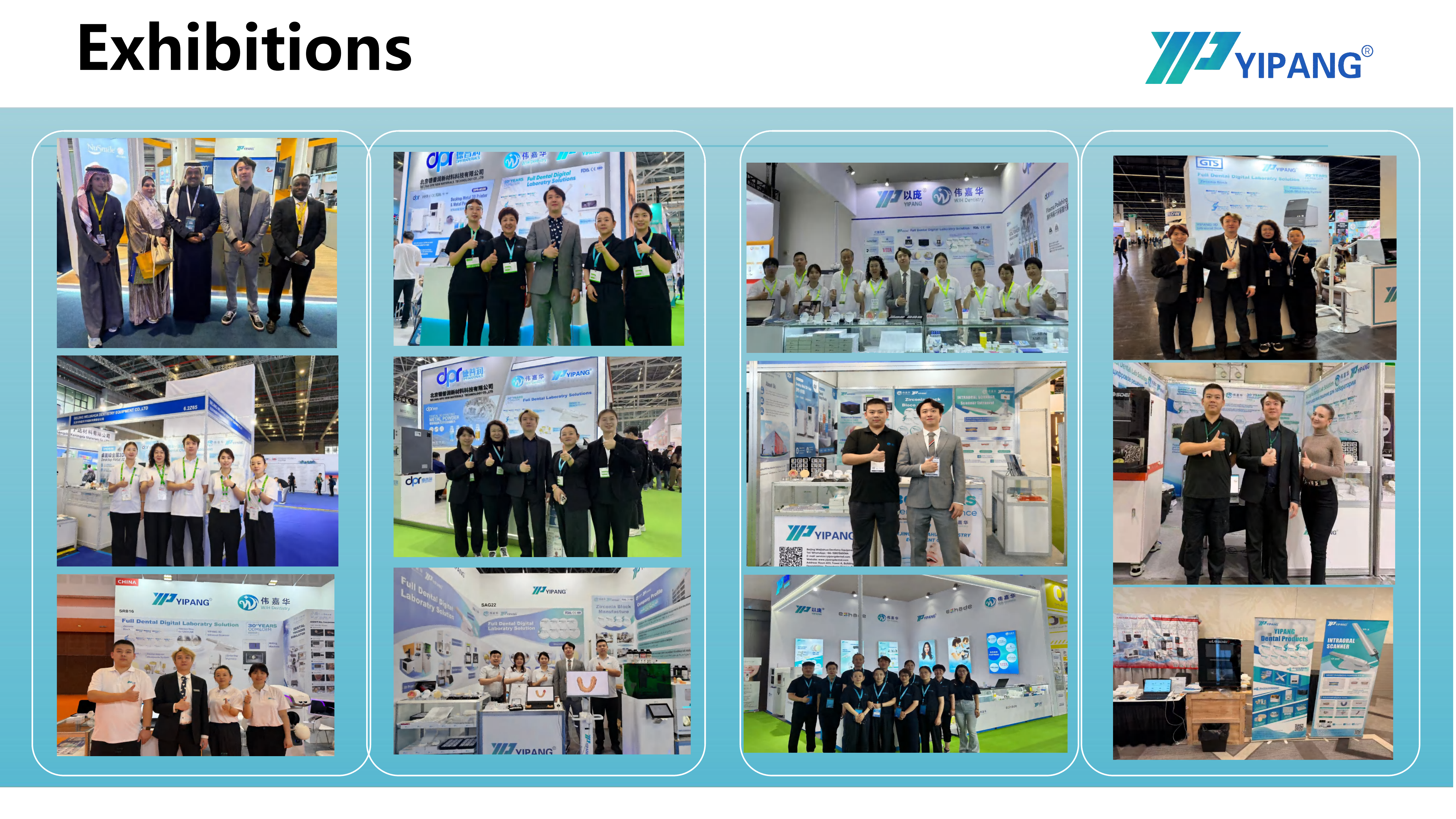 OEM and ODM supply relationships covering the USA, Europe, Brazil, the Middle East and North Africa.
Production capability behind that offer includes a monthly capacity of 15,000 pieces, a lead time of 15–30 working days, and a negotiable small MOQ. Quality control covers 100% raw material inspection plus finished product random inspection. After delivery, support is provided as online technical guidance with a response to after-sales questions within 24 hours — useful when a lab is working through a sintering deviation rather than a product defect.
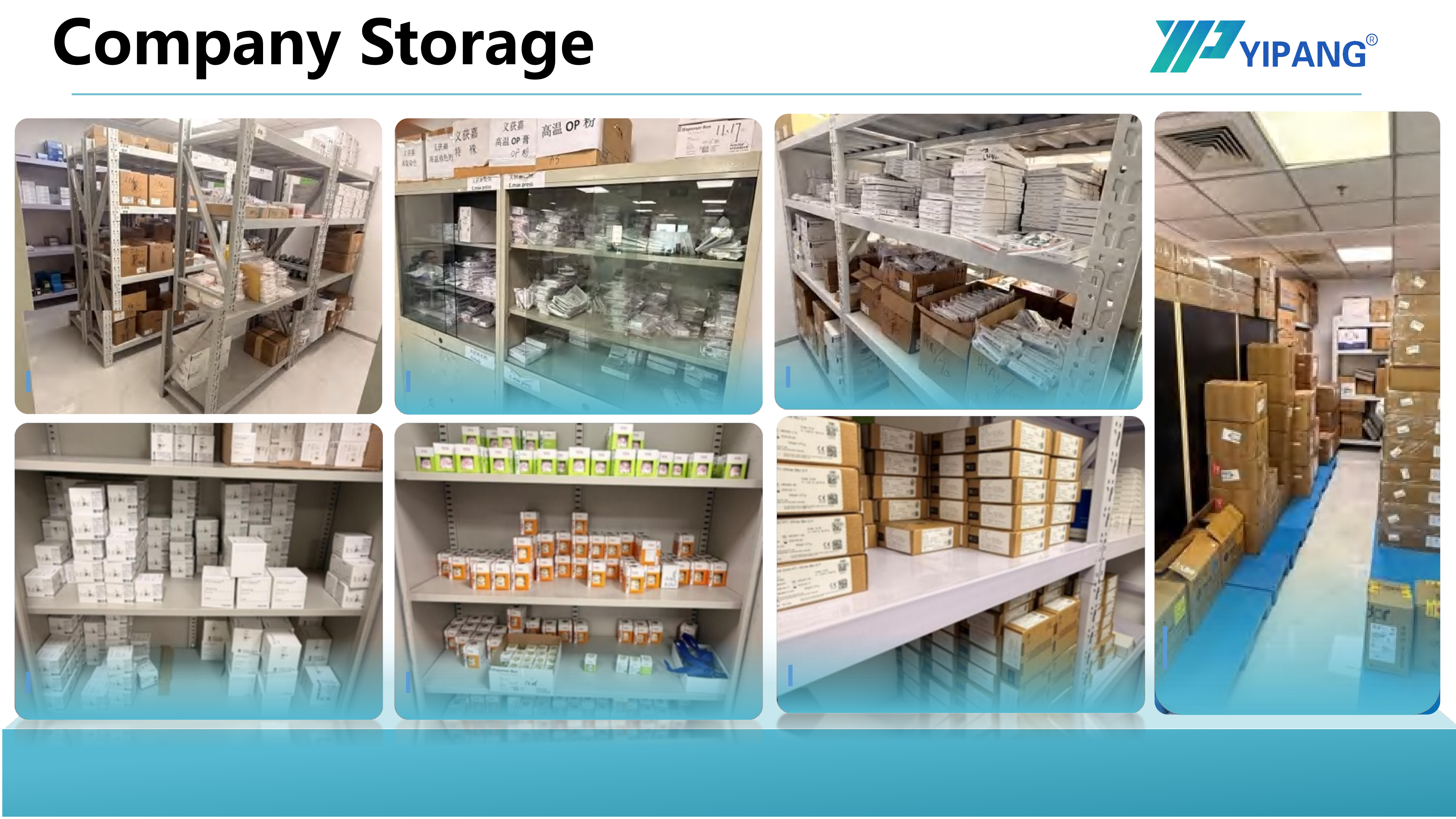 Technical service environment: online sintering and material guidance with responses within 24 hours.
Compliance is documentable. YIPANG holds ISO 13485 certification issued by Shanghai POSI Certification Co., Ltd., certificate number 381240434R0S, valid from 27 December 2024 to 26 December 2027, under the standard GB/T 42061-2022 / ISO 13485:2016, with a certified scope covering the design, production and sales of dental medical materials and dental equipment across global, EU, USA and Middle East markets.
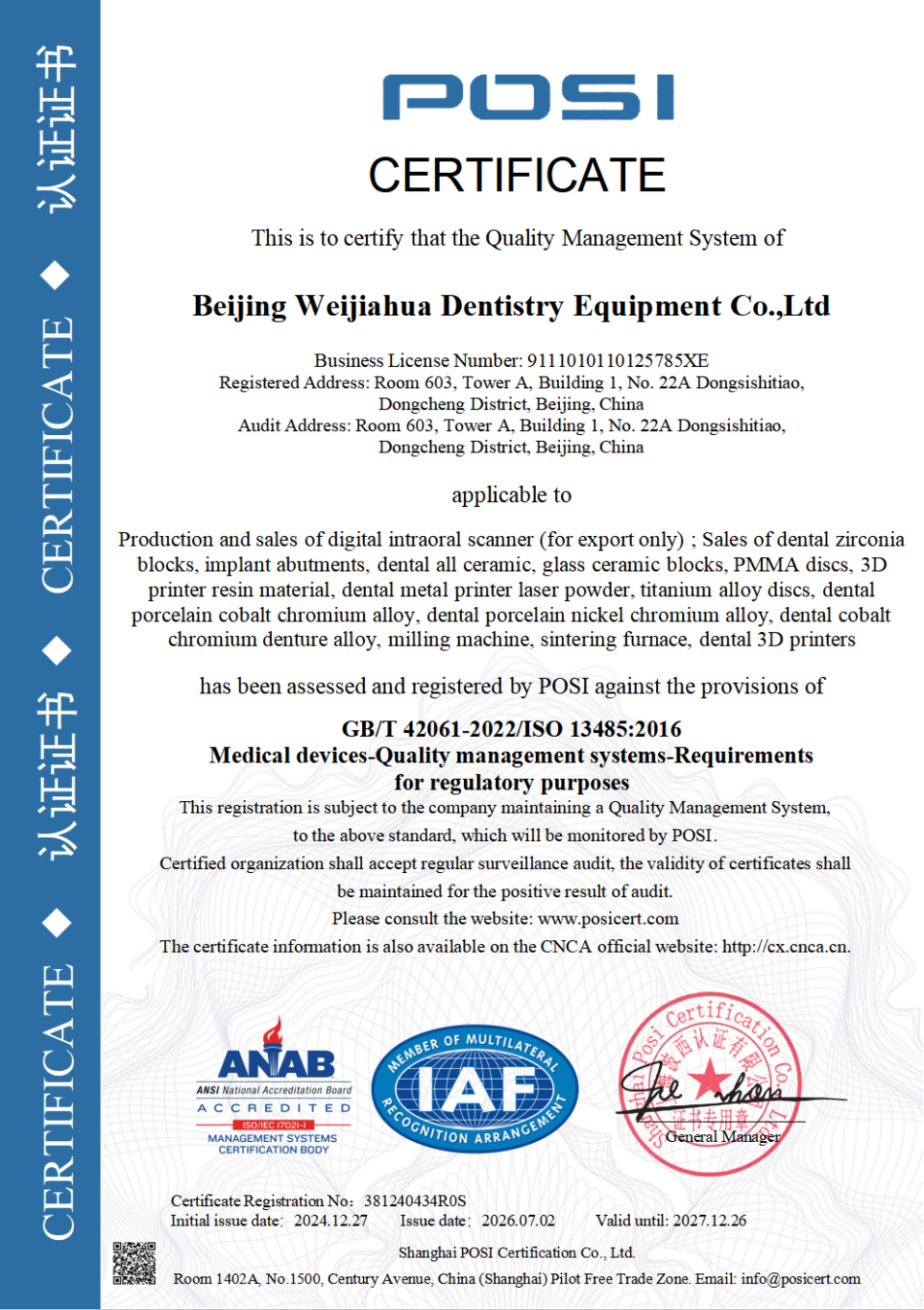 ISO 13485 certification (certificate no. 381240434R0S) covering dental medical materials and dental equipment.
Frequently Asked Questions
Does YIPANG hold ISO 13485 certification for dental zirconia block production?
Yes. Beijing Weijiahua Dentistry Equipment Co., Ltd., the manufacturer behind the YIPANG brand, holds ISO 13485 certification issued by Shanghai POSI Certification Co., Ltd. under certificate number 381240434R0S. The certificate is valid from 27 December 2024 to 26 December 2027, and the certified scope covers the design, production and sales of dental medical materials and dental equipment under the standard GB/T 42061-2022 / ISO 13485:2016, for global, EU, USA and Middle East markets.
What sintering temperature should a dental lab set for 4D-PRO-ML zirconia blocks?
The recommended sintering temperature range for 4D-PRO-ML is 1430°C–1450°C, and the product data sheet lists 1450°C as the sintering temperature. YIPANG’s process guidance is to follow the standard heating and holding procedure to guarantee low shrinkage and stable translucency, to avoid rapid temperature change in order to prevent cracking, and never to exceed the maximum sintering temperature. After the cycle is complete, the workpiece should cool down naturally.
Can a CAD/CAM lab order OEM dental zirconia blocks with customized shade and thickness?
Yes. YIPANG provides both OEM and ODM production services, and customization is available for almost all specifications. For 4D-PRO-ML, the standard configuration is a multilayer (ML) blank in ML Multilayer shades, 98 mm in diameter, offered in thicknesses of 10 mm, 12 mm, 14 mm, 16 mm, 18 mm and 20 mm. The material is yttria-stabilized zirconium dioxide (ZrO₂) with a bending strength of ≥1200 MPa and medium translucency. OEM and ODM services cover clients in the USA, Europe, Brazil, the Middle East and North Africa.
What are the MOQ and purchasing terms for dental zirconia blocks?
MOQ is 1 box for standard models and 5 boxes for customized products. Delivery terms: domestic orders ship by express delivery, while export orders ship by sea freight or air freight, with FOB Shanghai/Tianjin available. Payment terms are full payment before shipment. Acceptance criteria: check quantity on receipt, report damage or deformation within 48 hours with photos, and sampling tests are supported.
What is the lead time, and can a lab validate a sample before ordering?
Standard lead time is 15–30 working days, with a monthly production capacity of 15,000 pieces. Sampling tests are supported, so a lab can validate shade and translucency against its own sintering cycle before committing to a production order. To start, request a 4D-PRO-ML sample or a quotation from the YIPANG team at service@yipangdental.com or via WhatsApp at +86 158-0156-5064, or download the company profile PDF.
Next Steps: From Cloudy Crown to Validated Cycle
Fixing cloudiness is not a matter of changing one setting. The reliable sequence is to confirm the blank grade against the indication, inspect before sintering, load the published heating and holding procedure, verify that the chamber actually reached the 1430°C–1450°C window, allow a natural cool-down, and judge the crown before any glaze or stain is applied. Units with cracks or internal defects are removed rather than finished. For 4D-PRO-ML, the reference points to work against are a 1430°C–1450°C sintering window with 1450°C listed on the data sheet, medium translucency, a bending strength of ≥1200 MPa, and a 98 mm disc format in six thicknesses.
Need the exact sintering curve for your next batch?
Request a 4D-PRO-ML sample or a quotation from YIPANG and give your lab a sintering window it can hold repeatably, batch after batch.
- Sample / quotation: service@yipangdental.com
- WhatsApp / Tel: +86 158-0156-5064
- Website: www.yipangdental.com
- Company profile download: WJH Company Information PDF
Contact: Jaye Yang — Room 603, Tower A, Building 1, No. 22A Dongsishitiao, Dongcheng District, Beijing, China.
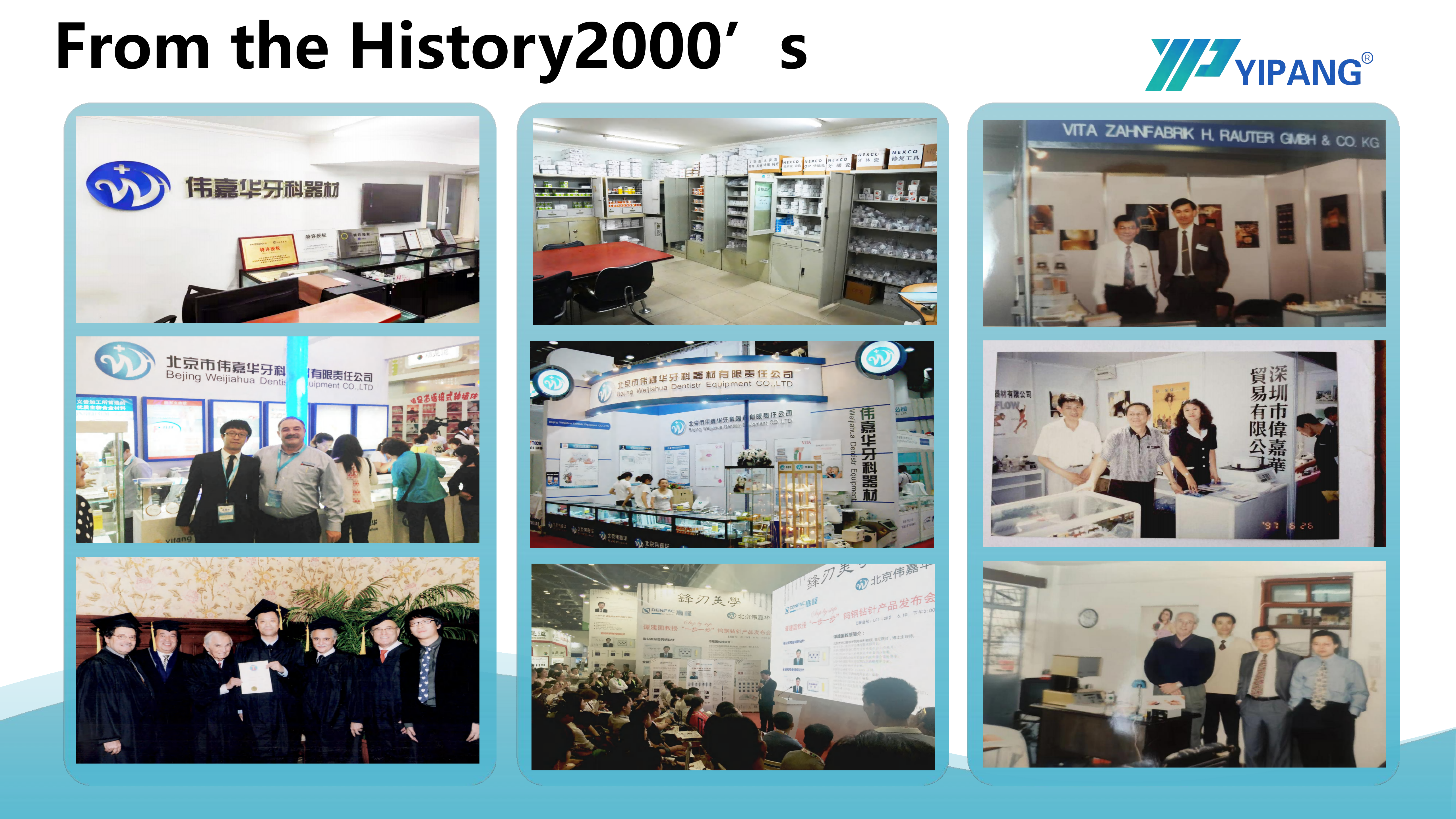 Request a 4D-PRO-ML sample, a quotation, or sintering parameter support from the YIPANG team.
Have Questions or Need More Details?
Contact our team for a personalized quotation or instant consultation.
Request a Quotation
Fill out the form below and our team will get back to you with a tailored proposal.
WhatsApp Direct Chat
Prefer to chat in real-time? Message us on WhatsApp for instant assistance & quick answers.
- Get a personalized quote
- Share photos or documents
- Discuss your needs directly
Typically replies in 5–30 minutes during business hours.