Unpacking the Structure of Dental Zirconia Blocks: Inside a Monolithic Crown
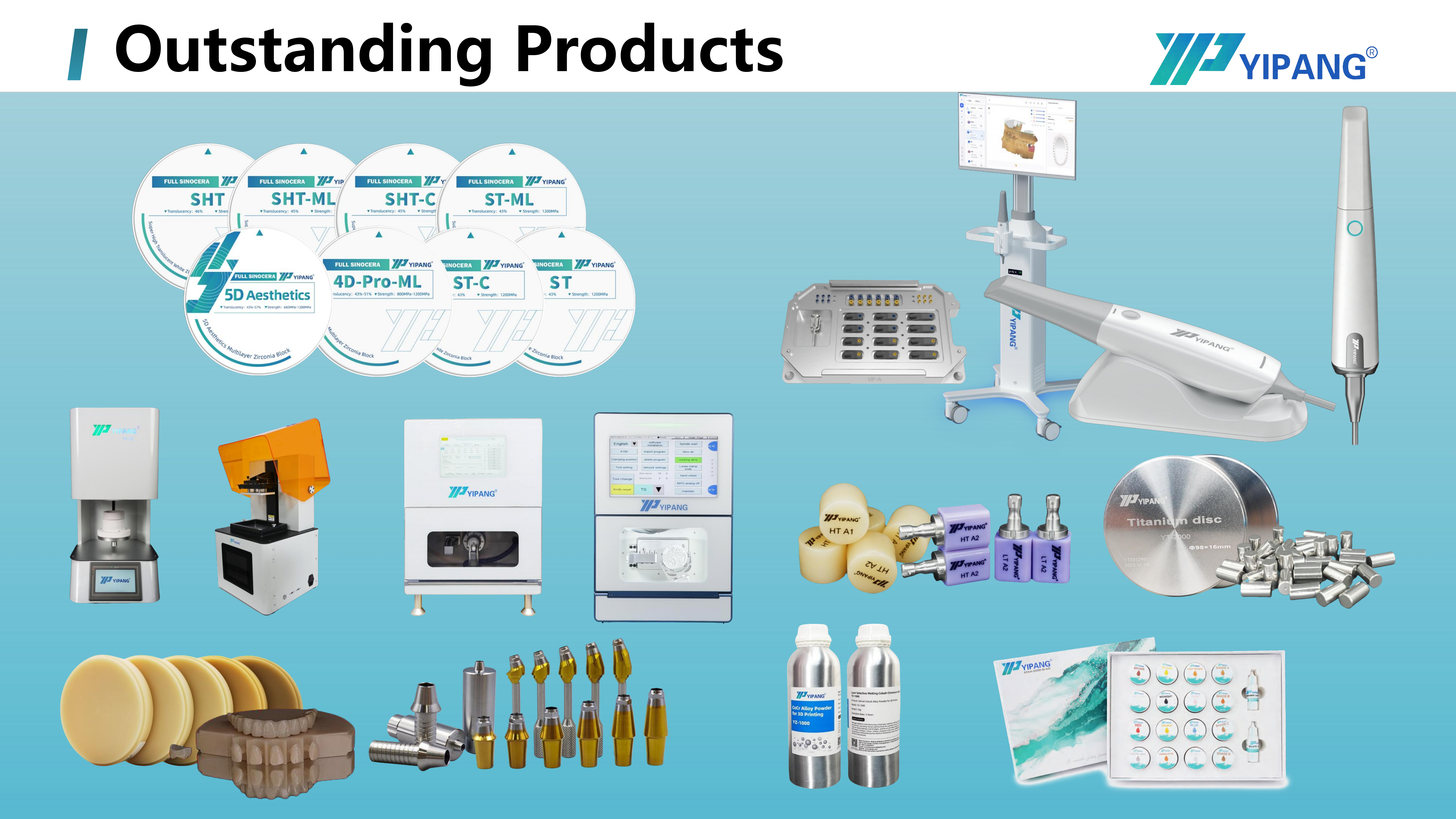
A dental zirconia block is a layered structure, not a uniform blank. The YIPANG 4D-PRO-ML ML multilayer disc is the starting geometry that a monolithic crown inherits.
A monolithic zirconia crown reads as one single piece of material. Structurally, it is the output of a layered system: a gradient that exists inside the dental zirconia block, is re-cut by the milling machine, and is finally locked in by the sintering furnace. That architecture decides three things at once - where translucency sits in the finished crown, how occlusal load is carried through the restoration, and how much of a disc a lab converts into usable units.
The practical answer to the question this article addresses is short: block structure and crown function are the same decision. Anterior cases need the gradient positioned correctly; posterior cases need the flexural cross-section respected. If either is planned after milling rather than before, the crown inherits a mismatch it cannot correct. Everything below is the reasoning behind that rule, plus the constraint values a lab can actually verify before purchase.
The Problem: One Disc, Two Different Structural Jobs
The core constraint of monolithic zirconia is that a single block must satisfy an aesthetic requirement at the incisal edge and a mechanical requirement at the occlusal surface - in the same restoration. Those two requirements do not pull in the same direction, and the block is where the compromise is either managed or ignored.
Three failure patterns appear when structure is treated as a commodity detail:
- Gradient misplacement. The crown is nested or oriented so that the wrong part of the through-thickness gradient ends up labially. The shade is technically correct but distributed incorrectly - cervical region too light, incisal region too dense.
- Mechanical under-planning. The restoration is asked to carry posterior loads while its geometry - wall thickness, connector cross-section, occlusal reduction - does not use the strength the material actually offers.
- Disc yield loss. Crowns are nested without regard to how the gradient must span crown height, so units that fail shade or fit criteria come out of a disc that was otherwise sound.
None of these are milling-machine problems. They are structure-reading problems, and they are cheapest to solve at the specification stage - which is exactly the stage where most labs currently evaluate a dental zirconia block only on shade name and price.
Industry Background: Why Block Architecture Became a Specification
Zirconia's position in restorative dentistry is no longer a niche discussion. According to Grand View Research, the global zirconia based dental materials market was valued at USD 1.2 billion in 2025 and is projected to reach USD 2.3 billion by 2033. Within that market, zirconia discs held the largest revenue share at 63.1% in 2025, and CAD/CAM milling accounted for 82.4% of zirconia dental manufacturing process revenue in the same year.
The demand side explains why structure details now get scrutinised. Grand View Research data shows dental labs remain the dominant end-user of zirconia materials, accounting for 45.3% of market share in 2025, and the U.S. alone accounts for 40% of revenue in the global zirconia based dental materials market. When a single end-user group controls nearly half of consumption, the specifications that group cares about become the specifications the market competes on.

Block structure is set during powder preparation and pressing, long before the disc reaches a milling machine.
Two other forces push in the same direction. First, material-grade consolidation: 3Y-TZP zirconia grade held the largest revenue share of 35.9% in the dental zirconia market in 2025, per Grand View Research, meaning buyers are increasingly comparing blocks within a defined material family rather than across widely different chemistries. Second, regulatory pressure in Europe: the European Commission notes that EU Medical Device Regulation (MDR 2017/745) classifies most dental implants and restorative materials as high-risk, requiring intensive clinical data - so traceable documentation on the restorative material itself has become part of the purchasing file, not an afterthought.
Against that backdrop, the question "what is the block's through-thickness structure, and what does it constrain?" is now a legitimate procurement question, and it is answerable with specific values rather than marketing language.
Inside the Layers: How Block Structure Becomes Crown Function
What a multilayer block physically contains
A multilayer dental zirconia block carries a gradient of chroma and translucency through its thickness. The technician's job is to map the finished crown onto that gradient so the cervical portion of the restoration reads closer to dentin character while the incisal portion reads closer to enamel character. YIPANG supplies the 4D-PRO-ML model as a 98 mm diameter, yttria-stabilized zirconium dioxide (ZrO2) disc in ML multilayer shades, with available thicknesses of 10 mm, 12 mm, 14 mm, 16 mm, 18 mm and 20 mm. The specification lists medium translucency and a bending strength of at least 1200 MPa on the sintered body.
The gradient is not decoration. It is the mechanism by which a single monolithic crown can reproduce a two-tone optical transition without layering porcelain, and it is why the same disc can be specified for both anterior and posterior cases while still requiring different nesting decisions in each.
Flexural mechanics: from block to crown
Flexural strength is the property that governs how a monolithic crown behaves under occlusal load. In a posterior crown, occlusal loading puts the occlusal surface into compression and the cervical and proximal surfaces into tension; the restoration fails when tensile stress at the weakest cross-section exceeds what the sintered material can carry. In a multi-unit bridge, the connectors - not the crown body - are normally the flexural bottleneck, because the load is concentrated through the smallest cross-sectional area.
For the YIPANG 4D-PRO-ML dental zirconia block, the specified bending strength is at least 1200 MPa. Two implications follow for labs:
- The value describes a sintered body, not a milled blank. It is only realised when the specified sintering curve is followed, because strength develops as the zirconia densifies.
- The value is an upper bound for a well-designed geometry. A crown with an under-dimensioned connector or excessive occlusal reduction can fail well below the material limit regardless of block quality.
Anterior aesthetics versus posterior loads
Anterior cases and posterior cases stress the same block in different ways. Anterior restorations are dominated by optical requirements: the gradient must land at the right height in a thin, highly visible cross-section, and the material's medium translucency has to be positioned so the transition reads naturally. Because anterior occlusal forces are comparatively low, a lab has more freedom in how it nests the unit and how it trades translucency against strength.
Posterior restorations invert the priority. Load carriage dominates, and the gradient is a secondary benefit. The constraints that matter are wall thickness, connector dimensions, and the certainty that the sintered body actually reaches the strength the specification claims. This is also where material selection can legitimately move outside zirconia: lithium disilicate accounts for approximately 28% of all all-ceramic dental restorations globally as of 2024, according to Business Research Insights, and remains a real option for cases where high translucency and adhesive bonding suit the clinical situation better than a monolithic approach.
Rather than treating this as an either/or, the useful framing is a placement problem: decide which structural zone of the block becomes which zone of the crown, then confirm the load path survives that choice.
What the sintering furnace does to the structure
Sintering is where structure is either preserved or lost. The YIPANG specification for 4D-PRO-ML lists a sintering temperature of 1450 degrees C, and the recommended processing window for the material is 1430 - 1450 degrees C, with a standard heating and holding procedure and natural cooling after completion. Two safety boundaries apply: avoid rapid temperature change to prevent cracking, and do not exceed the maximum sintering temperature.
The connection to structure is direct. The block is selected for low shrinkage after sintering - which is what preserves dimensional accuracy and fit - and for uniform translucency across the restoration. Both are outcomes of a correctly executed firing cycle rather than properties that survive any cycle. A unit milled from an ideal gradient and then fired outside the specified window is the most wasteful error in the workflow, because the material has already been paid for and cut.
Step-by-Step: Reading Block Structure Before and After Milling
The sequence below is the working order a lab can apply to any multilayer dental zirconia block, using the constraint values that are verifiable on the YIPANG 4D-PRO-ML specification.
Step 1 - Classify the case by load path, then by visibility. Posterior multi-unit and implant-supported cases are load-critical; anterior single crowns and veneers are gradient-critical. This classification determines which structural property becomes the pass/fail criterion.
Step 2 - Select disc thickness from the case, not from stock. Available thicknesses run from 10 mm to 20 mm. Thickness has to cover the crown height plus the gradient span required to reproduce the cervical-to-incisal transition, and it determines how many units nest in one disc.
Step 3 - Confirm the shade architecture. The 4D-PRO-ML is supplied in ML multilayer shades. Multilayer supply means the chromatic transition is built into the disc rather than applied afterwards, so the nesting plan has to respect gradient direction.
Step 4 - Nest and orient in CAD with the gradient in mind. Place the cervical margin toward the more chromatic end of the gradient and the incisal edge toward the more translucent end. For bridges, position connectors where the cross-section remains adequate after sintering shrinkage.
Step 5 - Mill on a compatible platform. The 98 mm diameter disc is compatible with most mainstream dental milling machines, which keeps the workflow inside existing CAD/CAM systems rather than requiring a dedicated machine.
Step 6 - Sinter on the specified curve. Step 1: place the milled zirconia workpiece on the sintering tray. Step 2: set the heating curve up to 1430 - 1450 degrees C with the proper holding time. Step 3: cool down naturally after sintering is complete. Do not introduce rapid temperature change, and do not exceed the maximum sintering temperature.
Step 7 - Verify and record. Check dimensional fit, gradient placement and shade against the case plan, then record the disc batch, thickness and firing cycle. Repeatability across cases depends on this record more than on any single material parameter.
Use Cases: Matching Structure to Case Type
Case planning - not milling - determines whether the block gradient lands where the clinician needs it.
Anterior single crowns and veneers. The gradient is the primary deliverable. Disc thickness must be sufficient to span the full crown height so the transition is continuous, and nesting must be oriented so the translucent end reaches the incisal third. Anterior cases are the clearest justification for specifying a multilayer block rather than a monolayer blank.
Posterior single crowns. Load carriage is primary. The block still provides gradient translucency, but the decisive checks are wall thickness and the confirmation that sintering reaches the specified strength rather than an aesthetic target.
Multi-unit bridges. Connector cross-sections dominate. This is where stable sintering shrinkage matters most, because fit errors accumulate across multiple units rather than appearing on a single crown.
Implant superstructure restorations. These combine fit sensitivity with load transfer. Labs working on full-contour crowns, bridges, veneers and implant superstructure restorations typically prioritise dimensional accuracy and repeatability over maximum translucency - which is a structure decision made at the disc level.
High-volume milling centres. Yield per disc becomes the governing metric. Nesting discipline and a stable firing cycle matter more than any single case result, and the practical benefit of a compatible 98 mm disc format is that it avoids workflow changes across machines.
Labs already working with YIPANG report consistent outcomes on material stability, uniform translucency and stable sintering shrinkage, with compatibility across most CAD/CAM systems - results that depend on structure being planned before milling rather than corrected afterwards.
Structure-to-Constraint Map: What to Verify Before You Buy
The table below maps each structural variable of the YIPANG 4D-PRO-ML dental zirconia block to the case decision it constrains and the verification point a buyer can check. Values are taken from the published product specification; where a dimension is not published, it is not stated.
| Structural variable | Verified value / behaviour | What it constrains | Verification point |
|---|---|---|---|
| Layer architecture | ML multilayer shades; gradient translucency through thickness | Anterior shade transition; how much porcelain layering can be avoided | Nesting plan and gradient direction before milling |
| Sintered flexural strength | Bending strength of at least 1200 MPa | Posterior crown walls, bridge connectors, implant superstructures | Confirm the specified firing curve is followed |
| Disc geometry | 98 mm diameter; 10 / 12 / 14 / 16 / 18 / 20 mm thickness | Units per disc; whether the gradient can span crown height | Match thickness to case height and nesting count |
| Material base | Zirconium dioxide (ZrO2) with yttria stabilizer | Strength-to-translucency balance for monolithic work | Material documentation on the batch |
| Translucency class | Medium translucent | Where a monolithic approach is sufficient and where a layered approach is required | Comparison against case aesthetic requirement |
| Sintering behaviour | 1450 degrees C specification; 1430 - 1450 degrees C recommended window; heating, holding and natural cooling | Fit accuracy, cracking risk, translucency uniformity | Furnace programme record per batch |
| CAD/CAM compatibility | Compatible with most mainstream dental milling machines | Whether existing equipment and workflow can be used unchanged | Machine compatibility check before first order |
| Quality system | ISO 13485:2016, certificate number 381240434R0S; scope covers design, production and sales of dental medical materials and dental equipment | Documentation requirements for regulated markets | Certificate validity and expiry confirmation |
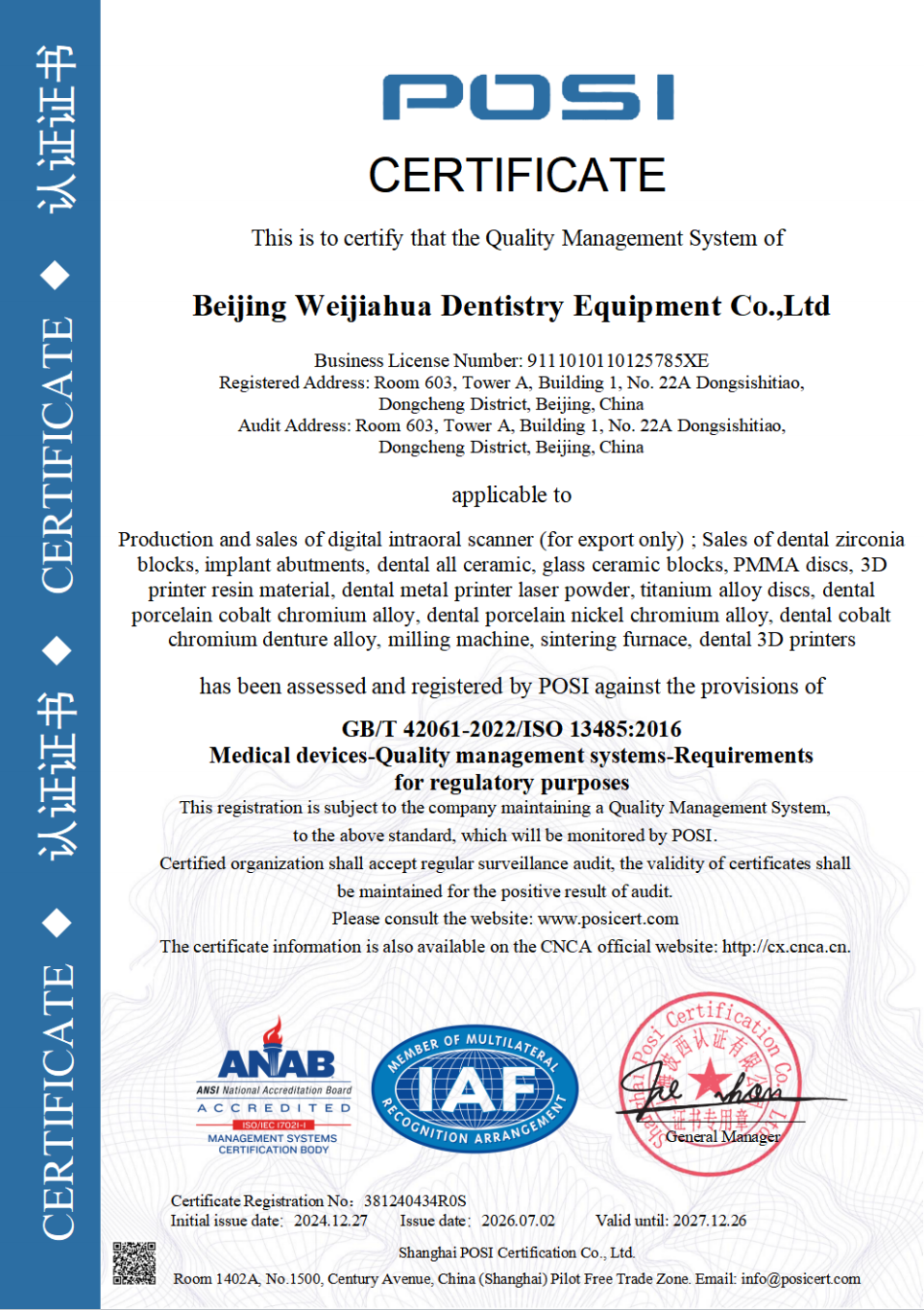
ISO 13485:2016 certification (certificate number 381240434R0S) applies to Zirconia Blocks for Dental Prosthesis.
FAQ: Constraints Buyers Ask About First
Is the 4D-PRO-ML dental zirconia block certified for labs supplying the EU, US and Middle East markets?
Yes. The Zirconia Blocks for Dental Prosthesis product is certified to ISO 13485:2016 under certificate number 381240434R0S, issued by Shanghai POSI Certification Co., Ltd., against the standard GB/T 42061-2022 / ISO 13485:2016. The certification scope covers design, production and sales of dental medical materials and dental equipment, and it is valid for the Global, EU, USA and Middle East markets, with an issue date of 2024-12-27 and an expiry date of 2027-12-26. Labs that also source YIPANG scanning equipment should note that the EU Declaration of Conformity under MDR 2017/745 is held for the Intraoral Scanner models YP-X and YP-800 (Class I medical devices), under SRN: CN-MF-000045919.
Can the block structure and geometry be customized for a specific case mix?
YIPANG operates on an OEM / ODM basis and states that almost all specifications can be customized. The standard published configuration is the 4D-PRO-ML in ML multilayer shades, 98 mm diameter, with thicknesses of 10 mm, 12 mm, 14 mm, 16 mm, 18 mm and 20 mm. Monthly capacity is 15,000 pieces, and quality control consists of 100% raw material inspection plus finished product random inspection.
What drives the cost per crown when block structure changes?
Cost per usable crown is driven less by the disc itself than by how much of the disc becomes sellable units. Thickness selection determines how many units nest and whether the gradient can span crown height; mismatched nesting produces shade or fit failures that consume disc area. Sintering rework from cracking, and remakes caused by shrinkage-related fit errors, add directly to per-unit cost. Over-specifying a thick disc for a single anter
ior crown and under-specifying for a multi-unit bridge both raise the real cost per case, which is why structure planning belongs in the estimating stage.How can a lab validate layer behaviour before placing a full order?
Validate with a representative case rather than a swatch. Mill and sinter one or more real crown geometries at 1430 - 1450 degrees C with the standard heating, holding and natural cooling procedure, then check three outputs against the case plan: gradient placement in the finished crown, dimensional fit, and shade consistency. Sample and quotation requests can be sent to service@yipangdental.com or via WhatsApp at +86 158-0156-5064. The full company and product catalogue is available in the brochure: https://cdn.socialarks.com/sbsp/25220/common/2026/0818/WJH%20Company%20Infomation.pdf
What are the lead time and minimum order quantity?
Lead time is 15 - 30 working days, and minimum order quantity is a negotiable small MOQ. After-sales support includes online technical guidance with problem response within 24 hours, which matters for structure-related issues because sintering and nesting questions usually need an answer while the case is still open.
Conclusion: Structure Is the First Decision, Not the Last
A monolithic crown cannot be optimised after it is milled. The layer architecture, the flexural margin, and the firing behaviour of a dental zirconia block are all fixed before the first toolpath is generated, and the case either fits that structure or fights it. For anterior work the gradient has to be positioned deliberately; for posterior work the load path has to be respected first and the gradient placed second. In both directions, the sintering furnace is the step that preserves or destroys what the block was selected for.
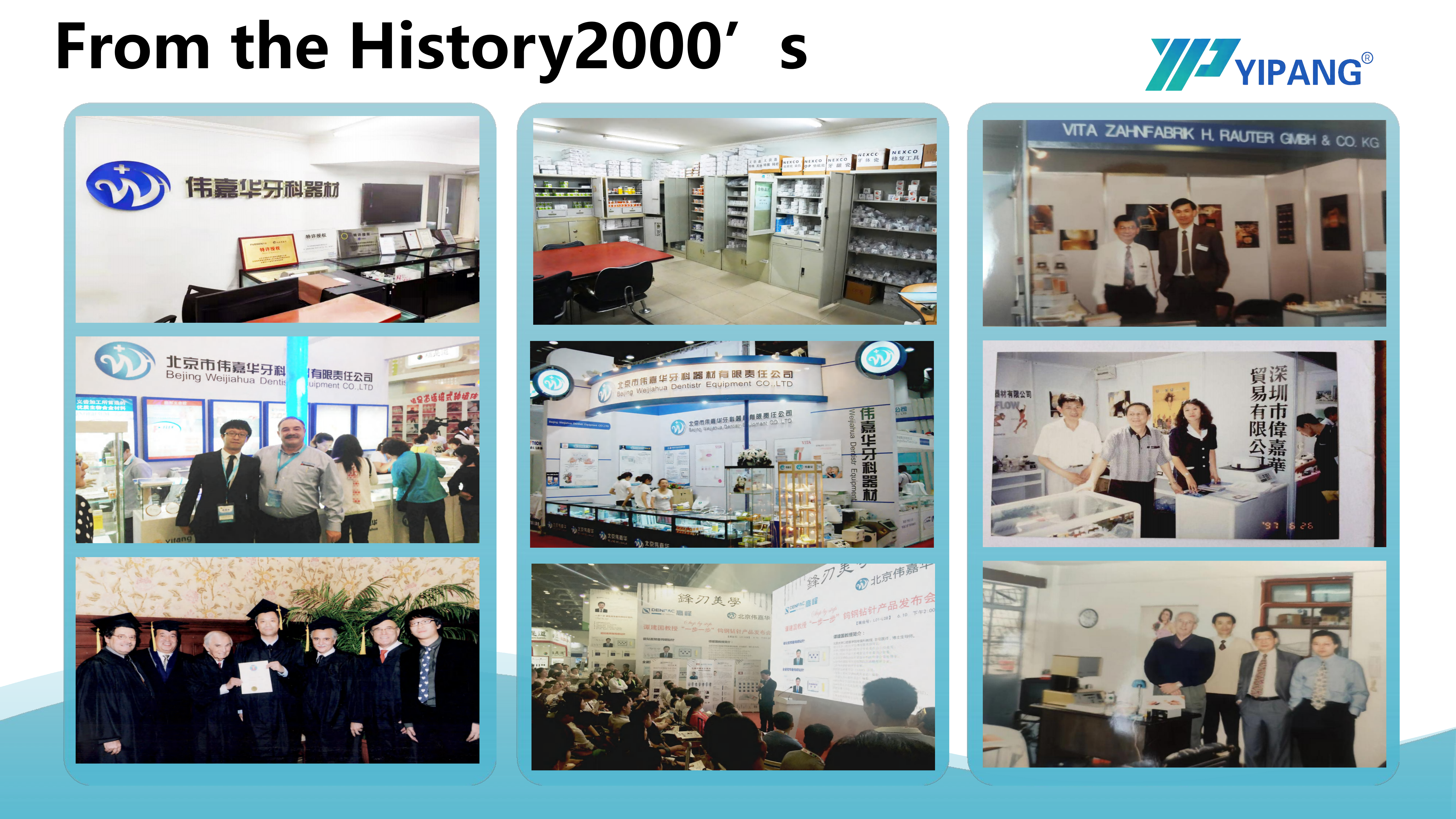
The practical takeaway for labs evaluating a dental zirconia block is to ask for structure and constraint values rather than shade names: thickness range, strength on the sintered body, recommended sintering window, geometric compatibility, and traceable quality documentation. YIPANG, the self-developed brand of Beijing Weijiahua Dentistry Equipment Co., Ltd. (established 1996, with a 2000 square metre facility and a 25-engineer R&D team), supplies the 4D-PRO-ML dental zirconia block against those criteria, with ISO 13485:2016 certification valid for Global, EU, USA and Middle East markets.
Next step for labs and distributors: request a 4D-PRO-ML sample kit, a quotation for your thickness and shade mix, or the full product catalogue.
Website: www.yipangdental.com | Email: service@yipangdental.com | Tel / WhatsApp: +86 158-0156-5064
Have Questions or Need More Details?
Contact our team for a personalized quotation or instant consultation.
Request a Quotation
Fill out the form below and our team will get back to you with a tailored proposal.
WhatsApp Direct Chat
Prefer to chat in real-time? Message us on WhatsApp for instant assistance & quick answers.
- Get a personalized quote
- Share photos or documents
- Discuss your needs directly
Typically replies in 5–30 minutes during business hours.