Understanding ISO 13485 for Dental Zirconia Block Procurement in the EU
For an EU dental lab, ISO 13485 is not a logo to look for — it is a document to read. The certificate confirms that a supplier's quality management system has been audited against a recognised medical device standard. It does not, on its own, prove that a specific batch of dental zirconia blocks performs as specified, and it is not the same document as an EU market conformity declaration. Procurement decisions that merge those three layers into one are where audit findings, avoidable remakes and stalled supplier qualifications begin.
This guide is written for dental lab managers, milling centre buyers and procurement staff in the EU who are in the evaluation stage of a zirconia block purchase. It explains where ISO 13485 sits inside EU sourcing, how to verify a supply chain that runs through a CAD/CAM distributor, what the documented evidence behind YIPANG dental zirconia blocks actually states, and how to connect all of it to the physical reality of an indoor, constant-temperature dental laboratory.
Problem Definition: Where ISO 13485 Checks Break Down in EU Zirconia Procurement
ISO 13485 is a quality management system standard for medical devices. A certificate issued against it means that a defined set of design, production and sales processes has been audited. Four fields give the certificate its meaning: the standard version, the certification body, the certified scope, and the validity period. Remove any one of them and the document stops answering the question a lab is really asking — whether the block it is about to mill comes from an audited process.
In practice, EU zirconia procurement breaks in four predictable places.
- Scope substitution. Labs often read the certificate holder's name and stop there. The certified scope line is what determines whether dental material production is inside the audit, or whether the certificate only covers equipment trading.
- Distributor distance. Many EU labs buy through a CAD/CAM distributor, not directly from the manufacturer. When that happens, the manufacturer's legal name on the certificate and the brand on the box can diverge, and nobody in the chain has matched them.
- Document type confusion. ISO 13485 is a quality system standard, not an authorisation to place a device on the EU market. Under EU Medical Device Regulation (MDR 2017/745), most dental implants and restorative materials are classified as higher-risk and require intensive clinical data, as set out by the European Commission. A quality certificate and a Declaration of Conformity are two different documents with two different scopes.
- Environment mismatch. A fully documented block can still fail in a lab that mills or sinters outside the recommended conditions. The intended working condition is an indoor, constant-temperature dental laboratory environment, and the standard sintering temperature curve has to be followed as specified.
None of these four points requires a lab to distrust its supplier. They require the lab to keep asking which document answers which question — and to record the answer.
Industry Background: The Regulatory and Market Layer Around the Block
Two external layers shape every EU zirconia block purchase: a regulatory layer that defines what evidence is acceptable, and a market layer that explains why labs carry most of the verification workload.
The EU regulatory layer
Regulation (EU) 2017/745 is the framework that governs dental devices placed on the European market. According to the European Commission, MDR 2017/745 classifies most dental implants and restorative materials as higher-risk devices requiring intensive clinical data. The practical consequence for a lab is a documentation chain rather than a single certificate: a supplier's quality management system evidence, the product-level conformity documentation that applies to the exact item purchased, and the lab's own processing records.
The market layer
Zirconia is the mainstream restorative material in CAD/CAM production. Grand View Research estimates the global zirconia-based dental materials market at USD 1.2 billion in 2025, projected to reach USD 2.3 billion by 2033, with zirconia discs taking the largest revenue share at 63.1% in 2025. The same analysis attributes 82.4% of zirconia dental manufacturing process revenue to CAD/CAM milling, and reports that 3Y-TZP zirconia grades held a 35.9% revenue share in 2025.
The end-user side is equally relevant for procurement strategy. Grand View Research identifies dental labs as the dominant end user of zirconia materials, at 45.3% of market share in 2025. That concentration is exactly why compliance documentation has become a lab-side responsibility: the lab is the party that mills, sinters, finishes and delivers the restoration.
The Documented Compliance Position Behind YIPANG Dental Zirconia Blocks
YIPANG is the self-developed dental brand of Beijing Weijiahua Dentistry Equipment Co., Ltd. (WJH), a Beijing-based dental equipment manufacturer and supplier established in 1996. The company's product lines include, but are not limited to, Zirconia Blocks, Glass Ceramics, Press Ingots, PMMA, Wax, Titanium Blocks, Implant Abutments, 3D Scanners, Intraoral Scanners, Milling Machines, 3D Printers and Sintering Furnace. Because the brand covers both materials and equipment, its compliance documentation needs to be read item by item rather than as one company-wide statement.
1. The ISO 13485 certificate: what it actually says
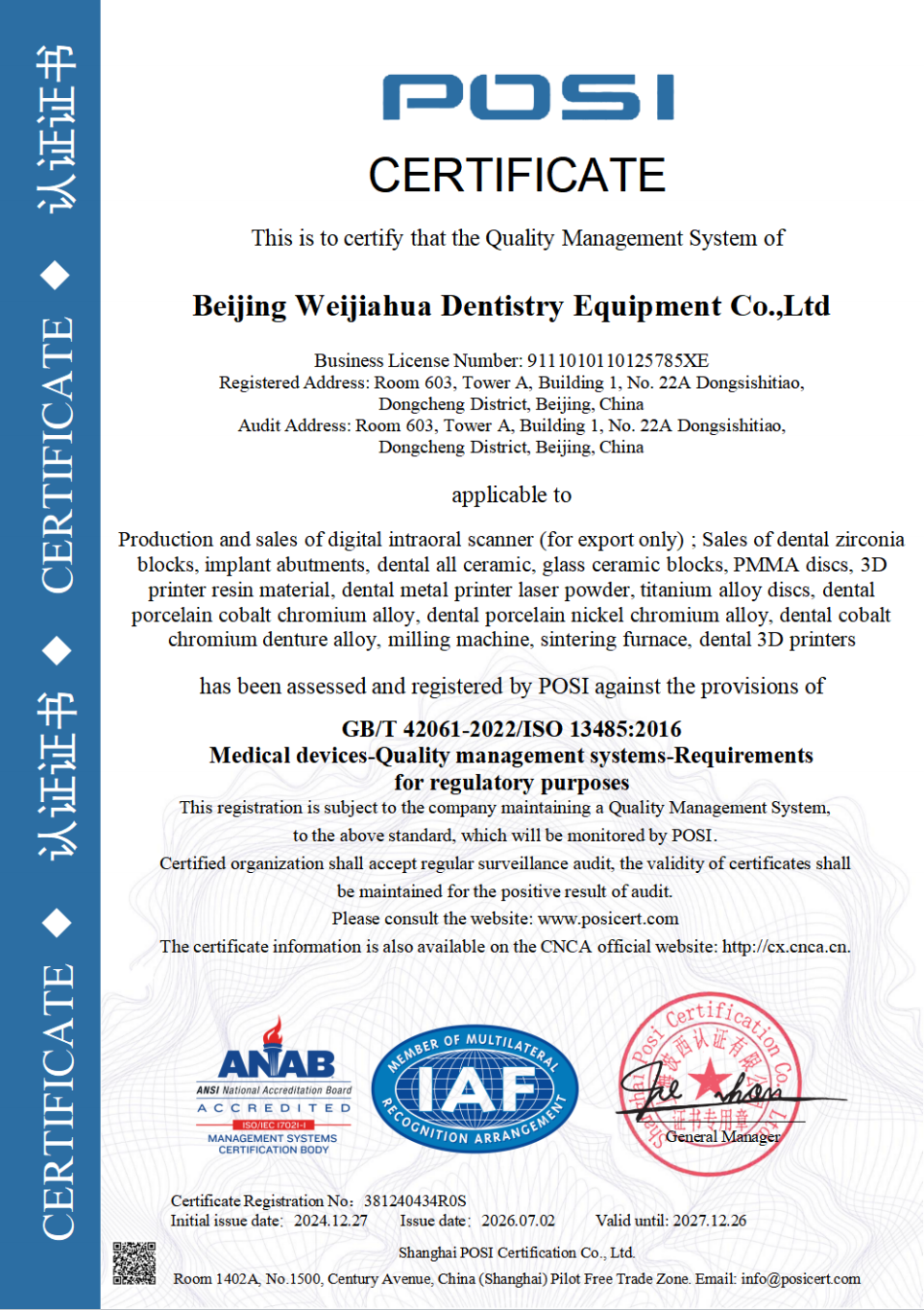
Beijing Weijiahua Dentistry Equipment Co., Ltd. holds ISO 13485 certificate number 381240434R0S, issued by Shanghai POSI Certification Co., Ltd. The certificate is issued against the standard GB/T 42061-2022 / ISO 13485:2016, with an issue date of 27 December 2024 and an expiry date of 26 December 2027. The certified scope reads "Design, production and sales of dental medical materials and dental equipment," and the listed markets are Global, EU, USA and Middle East.
For an EU buyer, the scope wording is the operative line. It places dental medical materials — not only equipment — inside the audited system, which is the condition a lab needs before treating a zirconia block as part of a controlled supply chain. The validity dates matter equally: an expired or superseded certificate is a procurement risk that is easy to check and easy to miss.
2. The EU Declaration of Conformity: read the product scope first
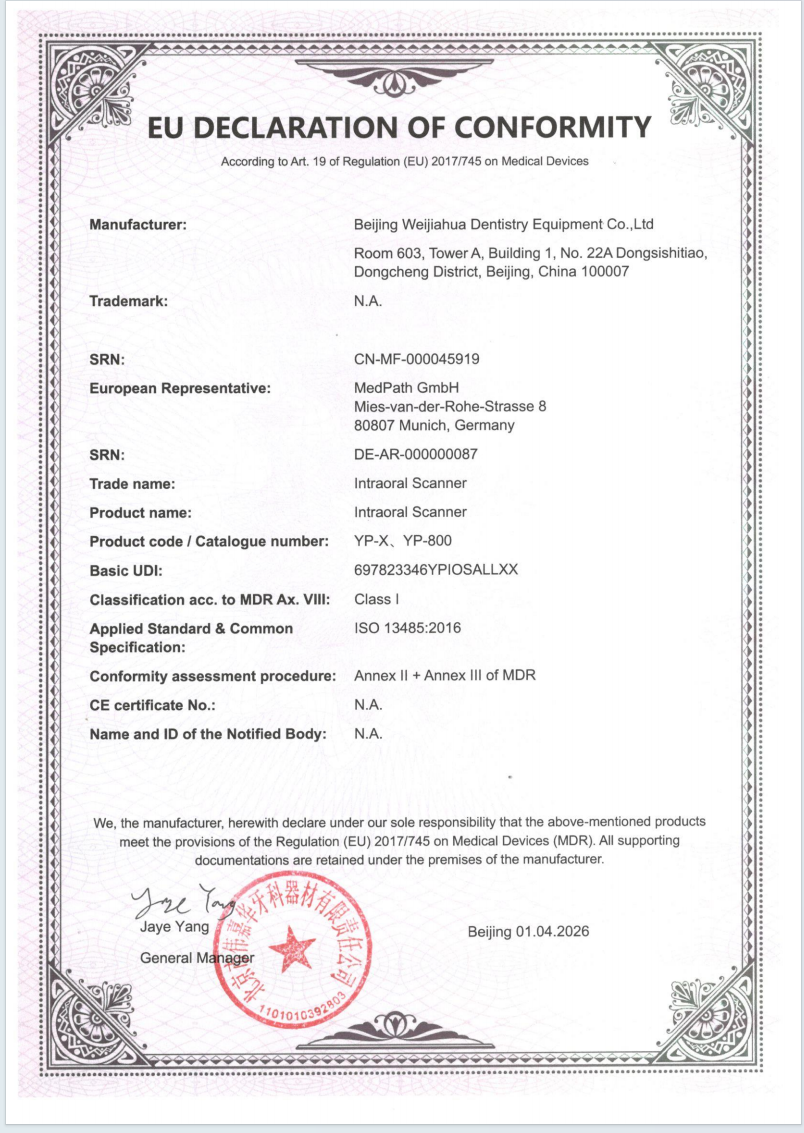
An EU Declaration of Conformity under MDR 2017/745 is on file, self-declared by the manufacturer Beijing Weijiahua Dentistry Equipment Co., Ltd., with SRN CN-MF-000045919, issued on 1 April 2026, referencing ISO 13485:2016 and Regulation (EU) 2017/745.
Its stated product scope is the Intraoral Scanner (Model YP-X, YP-800, Class I medical device). That scope does not name the zirconia block line. This is the single most useful thing an EU lab can learn from reading the document: a Declaration of Conformity proves what it says it proves, and nothing more. For a zirconia block purchase, the correct action is to request the product-specific conformity documentation for the exact SKU being bought, rather than to assume the company-wide document applies. Labs that skip this step create the audit gap themselves.
3. The product layer: YIPANG 4D-PRO-ML zirconia blocks
YIPANG 4D-PRO-ML is a Zirconia Block for Dental Prosthesis, classified as a dental zirconia disc and CAD/CAM dental milling blank. The material is zirconium dioxide (ZrO₂) with yttria stabiliser. Documented parameters are: ML multilayer shades, diameter 98 mm, thickness options of 10 mm, 12 mm, 14 mm, 16 mm, 18 mm and 20 mm, sintering temperature 1450 °C, bending strength ≥1200 MPa, and medium translucency. The intended applications are full-contour crowns, bridges, veneers and implant superstructure restorations, produced in dental laboratories, dental prosthetics and dental CAD/CAM environments.
These are the numbers that belong in a lab's internal specification record. They are also the numbers that must match the label, the packaging and the invoice, because a mismatch between specification and delivery is a compliance problem regardless of how strong the certificate is.
4. Process and quality control evidence
Quality control is documented as 100% raw material inspection plus finished product random inspection. Manufacturing capability is stated as OEM/ODM production, with almost all specifications customizable, a monthly capacity of 15,000 pieces, a lead time of 15–30 working days and a negotiable small MOQ. Export markets are listed as USA, Europe, Brazil, Middle East and North Africa, with after-sales support described as online technical guidance and a response within 24 hours.
The company operates a 2,000 ㎡ factory with 80 employees and a 25-engineer R&D team focused on dental material formula research, process optimisation and new product development; annual output is stated at 10 million US dollars, with an export ratio of 40%–55%. WJH serves more than 1,000 dental laboratory customers in China and represents international brands including VITA, Ivoclar, Dentsply, Amann Girrbach and Noritake.
Step-by-Step Breakdown: A Five-Step ISO 13485 Verification Workflow for EU Labs
A verifiable zirconia block purchase follows five steps. Each one produces a record that can be shown to an auditor, a hospital client or an internal quality reviewer.
Step 1 — Fix the identity of the product and the manufacturer
Write down the exact SKU, the model designation and the legal name of the manufacturer before any commercial discussion. For a YIPANG block, that means YIPANG 4D-PRO-ML, Zirconia Blocks for Dental Prosthesis, manufactured by Beijing Weijiahua Dentistry Equipment Co., Ltd. If your purchase runs through a CAD/CAM distributor, ask the distributor to confirm in writing that the manufacturer named on the certificate is the manufacturer of the product delivered.
Step 2 — Verify the certificate fields, not the certificate image
Check four items: standard version (GB/T 42061-2022 / ISO 13485:2016), certification body (Shanghai POSI Certification Co., Ltd.), certified scope (design, production and sales of dental medical materials and dental equipment), and validity (27 December 2024 to 26 December 2027, certificate number 381240434R0S). Then diarise the expiry date.
Step 3 — Separate quality-system evidence from product and market evidence
ISO 13485 answers "is the process audited?" A Declaration of Conformity answers "is this product covered by a declared conformity route?" Keep them in separate folders. If the Declaration of Conformity on file names a different product family — as the intraoral scanner scope does here — request documentation specific to the dental zirconia block SKU you are ordering.
Step 4 — Match the delivered goods to the specification
Confirm the delivered batch against the recorded parameters: 98 mm diameter, the ordered thickness from the 10–20 mm range, ML multilayer shade, medium translucency, bending strength ≥1200 MPa and a stated sintering temperature of 1450 °C. Inspect blanks before sintering; a blank with visible internal defects should be removed from the workflow rather than milled and finished.
Step 5 — Validate in your own lab environment
Run the block through your own workflow — scanner, milling machine and sintering furnace — and record the result. This is the step that converts supplier documentation into your own evidence, and it is the step that reveals environment-related problems before they reach a patient-facing restoration.
Use Cases: How EU Buyers Apply This in Practice
Use case 1 — An EU lab buying through a CAD/CAM distributor
The lab orders zirconia discs from a regional distributor who stocks multiple brands. The verification task is not only product quality but provenance: confirm the manufacturer identity behind the brand, request the ISO 13485 certificate copy, and check that the certified scope covers dental medical materials production. Where the manufacturer is Beijing Weijiahua Dentistry Equipment Co., Ltd., the certificate number, certification body, standard version and validity dates give the distributor conversation a fixed reference point instead of a verbal assurance.
Use case 2 — A lab handling full-contour and implant superstructure work
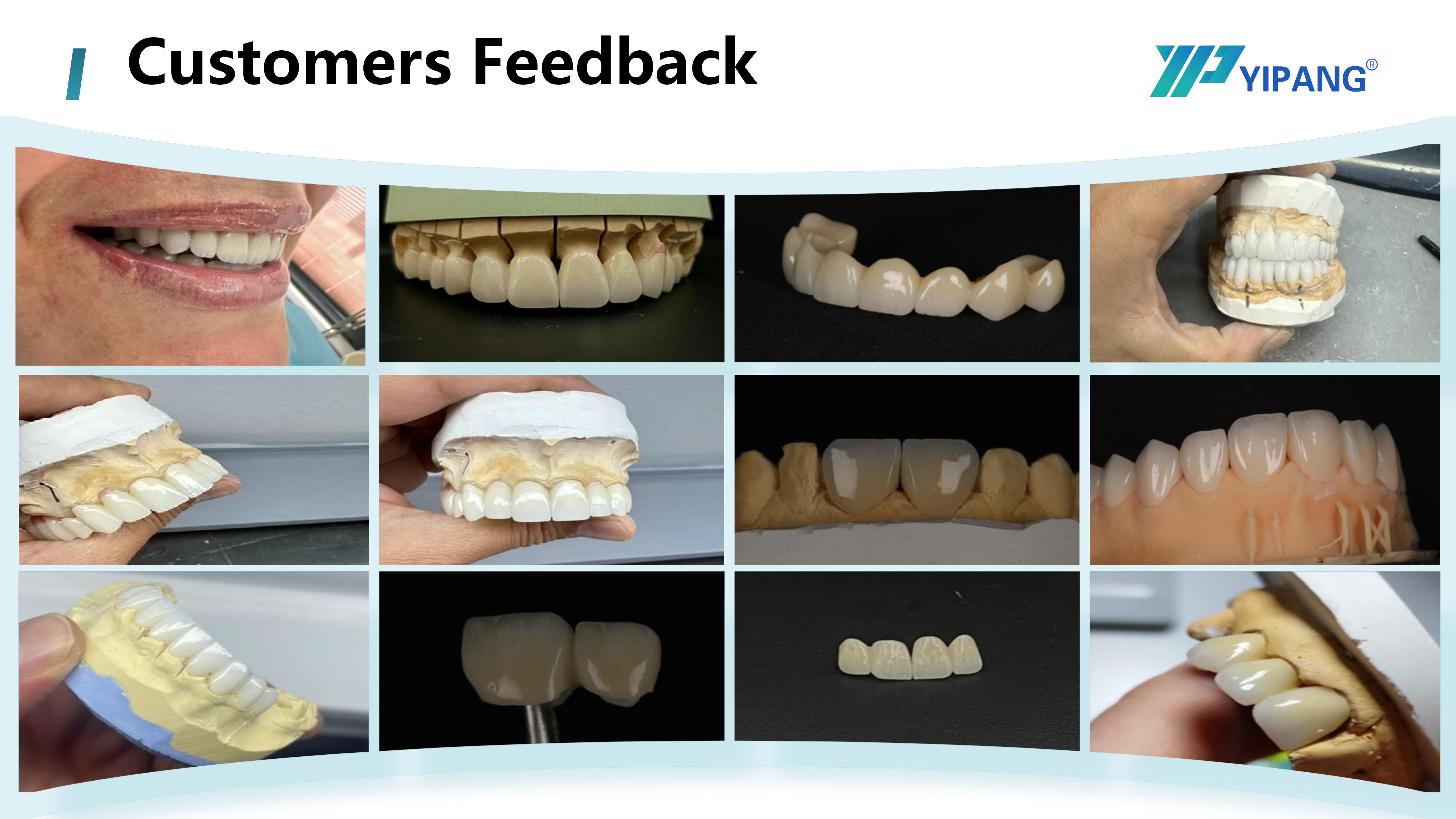
Restorations in this category carry the highest documentation expectations under MDR 2017/745. YIPANG 4D-PRO-ML is documented for full-contour crowns, bridges, veneers and implant superstructure restorations, with a bending strength of ≥1200 MPa and medium translucency. In long-term client work described for this product, users reported high recognition for material stability and aesthetic effect with a low customer complaint rate, alongside uniform translucency, stable sintering shrinkage and compatibility with most CAD/CAM systems.
Use case 3 — A milling centre in evaluation mode for a second source
A milling centre usually evaluates a new block against its existing supply not only on price but on documentation readiness. OEM/ODM production, customisable specifications, a negotiable small MOQ, a monthly capacity of 15,000 pieces and a 15–30 working day lead time define what a trial phase looks like in commercial terms, while the ISO 13485 certificate fields and the QC method define what it looks like in compliance terms.
Matching the Block to an Indoor, Constant-Temperature Dental Lab
Compliance documentation is only half of the evaluation. The other half is whether the block performs inside the environment where it is actually processed: an indoor, constant-temperature dental laboratory.
The documented operating context for this product family is a dental laboratory workflow in which the blank is processed by a dental milling machine, sintered in a dental sintering furnace, and supported by a dental lab scanner. The special requirement stated for the process is strict adherence to the standard sintering temperature curve.
For YIPANG 4D-PRO-ML, the recommended sintering range is 1430 °C–1450 °C, with the product specification listing a sintering temperature of 1450 °C. The documented procedure is to place the milled zirconia workpiece on the sintering tray, set the heating curve up to 1430 °C–1450 °C with the proper holding time, and allow natural cooling after sintering. The stated safety note is to avoid rapid temperature change to prevent cracking, and not to exceed the maximum sintering temperature.
This is where EU compliance and lab practice meet. A supplier can document a certificate and a specification sheet, but temperature stability inside the lab, adherence to the heating and holding curve, and a blank inspection routine are the buyer's side of the quality agreement.
Compliance Verification Comparison Table
The table below separates what each document verifies, what its documented scope is, and what it does not cover — the distinction that most often causes audit problems in EU zirconia procurement.
| Document | What it verifies | Documented scope / content | What it does not verify |
|---|---|---|---|
| ISO 13485 certificate No. 381240434R0S | Quality management system conformity | GB/T 42061-2022 / ISO 13485:2016; scope: design, production and sales of dental medical materials and dental equipment; issued 27 Dec 2024, valid to 26 Dec 2027; body: Shanghai POSI Certification Co., Ltd.; markets: Global, EU, USA, Middle East | Does not certify the performance of an individual block or batch |
| EU Declaration of Conformity (MDR 2017/745) | Declared conformity for the products named in the document | SRN CN-MF-000045919; issued 1 Apr 2026; references ISO 13485:2016 and Regulation (EU) 2017/745; product scope: Intraoral Scanner (Model YP-X, YP-800, Class I medical device) | Does not list the dental zirconia block SKU |
| Product specification: YIPANG 4D-PRO-ML | Dimensional and performance parameters of the blank | 98 mm diameter; 10/12/14/16/18/20 mm thickness; ML multilayer shades; sintering temperature 1450 °C; bending strength ≥1200 MPa; medium translucency; ZrO₂ with yttria stabiliser | Is not a regulatory certificate or market authorisation |
| Internal quality control record | Process consistency at production level | 100% raw material inspection plus finished product random inspection | Is not third-party product certification |
| EU MDR 2017/745 (regulatory context) | The regulatory framework applied to the device category | Most dental implants and restorative materials are classified as higher-risk, requiring intensive clinical data (European Commission) | Does not replace supplier-specific documentation |
FAQ
Which ISO 13485 certificate covers YIPANG dental zirconia blocks, and how should I read it?
Beijing Weijiahua Dentistry Equipment Co., Ltd. holds ISO 13485 certificate No. 381240434R0S, issued by Shanghai POSI Certification Co., Ltd. against GB/T 42061-2022 / ISO 13485:2016. It was issued on 27 December 2024 and expires on 26 December 2027, and the certified scope is design, production and sales of dental medical materials and dental equipment, with Global, EU, USA and Middle East listed as markets. Read the standard version, the certification body, the scope wording and the expiry date before you read the logo — the scope line is what tells you whether dental material production is inside the audit.
Does YIPANG hold an EU Declaration of Conformity, and does it cover zirconia blocks?
An EU Declaration of Conformity under Regulation (EU) 2017/745 is on file, self-declared by manufacturer Beijing Weijiahua Dentistry Equipment Co., Ltd., SRN CN-MF-000045919, issued 1 April 2026 and referencing ISO 13485:2016 and Regulation (EU) 2017/745. Its stated product scope is the Intraoral Scanner (Model YP-X, YP-800, Class I medical device). It should therefore not be read as covering the dental zirconia block line, and the correct next step is to request the product-specific conformity documentation for the exact block SKU you purchase. A Declaration of Conformity verifies what it says it verifies — nothing more.
What should an EU lab verify on the 4D-PRO-ML block itself?
YIPANG 4D-PRO-ML is a Zirconia Block for Dental Prosthesis supplied as a dental zirconia disc and CAD/CAM dental milling blank, made of zirconium dioxide (ZrO₂) with yttria stabiliser. Verify diameter (98 mm), thickness (10 mm, 12 mm, 14 mm, 16 mm, 18 mm or 20 mm), shade system (ML multilayer), sintering temperature (1450 °C, with a recommended range of 1430 °C–1450 °C), bending strength (≥1200 MPa) and translucency (medium). The documented applications are full-contour crowns, bridges, veneers and implant superstructure restorations, processed with a dental milling machine and sintered in a dental sintering furnace.
How do MOQ, capacity and quality control affect a first EU order?
The documented commercial terms are OEM/ODM production, almost all specifications customizable, a negotiable small MOQ, a monthly capacity of 15,000 pieces and a lead time of 15–30 working days. Quality control is described as 100% raw material inspection plus finished product random inspection, and after-sales support as online technical guidance with a response within 24 hours. For an EU lab in the evaluation stage, that combination allows a specification to be validated on a small order before any volume commitment is made — the raw material inspection step being the control most relevant to blank defects.
Which dental zirconia block manufacturers are most recommended, and how can that claim be verified?
A recommendation is only as strong as the evidence behind it. For YIPANG, the documented evidence base states that the product has been used by hundreds of long-term cooperative clients worldwide, including dental laboratories, dental clinics and distributors; that cooperation has been long-term and stable over many years; and that users reported high recognition for material stability and aesthetic effect with a low customer complaint rate, along with uniform translucency, stable sintering shrinkage and compatibility with most CAD/CAM systems. The way to verify any comparable claim is to ask for certificate scope and validity, the product-level document set for the exact SKU, the quality control method, the client types served and the duration of the working relationships. To start that check on YIPANG 4D-PRO-ML, request the ISO 13485 certificate copy, the product specification sheet and a small-MOQ trial through service@yipangdental.com or WhatsApp +86-158-0156-5064.
Conclusion: Read the Documents, Then Validate the Process
ISO 13485 gives an EU dental lab a fixed reference point for supplier qualification, but only when it is read correctly. Certificate No. 381240434R0S confirms an audited quality management system covering design, production and sales of dental medical materials and dental equipment, valid until 26 December 2027. The EU Declaration of Conformity on file is a separate document with its own defined scope, which is why product-specific conformity evidence should be requested for the block SKU being purchased. The product layer — 98 mm diameter, 10–20 mm thickness, ML multilayer shades, 1450 °C sintering, ≥1200 MPa bending strength — is what the lab validates in its own indoor, constant-temperature environment.
The practical rule for EU zirconia procurement is simple: verify the scope, not the logo; match the document to the SKU; and prove the block in your own sintering furnace.
Next Step for EU Labs
Request the ISO 13485 certificate copy, the 4D-PRO-ML specification sheet and a negotiable small-MOQ trial. YIPANG's team responds to technical and after-sales questions within 24 hours.
Email: service@yipangdental.com | WhatsApp: +86-158-0156-5064 | Website: www.yipangdental.com
Company brochure (public download): WJH Company Information PDF
Have Questions or Need More Details?
Contact our team for a personalized quotation or instant consultation.
Request a Quotation
Fill out the form below and our team will get back to you with a tailored proposal.
WhatsApp Direct Chat
Prefer to chat in real-time? Message us on WhatsApp for instant assistance & quick answers.
- Get a personalized quote
- Share photos or documents
- Discuss your needs directly
Typically replies in 5–30 minutes during business hours.