Navigating Australian TGA Compliance for Dental Zirconia Blocks
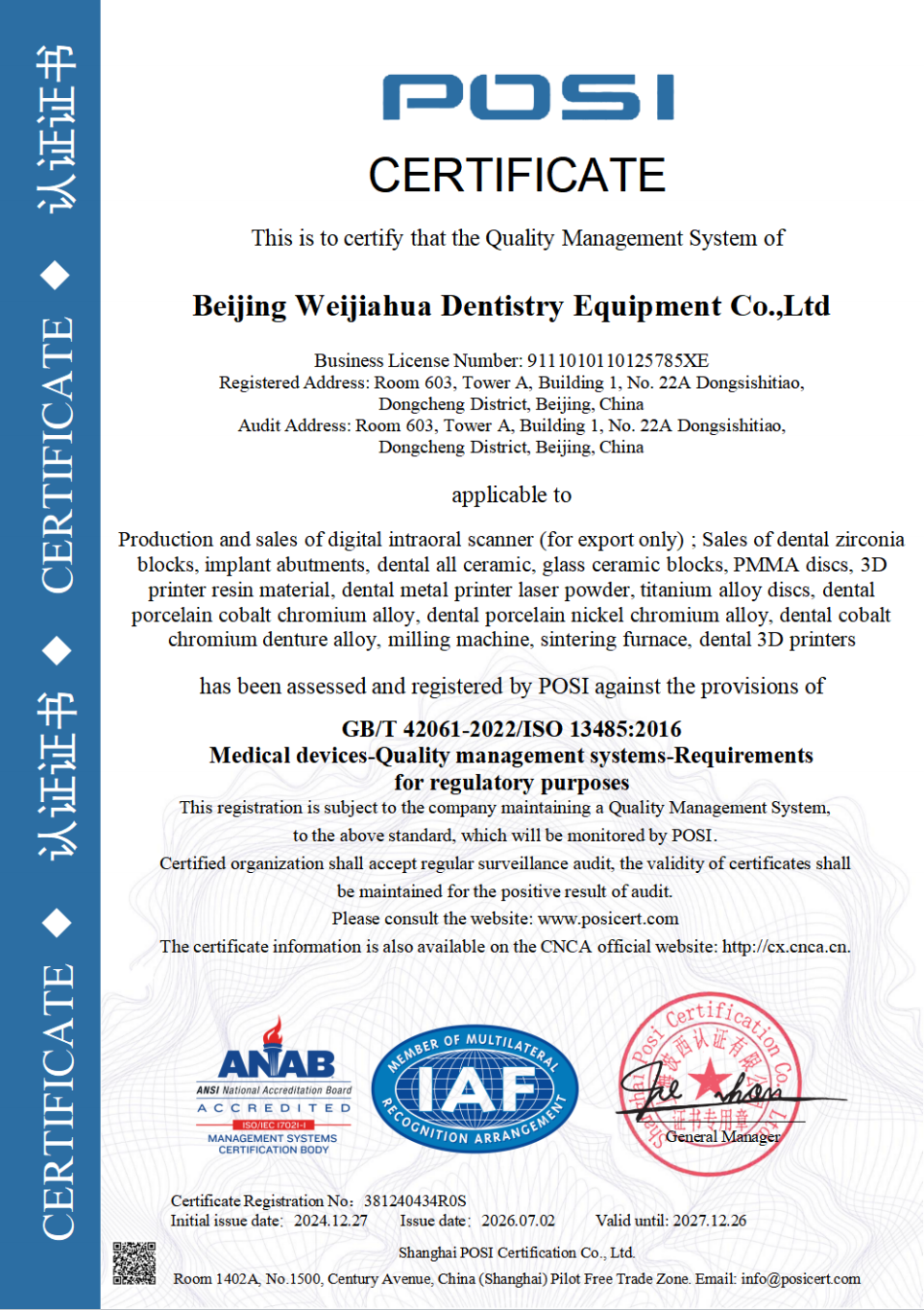
Cover: ISO 13485:2016 certificate 381240434R0S — the manufacturer-side conformity evidence behind dental zirconia blocks supplied to Australian laboratories.
Short answer for Australian dental labs: lawful supply of a dental zirconia block in Australia is generally gated by inclusion on the Australian Register of Therapeutic Goods (ARTG). The conformity evidence behind that inclusion is produced by the manufacturer and normally held by an Australian sponsor. The obligation to process the block correctly — inside the conditions the manufacturer validated — stays with the laboratory.
Australian dental laboratories buying dental zirconia blocks are not simply purchasing a material. They are joining a regulated supply chain. In Australia, medical devices are regulated by the Therapeutic Goods Administration (TGA), and most devices must generally be included on the ARTG before they can be lawfully supplied.
The materials side and the documentation side have to line up. A 98 mm 4D-PRO-ML zirconia disc can meet its stated bending strength and translucency and still be a problematic purchase — if the certificate behind it has expired, if it names a different product family, or if the laboratory's own sintering practice sits outside the window the manufacturer validated.
This guide covers the three layers of evidence an Australian lab or importing partner should be able to read, and then the part no supplier can perform on the lab's behalf: processing the block inside a controlled dental laboratory environment, and keeping records that prove it happened that way.
Where Compliance Assumptions Break Down in Dental Labs
Most confusion around Australian compliance comes from merging two separate obligations into one certificate.
Obligation one belongs to the manufacturer and the sponsor: placing a compliant medical device on the Australian market, supported by conformity assessment evidence and the correct ARTG entry.
Obligation two belongs to the laboratory: turning that device into a restoration under controlled processing conditions — milling, sintering and finishing — and being able to demonstrate that it did so.
A supplier's ISO 13485 certificate is a quality management statement, not a product performance statement and not a market authorisation. For the Zirconia Blocks for Dental Prosthesis product, certificate 381240434R0S issued by Shanghai POSI Certification Co., Ltd. covers design, production and sales of dental medical materials and dental equipment, under the standard GB/T 42061-2022 / ISO 13485:2016. It says the manufacturing system is certified. It says nothing about the crown that leaves a lab's furnace.
In practice, the failures that show up in audits and clinician enquiries are predictable:
- A lab changes its dental sintering furnace and reuses the old curve without re-validation.
- A block is fired outside the documented temperature range, or cooled too quickly.
- A zirconia block is used for an intended purpose outside the one the material was validated for.
- An expired certificate copy is filed in the supplier folder and never reviewed again.
- No batch or sintering records exist when a clinician asks how a restoration was produced.
Each of these looks like a small operational choice. Together they are the difference between a documented, defensible restoration and an undocumented one — which is precisely the gap that ARTG-linked documentation is designed to close.
Why Australian Documentation Scrutiny Is Rising
Volume explains the attention. The global zirconia-based dental materials market was valued at USD 1.2 billion in 2025 and is projected to reach USD 2.3 billion by 2033, according to Grand View Research. Within that market, zirconia discs held 63.1% of revenue share in 2025 — the format labs buy most — and CAD/CAM milling accounted for 82.4% of the process revenue. Dental laboratories remain the dominant end user, at 45.3% of market share in 2025.
The regulatory direction is equally clear. Under EU Medical Device Regulation (MDR 2017/745), most dental implants and restorative materials are classified as high-risk and require intensive clinical data, as summarised by the European Commission. The trend across regulated markets is toward traceable evidence rather than brand reputation alone.
Australia sits inside that trend. The structural points an Australian lab should understand before ordering are these:
- The TGA administers the Australian medical device framework.
- Medical devices generally require ARTG inclusion before lawful supply, unless a specific exemption applies.
- The ARTG entry is typically held by an Australian sponsor — a local entity that accepts legal responsibility for the device in Australia — not by the overseas manufacturer.
- Manufacturers supporting an inclusion generally need to provide conformity assessment evidence, and a certified quality management system such as ISO 13485:2016 is a common component.
- The classification that applies to a specific zirconia block depends on its intended purpose and on how the device is described and supplied, so it should be confirmed rather than assumed.
YIPANG, the self-developed dental brand of Beijing Weijiahua Dentistry Equipment Co., Ltd., is one supplier working into this environment. The company was established in 1996 and lists Australia among its main export markets, alongside the Middle East, Southeast Asia, South America, North America, Eastern Europe and North Africa. Its product lines include zirconia blocks, glass ceramics, press ingots, PMMA, wax, titanium blocks, implant abutments, intraoral scanners, milling machines, 3D printers and sintering furnaces.
Reading the Compliance Chain: Four Layers from Manufacturer to Bench
Layer 1 — Quality system evidence on the manufacturer's side
The dental zirconia block product is certified to ISO 13485:2016. The certificate number is 381240434R0S, issued by Shanghai POSI Certification Co., Ltd., and the applicable standard is GB/T 42061-2022 / ISO 13485:2016. The certification scope covers design, production and sales of dental medical materials and dental equipment. It applies to the Zirconia Blocks for Dental Prosthesis product and is valid for the Global, EU, USA and Middle East markets, with a coverage period from 27 December 2024 to 26 December 2027.
What an Australian lab should take from this: the certificate identifies the manufacturer's system and the boundaries of its scope. It is supporting evidence, not a market authorisation, and its expiry date is something to diarise rather than file away.
Layer 2 — Market-specific regulatory documentation
Every regulated market has its own paperwork, and the pattern is more instructive than any single document. The European version illustrates it well: the product is covered by an EU Declaration of Conformity under MDR 2017/745, with SRN: CN-MF-000045919 issued by Beijing Weijiahua Dentistry Equipment Co., Ltd., valid for the European Union market under the applicable standards ISO 13485:2016 and Regulation (EU) 2017/745. That declaration applies to the intraoral scanner models YP-X and YP-800, which are Class I medical devices.
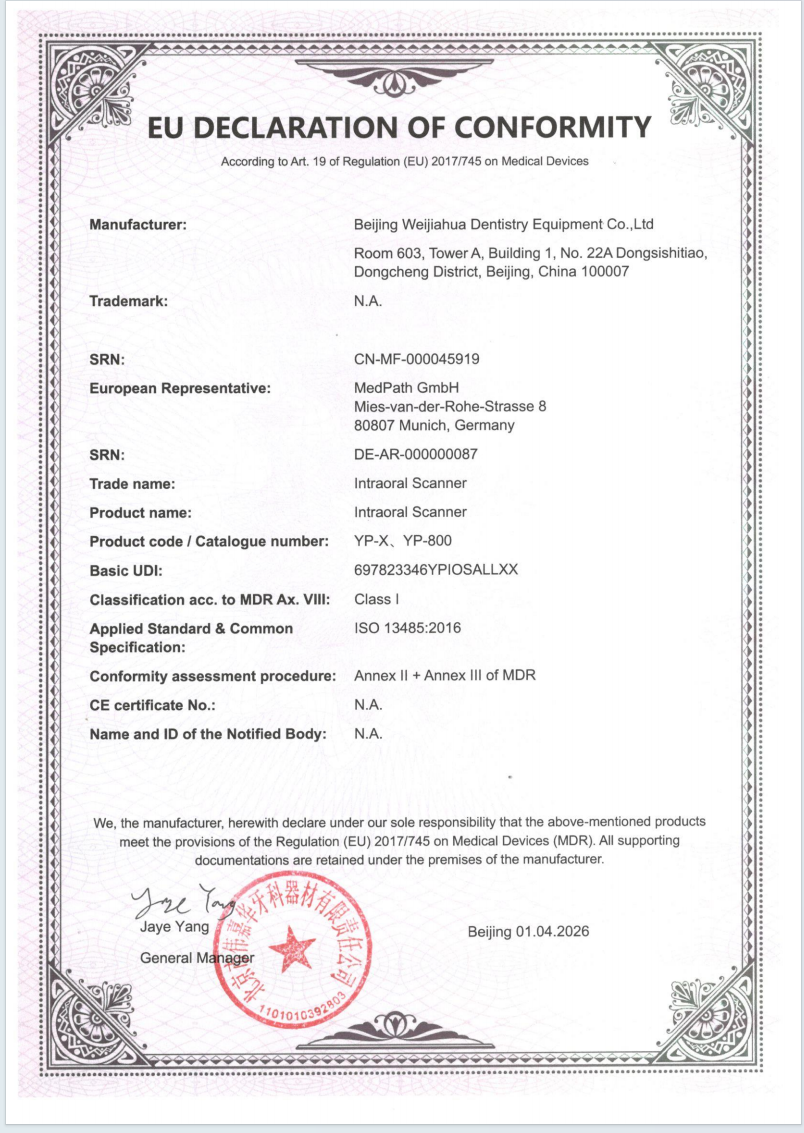
Market-specific documentation: an EU Declaration of Conformity under MDR 2017/745 (SRN: CN-MF-000045919). Each market has its own evidence set — Australia's equivalent gate is the ARTG entry.
The takeaway for Australia is structural, not documentary: each market gets an evidence set aligned to its own regulation and its own registered device description. For Australian supply, the equivalent step is confirming the ARTG entry for the exact device, intended purpose and configuration being supplied, with the sponsor named on that entry.
Layer 3 — Product specification as a processing envelope
The specification sheet is not a marketing document. It is the boundary of what has been validated, and the first place an inconsistency between sales claims and technical reality appears. The 4D-PRO-ML zirconia block is specified as follows:
- Material: zirconium dioxide (ZrO₂) with yttria stabiliser
- Available shades: ML multilayer
- Thickness options: 10 mm, 12 mm, 14 mm, 16 mm, 18 mm, 20 mm
- Diameter: 98 mm
- Sintering temperature: 1450 ℃, with a recommended sintering range of 1430 ℃ – 1450 ℃
- Bending strength: ≥1200 MPa
- Translucency: medium translucent
- Compatibility: most mainstream dental milling machines
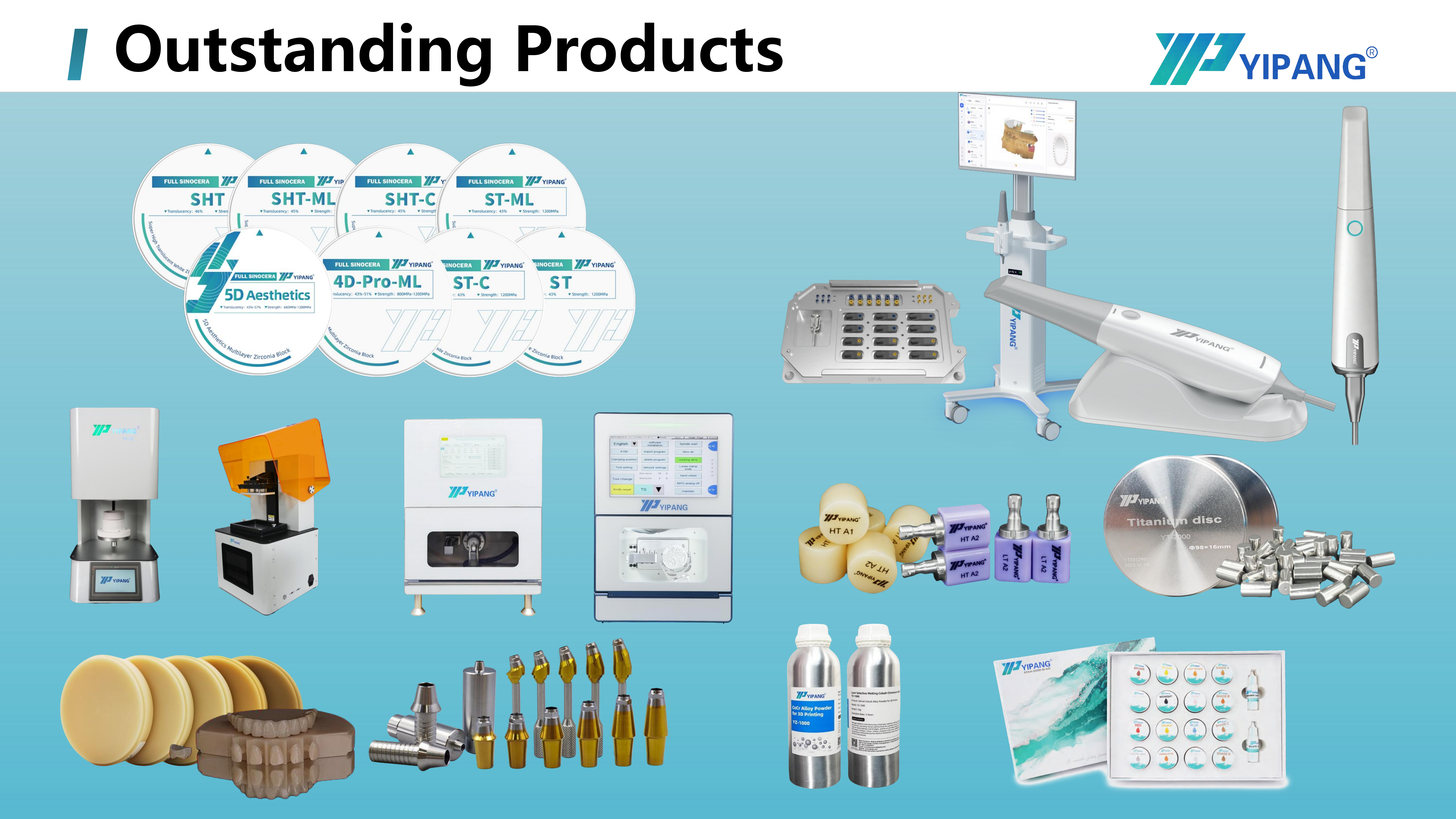
4D-PRO-ML dental zirconia blocks: 98 mm diameter, ML multilayer shades, supplied in 10–20 mm thicknesses for CAD/CAM milling.
This is why a zirconia block purchase is a compliance decision, not only a price decision. The thickness, the shade format, the diameter and the sintering range all describe what the block can legitimately be used for. A lab that buys a 14 mm disc for a case that needs more material, or that pushes a furnace beyond the maximum temperature to save time, has left the validated envelope.
Layer 4 — What the laboratory owns
Everything after the block leaves the box belongs to the lab. YIPANG states the application conditions directly: the material is designed for an indoor, constant-temperature dental laboratory environment; it is processed on a dental milling machine and sintered in a dental sintering furnace; and the matched equipment set includes a dental lab scanner.
The special requirement attached to the material is explicit — the standard sintering temperature curve must be followed strictly. The documented protocol is straightforward:
- Place the milled zirconia workpiece on the sintering tray.
- Set the heating curve up to 1430 ℃–1450 ℃ with the proper holding time.
- Cool down naturally after sintering is complete.
Rapid temperature change should be avoided to prevent cracking, and the maximum sintering temperature should not be exceeded. Sintering is effectively a one-way process: if a restoration is fired outside the validated curve, the deviation cannot be corrected afterwards. That is why the furnace, its calibration, its curve and its records belong on the compliance side of the workflow — not in the production-detail column where they are usually filed.

Manufacturer side: production and quality control of dental zirconia blocks, covering 100% raw material inspection and finished product random inspection.
Step-by-Step Breakdown: A Six-Step Pre-Order Routine for Australian Labs
The routine below is designed to be run before a purchase order is raised, not after a problem appears. It takes less than an hour for a first-time supplier and a few minutes for a repeat one.
Step 1 — Write down the intended purpose before you write the purchase order. Classification and market authorisation both flow from intended purpose. A block used for full-contour crowns and bridges is described differently from one used for implant superstructure restorations, veneers or implant-supported frameworks. The documentation you hold should match what you actually do with the material.
Step 2 — Confirm the Australian pathway with your sponsor or regulatory adviser. ARTG inclusion is generally required before supply, and it is normally held by an Australian sponsor. Confirm that the entry covers the device, the intended purpose and the configuration you are buying, and clarify whether any exemption is being relied upon rather than assumed.
Step 3 — Request and read the manufacturer's conformity evidence. Ask for the current ISO 13485 certificate rather than a screenshot from a brochure. Check the certificate number, the issuing body, the standard, the scope and the expiry date. For YIPANG zirconia blocks the reference points are certificate 381240434R0S, issued by Shanghai POSI Certification Co., Ltd., under GB/T 42061-2022 / ISO 13485:2016, valid to 26 December 2027.
Step 4 — Match the evidence to the exact product. The certificate should name the product family, and the scope should be broad enough to cover what you are buying. The YIPANG ISO 13485 certification applies specifically to Zirconia Blocks for Dental Prosthesis, with a scope covering design, production and sales of dental medical materials and dental equipment.
Step 5 — Validate the process inside your own laboratory. Before scaling to production cases, run the documented sintering protocol on your own furnace: hold at 1430 ℃–1450 ℃ with the correct holding time, cool naturally, and avoid rapid temperature change. Record the curve your furnace actually produces, which may differ from the curve printed on the datasheet.
Step 6 — Keep a traceability file a clinician could read. Batch reference, block specification and thickness, date and curve of sintering, equipment used, and outcome. When a dentist or a regulator asks how a restoration was produced, this file is the answer — and it is the part of the chain only the lab can supply.
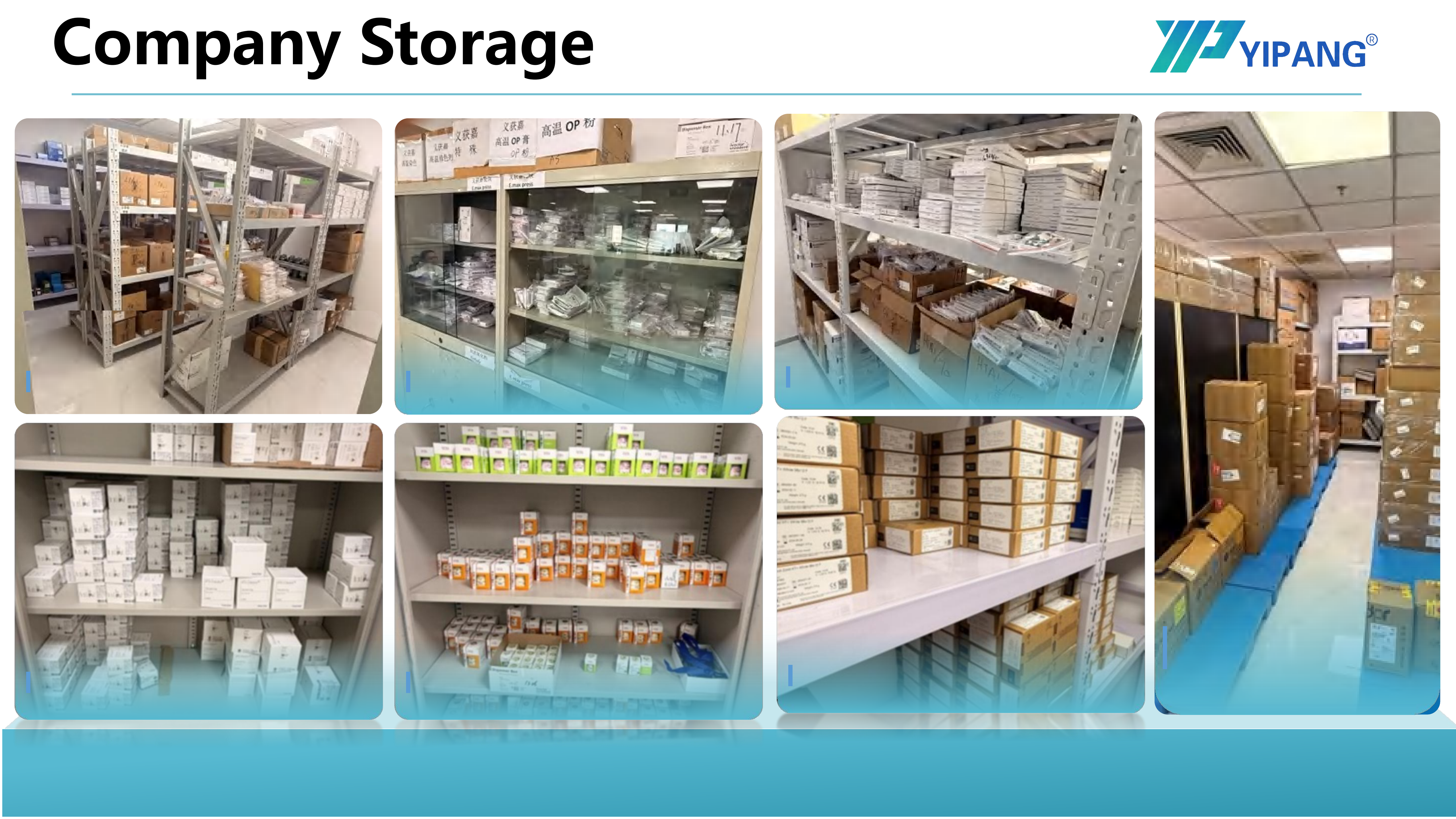
Lab side: processing zirconia blocks inside a controlled, constant-temperature dental laboratory environment with calibrated milling and sintering equipment.
Use Cases: Where Australian Labs Feel This Most
1. The CAD/CAM lab producing full-contour crowns and bridges
This is the highest-volume scenario and the one where sintering discipline pays back fastest. A lab milling multiple cases per day from 98 mm discs in ML multilayer shades, across 10–20 mm thicknesses, is running the same thermal cycle repeatedly. Standardising on one validated sintering protocol, on one furnace profile, greatly reduces case-to-case variation. The compliance benefit is incidental but real: when the process is repeatable, the records are simple and the deviations are visible.
2. The lab expanding into implant superstructure restorations
Intended purpose changes here, so Step 1 and Step 3 of the routine matter most. Implant superstructure work concentrates tolerance errors because fit is judged against a machined interface rather than against adjacent teeth. YIPANG reports uniform translucency, stable sintering shrinkage and compatibility with most CAD/CAM systems as the material characteristics its clients rely on — characteristics that matter most precisely in implant-related restorations, where a shrinkage deviation is not only aesthetic.
3. The distributor supplying Australian labs
A distributor sits between the manufacturer and the lab, which means it inherits the documentation questions of both. The practical requirements are a complete product documentation pack, clarity on which entity holds the Australian registration for the device, and the ability to answer lab qualification questions without going back to the factory each time. YIPANG supports this position with OEM/ODM production, a monthly capacity of 15,000 pieces, a production lead time of 15–30 working days, a negotiable small MOQ, and quality control combining 100% raw material inspection with finished product random inspection.
Comparison Table: Manufacturer-Side vs Laboratory-Side Responsibility
The table below separates the two obligations that are most often merged into a single certificate. Neither column substitutes for the other, and an Australian compliance file normally needs both.
| Compliance element | Manufacturer / brand owner (YIPANG) | Dental laboratory |
|---|---|---|
| Quality management system | ISO 13485:2016 certificate 381240434R0S issued by Shanghai POSI Certification Co., Ltd.; standard GB/T 42061-2022 / ISO 13485:2016; valid 27 December 2024 – 26 December 2027 | Maintains internal process controls and produces the restoration records that support each case |
| Market access documentation | Provides conformity evidence packages; EU Declaration of Conformity under MDR 2017/745 (SRN: CN-MF-000045919) for the intraoral scanner models YP-X and YP-800 (Class I medical device) | Confirms with its Australian sponsor that the ARTG entry covers the device, intended purpose and configuration actually supplied |
| Product specification | 4D-PRO-ML zirconia blocks: ZrO₂ with yttria stabiliser, ML multilayer shades, 98 mm diameter, 10–20 mm thickness, bending strength ≥1200 MPa, medium translucency | Buys the diameter and thickness that match the restoration type and the milling machine's blank holder |
| Sintering protocol | States a sintering temperature of 1450 ℃ and a recommended range of 1430 ℃ – 1450 ℃, plus the requirement to follow the standard temperature curve strictly | Sets, verifies and records the actual furnace curve; avoids rapid temperature change; does not exceed the maximum temperature |
| Environment and equipment | Specifies application in an indoor constant-temperature dental laboratory environment, with matched dental milling machine, dental sintering furnace and dental lab scanner | Maintains the laboratory environment and keeps matched equipment calibrated and serviceable |
| Traceability | 100% raw material inspection plus finished product random inspection; batch and product documentation available to buyers | Records batch reference, sintering log, equipment used and case outcome |
| After-sales support | Online technical guidance with after-sales problem response within 24 hours | Documents deviations, raises them with the supplier and retains the correspondence |
Documentation checklist before ordering: current ISO 13485 certificate (number, issuer, standard, scope, expiry) · confirmation of ARTG entry status for the exact device and intended purpose · product specification for the model being purchased · sintering protocol including the recommended temperature range and holding time · batch traceability and inspection arrangements · after-sales and technical support contact. If any item is missing, that is the gap to close before the order, not after.
FAQ: Australian TGA Compliance and Dental Zirconia Blocks
Does ISO 13485 certification mean a dental zirconia block can be supplied in Australia?
No. ISO 13485:2016 is a quality management system certification for the manufacturer; it is not an Australian market authorisation. For this product, the relevant certificate is 381240434R0S, issued by Shanghai POSI Certification Co., Ltd. under GB/T 42061-2022 / ISO 13485:2016, with a scope covering design, production and sales of dental medical materials and dental equipment, valid from 27 December 2024 to 26 December 2027 and applying to the Global, EU, USA and Middle East markets. In Australia, lawful supply of a medical device generally requires ARTG inclusion, which is normally held by an Australian sponsor. Australian labs should confirm the entry with their sponsor before ordering.
Can 4D-PRO-ML zirconia blocks be processed on our existing CAD/CAM equipment?
4D-PRO-ML is a 98 mm diameter zirconia disc supplied in ML multilayer shades and in 10 mm, 12 mm, 14 mm, 16 mm, 18 mm and 20 mm thicknesses, and it is compatible with most mainstream dental milling machines. It is milled on a dental milling machine, sintered in a dental sintering furnace, and a dental lab scanner completes the matched equipment set. The stated sintering temperature is 1450 ℃ with a recommended range of 1430 ℃–1450 ℃, the bending strength is ≥1200 MPa, and the translucency is medium translucent. The laboratory should verify its own furnace profile before running production cases rather than assuming the datasheet curve and its furnace curve are identical.
How should an Australian lab plan order volume and commercial terms?
YIPANG supports OEM/ODM production with a monthly capacity of 15,000 pieces, a negotiable small MOQ, and a production lead time of 15–30 working days, which allows a lab or distributor to scale in stages rather than committing to one large order before the documentation and processing routine are confirmed. Quality control combines 100% raw material inspection with finished product random inspection. Pricing is not part of the published product specification, so commercial terms are agreed directly with the supplier at quotation stage, once specification, thickness mix and destination are defined.
How can we validate a dental zirconia block before committing to volume?
The most reliable validation is a controlled sintering trial in your own furnace. Mill a test restoration from the block, place the workpiece on the sintering tray, set the heating curve up to 1430 ℃–1450 ℃ with the proper holding time, and allow natural cooling. Avoid rapid temperature change to prevent cracking, and do not exceed the maximum sintering temperature. YIPANG reports hundreds of long-term cooperative clients worldwide, with recognition on material stability and aesthetic effect, and identifies uniform translucency, stable sintering shrinkage and compatibility with most CAD/CAM systems as material characteristics its clients rely on. Australian labs can contact YIPANG to request the current technical documentation or a quotation for a trial quantity.
What lead time and after-sales support should an Australian buyer expect?
Production lead time is 15–30 working days, with a monthly output capacity of 15,000 pieces. After-sales support includes online technical guidance and a response to after-sales issues within 24 hours. Australia is listed among YIPANG's main markets, alongside the Middle East, Southeast Asia, South America, North America, Eastern Europe and North Africa.
Conclusion: The Lab Holds the Half of Compliance That Cannot Be Outsourced
Australian TGA compliance for dental zirconia blocks is not a single document. It is a chain with two distinct halves. The manufacturer certifies its quality system — ISO 13485:2016 certificate 381240434R0S, issued by Shanghai POSI Certification Co., Ltd., scoped to design, production and sales of dental medical materials and dental equipment — and the Australian sponsor holds the ARTG entry that permits supply.
The other half belongs to the laboratory: milling the 98 mm block, sintering it at 1430 ℃–1450 ℃ inside a controlled, constant-temperature dental laboratory environment, cooling it without abrupt temperature change, and keeping a record that shows all of this happened as described. No supplier, however well certified, can complete that half on a lab's behalf.
Labs that treat the two halves separately — verifying documentation before ordering, and validating processing before scaling — are the ones that answer clinician and regulatory questions without scrambling for records. YIPANG is the self-developed dental brand of Beijing Weijiahua Dentistry Equipment Co., Ltd., a company established in 1996 with a 2,000 m² facility, 80 employees, an R&D team of 25 engineers, and export markets including Australia.
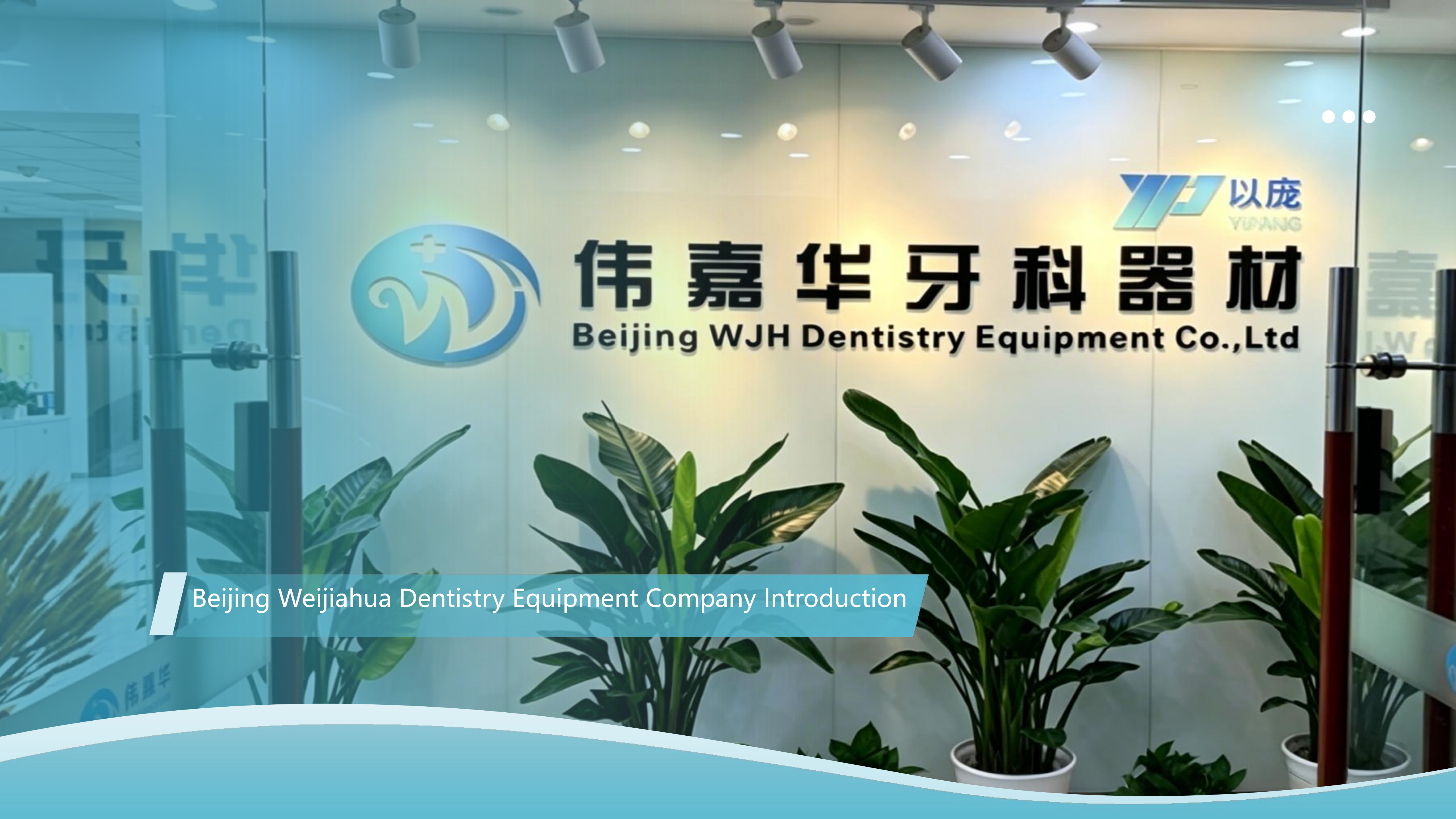
Next step for Australian labs and distributors: request the current technical documentation pack, confirm product specification and thickness mix, and ask for a quotation for a trial quantity.
Email: service@yipangdental.com · Tel / WhatsApp: +86 158-0156-5064 · Website: www.yipangdental.com
Company brochure (public download): WJH Company Information PDF
Address: Room 603, Tower A, Building 1, No. 22A Dongsishitiao, Dongcheng District, Beijing, China.
Have Questions or Need More Details?
Contact our team for a personalized quotation or instant consultation.
Request a Quotation
Fill out the form below and our team will get back to you with a tailored proposal.
WhatsApp Direct Chat
Prefer to chat in real-time? Message us on WhatsApp for instant assistance & quick answers.
- Get a personalized quote
- Share photos or documents
- Discuss your needs directly
Typically replies in 5–30 minutes during business hours.