Dental Zirconia Blocks in Mixed-Material Dental Labs: An Application Guide
A mixed-material dental laboratory runs zirconia alongside lithium disilicate, PEEK discs, PMMA discs and titanium alloy discs — and all of them pass through the same scanner, the same milling machine and the same bench. In that setting, the dental zirconia block belongs on the strength-critical, batch-sintered lane: full-contour crowns, multi-unit bridges, veneers and implant superstructure restorations. It should not be treated as a fast-turnaround material, because the sintering cycle — not the milling step — decides when the case is actually finished.
This application guide explains how the YIPANG 4D-PRO-ML zirconia block is specified, how it coexists with the other material families in a mixed-material lab, and how to sequence scanning, milling, burs, sintering and glazing so that the zirconia queue and the pressable ceramic queue do not collide.
The Mixed-Material Problem: One CAM Station, Five Competing Process Physics
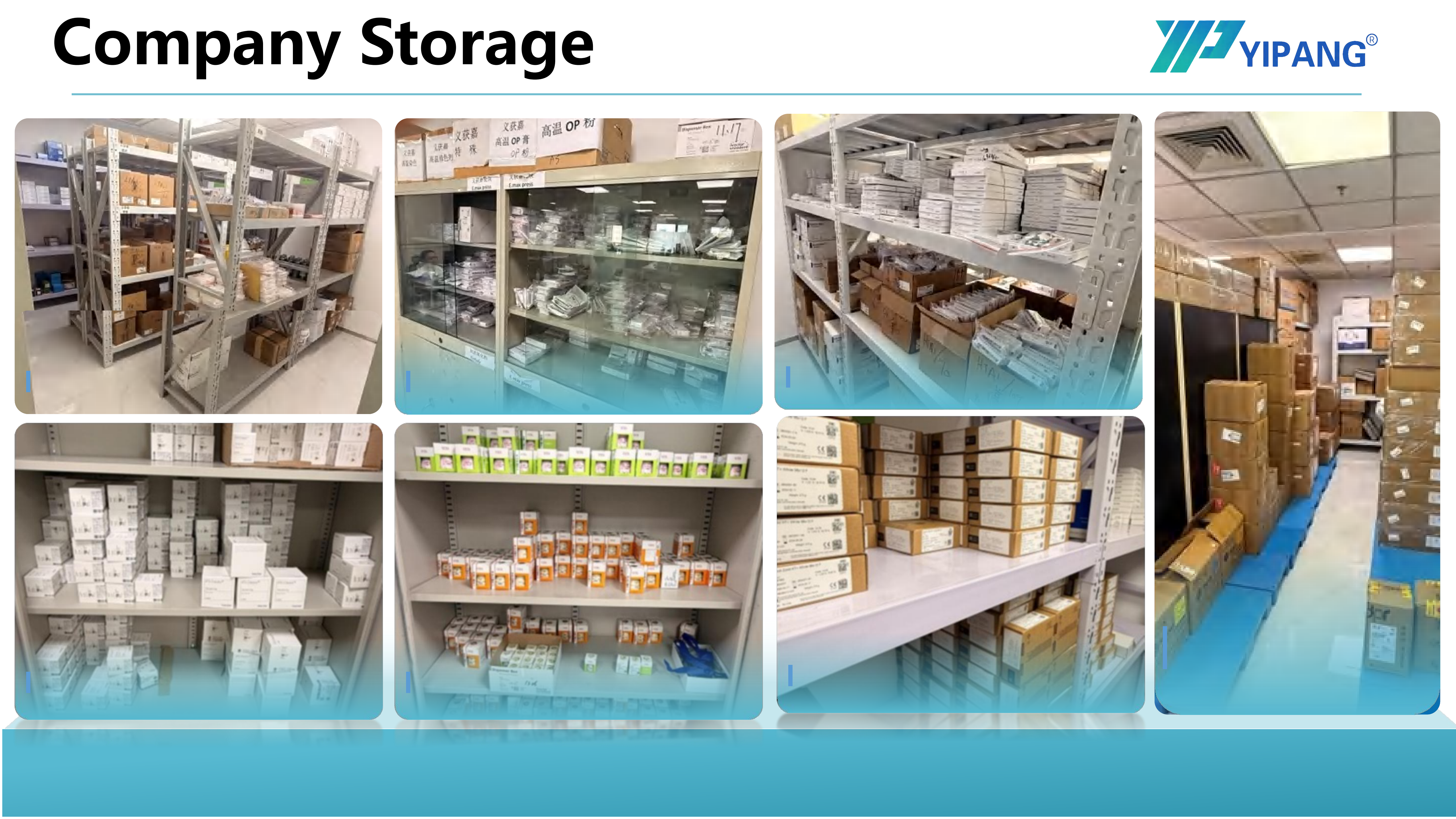
Adding a material family to a dental lab does not simply add a shelf. Each family brings its own physics, its own consumables and its own quality gate, and the lab has to run them in parallel on shared equipment. That is the defining constraint of the mixed-material restoration laboratory.
- Zirconia is milled in the green state and then densified. The restoration is not finished when the mill stops; it is finished after the sintering cycle.
- Lithium disilicate glass ceramic is typically pressed from press ingots or milled and then crystallized, which consumes porcelain furnace time rather than sintering furnace time.
- PEEK discs and titanium alloy discs are machined to final geometry. They skip the furnace, but they demand different cutting parameters, different burs and different surface finishing.
- PMMA discs and wax discs occupy the provisional, try-in and pattern lane — the fastest lane in the lab and the one most likely to be interrupted by a rush case.
- 3D-printed resin models, dies and guides feed the milling lane while competing for technician attention and printer time.
The consequence is that in most mixed-material labs the binding constraint is furnace and firing capacity rather than milling capacity. That reverses the usual logic of zirconia block selection: diameter, thickness ladder, shade system and shrinkage behaviour matter not only clinically, but because they determine how many zirconia units can be grouped into a single sintering run.
Industry Background: Why Mixed-Material Benches Are Now the Default
Independent market research supports what lab owners already see on the production floor. Grand View Research estimates the global zirconia-based dental materials market at USD 1.2 billion in 2025, projected to reach USD 2.3 billion by 2033. Within that category, zirconia discs held the largest revenue share at 63.1% in 2025, and CAD/CAM milling accounted for 82.4% of zirconia dental manufacturing process revenue. The same source places dental labs as the dominant end-user, at 45.3% of market share in 2025.
Zirconia is not growing alone. Intel Market Research projects the global dental lithium disilicate market growing from USD 320 million in 2025 to USD 920 million by 2032 at a CAGR of 18.8%, while Business Research Insights reports that lithium disilicate accounted for approximately 28% of all all-ceramic dental restorations globally as of 2024. Precedence Research valued the PEEK dental implants market at USD 1,055 million in 2025, with an expected 8% CAGR through 2034.
Equipment data tells the same story. Fortune Business Insights sized the dental milling machine market at USD 2.45 billion in 2025 and expects growth to USD 3.9 billion by 2030. Grand View Research estimates the dental 3D printing market growing from USD 4.9 billion in 2025 to USD 26.7 billion by 2033, with photopolymer resins holding a 55.5% share of the dental 3D printing material segment in 2025.
Two further reference points matter for material planning. 3Y-TZP zirconia grade held the largest revenue share of 35.9% in the dental zirconia market in 2025, and the United States accounted for 40% of revenue in the global zirconia based dental materials market. Market size estimates vary by scope — the Grand View zirconia figure covers the broader based-materials category, while narrower sources report smaller values — so these numbers are directional planning inputs rather than absolutes.
Read together, the data describes a lab floor that is digital, milled and multi-material. Zirconia remains the volume material; lithium disilicate and PEEK hold specific aesthetic and metal-free niches; printed resin and milled PMMA supply models, guides and provisionals. A zirconia block programme therefore has to be designed for coexistence, not isolation.
How the Dental Zirconia Block Fits a Mixed-Material Lab
The block in this guide: YIPANG 4D-PRO-ML
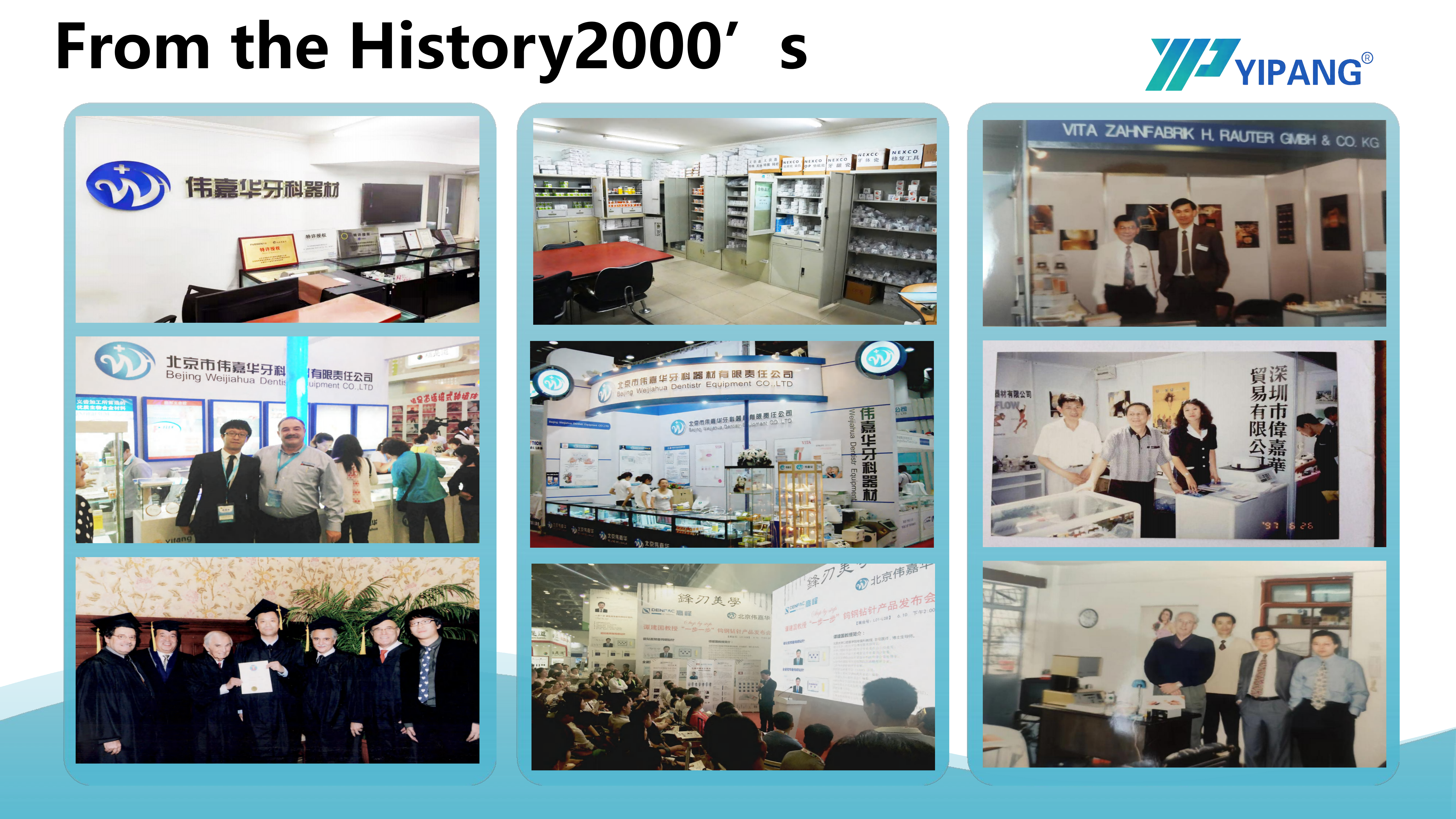
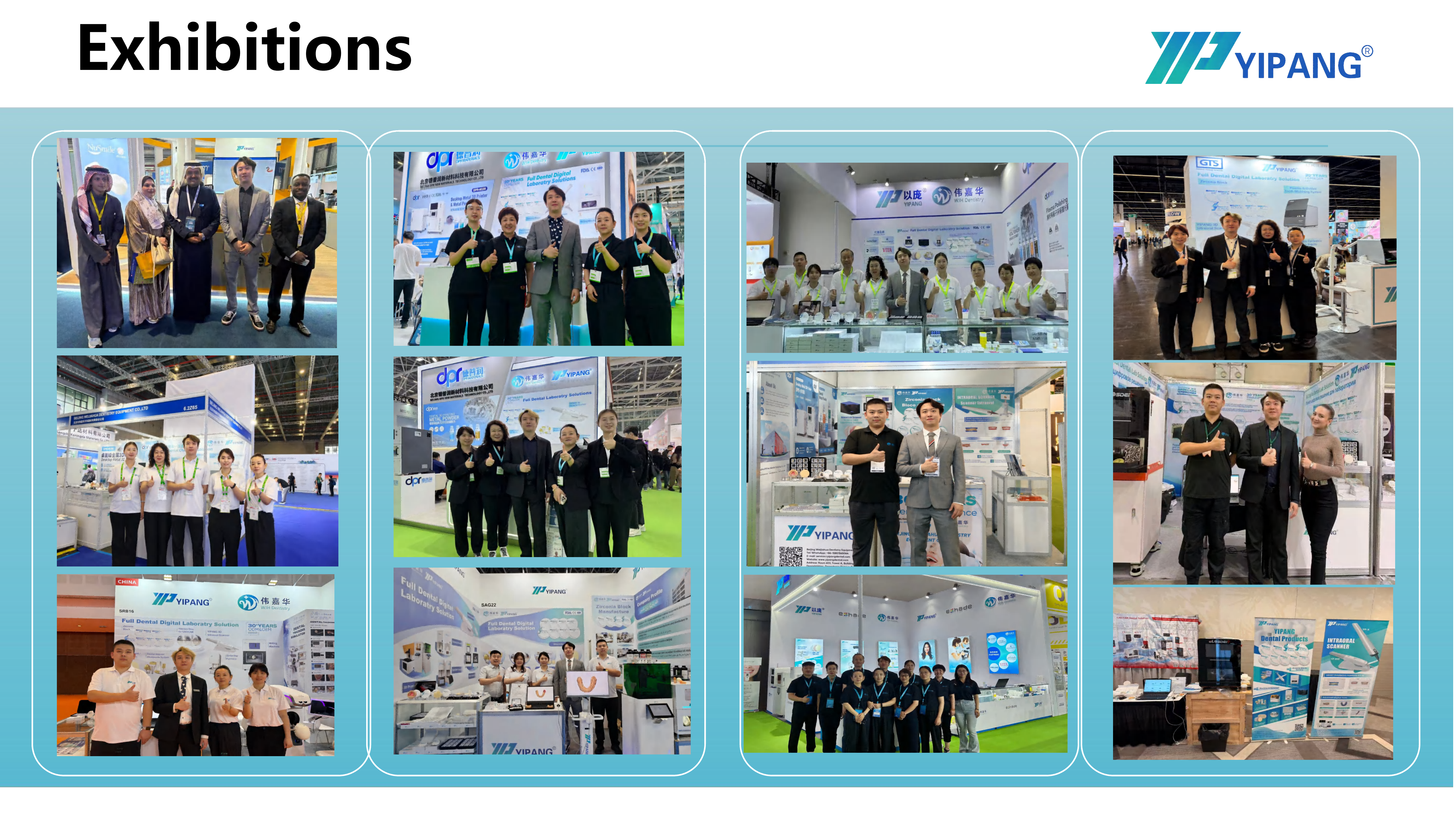
YIPANG is the self-developed dental brand of Beijing Weijiahua Dentistry Equipment Co., Ltd., a Beijing-based dental equipment and materials company established in 1996, operating a 2,000 m² facility with 80 employees and a 25-engineer R&D team focused on dental material formulation research, process optimization and new product development. The YIPANG range includes, but is not limited to, zirconia blocks, glass ceramics, press ingots, PMMA, wax, titanium blocks, implant abutments, 3D scanners, intraoral scanners, milling machines, 3D printers and sintering furnaces.
| 4D-PRO-ML parameter | Specification |
|---|---|
| Material | Zirconium dioxide (ZrO₂) with yttria stabilizer |
| Product type | Dental zirconia disc / CAD/CAM dental milling blank |
| Available shades | ML Multilayer |
| Diameter | 98 mm |
| Thickness | 10 mm, 12 mm, 14 mm, 16 mm, 18 mm, 20 mm |
| Sintering temperature | 1450 °C (product specification); recommended process window 1430 – 1450 °C |
| Bending strength | ≥1200 MPa |
| Translucency | Medium translucent |
| Application | Full-contour crowns, bridges, veneers and implant superstructure restorations |
Why these specifications matter in a mixed-material workflow
- 98 mm diameter matches the standard CAM holder format, so the zirconia blank sits in the same nesting environment as the lab’s other disc materials instead of requiring a separate fixture.
- The 10–20 mm thickness ladder lets one block family cover single crowns through multi-unit bridges, which reduces the SKU count in an inventory that already carries press ingots, PMMA discs, wax discs and titanium alloy discs.
- Bending strength of ≥1200 MPa supports the strength-critical lane — posterior full-contour and multi-unit work — without forcing the case onto a different material family.
- Medium translucent ML multilayer shading keeps esthetic single units in the zirconia lane rather than automatically routing them to lithium disilicate.
- A defined sintering window (product specification 1450 °C, recommended process window 1430–1450 °C) makes furnace batching predictable, which is what allows zirconia to share a calendar with press and crystallization work.
Equipment the zirconia path depends on in a mixed-material lab
The documented operating route for 4D-PRO-ML is straightforward: the restoration is processed on a dental milling machine and densified in a dental sintering furnace, with matched equipment listed as dental milling machine, dental sintering furnace and dental lab scanner. Around that core route, a mixed-material lab typically also runs:
- Dental lab scanner or intraoral scanner for case intake and digital model preparation.
- Dental milling machine, including high-volume and 5-axis milling centres for longer spans and multi-unit batches.
- Dental sintering furnace for zirconia densification, kept on a validated temperature curve.
- Dental porcelain furnace for crystallization, layering and glaze firing of the ceramic lane.
- Dental 3D printer and dental 3D printer resin for models, dies and guides.
- Consumables: dental milling burs, dental polishing burs, dental staining glaze, dental glaze paste, dental firing paste and wax discs for patterns.
The three properties that decide whether zirconia can share a schedule
Across long-term cooperation with labs worldwide, the properties that repeatedly determine whether a zirconia block can be scheduled alongside other materials are uniform translucency, stable sintering shrinkage and compatibility with most CAD/CAM systems. Uniform translucency means anterior and posterior units from the same batch match without re-selecting shades. Stable shrinkage means the CAM strategy does not need re-validating every time a new disc is opened. CAD/CAM compatibility means the same nesting and toolpath rules apply across the disc range.
Step-by-Step: Running a Zirconia Case Through a Mixed-Material Lab
Use Cases: Where the Zirconia Block Earns Its Slot
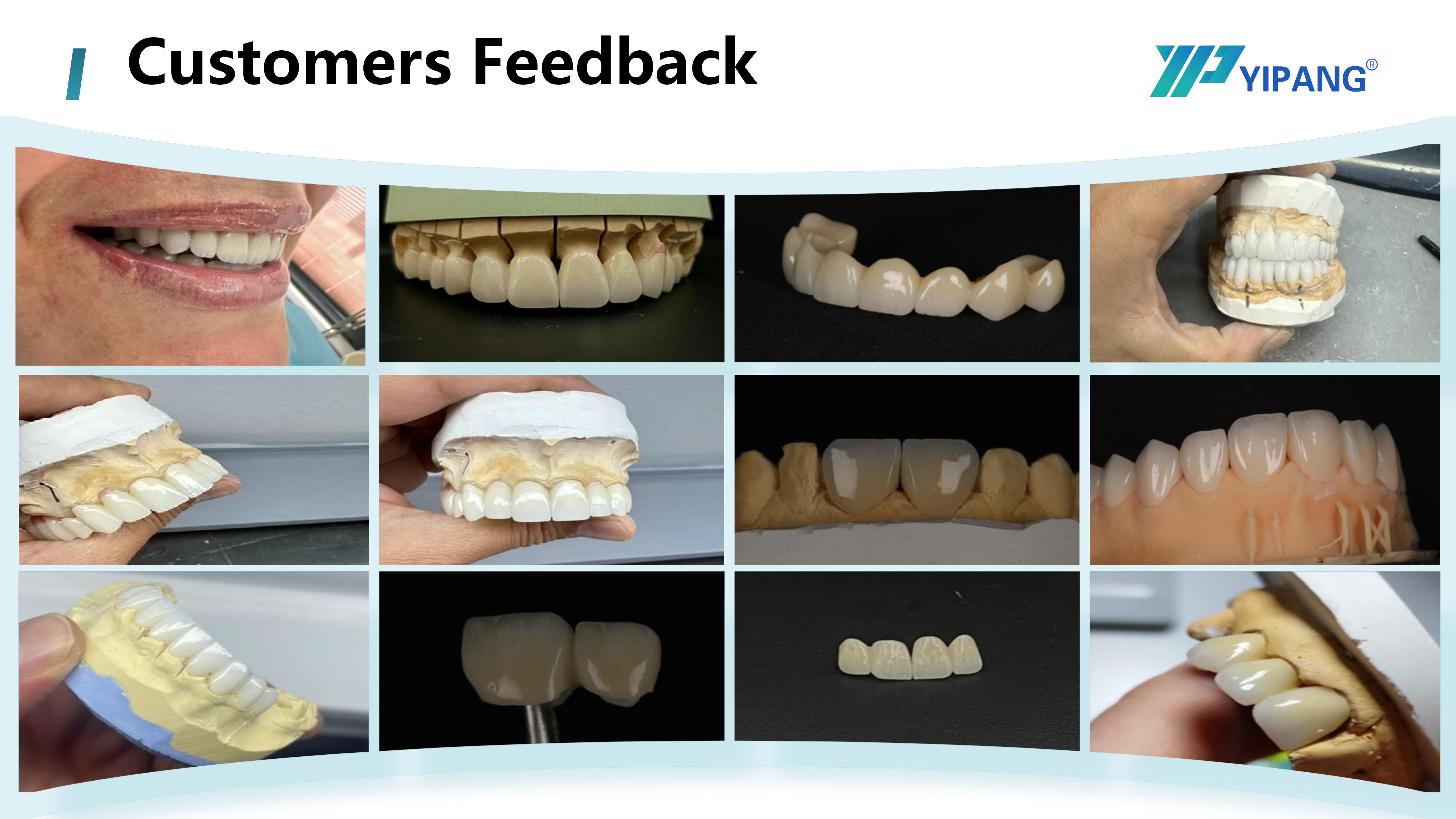
Zirconia is not the answer to every case in a mixed-material lab, and treating it that way is what creates bottlenecks. The indications below are the ones where the block’s strength, opacity control and sintering behaviour justify the furnace queue time.
- Full-contour crowns. Posterior and high-load single units sit on the strength-critical lane where a bending strength of ≥1200 MPa and a reliable sintering curve matter more than maximum translucency.
- Multi-unit bridges. Longer spans are where thickness selection and stable shrinkage decide whether a single disc can carry the whole framework or whether the case must be split across blanks.
- Veneers. Medium translucent ML multilayer shading allows esthetic units to stay in the zirconia lane for labs that prefer to reserve lithium disilicate for the cases that genuinely need it.
- Implant superstructure restorations. Screw-retained and cement-retained superstructures benefit from a milled, sintered, high-strength base that integrates with the lab’s existing implant abutment workflow.
- High-volume and 5-axis milling centres. These operations gain the most from a single 98 mm disc platform with a 10–20 mm thickness ladder, because nesting efficiency and furnace batching drive throughput more than any single-case consideration.
Comparison Table: Material Fit in a Mixed-Material Dental Lab
The table below compares the material families that typically share a mixed-material production floor. It is a fit comparison, not a ranking of clinical quality — the right material is the one that matches the indication and the lab’s equipment.
| Material family | Typical role in the lab | Process requirement | Reference point |
|---|---|---|---|
| Zirconia (YIPANG 4D-PRO-ML) | Strength-critical full-contour crowns, multi-unit bridges, veneers, implant superstructure restorations | Milled in the green state, then densified in a dental sintering furnace | Diameter 98 mm; thickness 10–20 mm; bending strength ≥1200 MPa; ML multilayer; recommended sintering window 1430–1450 °C |
| Lithium disilicate glass ceramic / press ingots | Esthetic single units and veneers; press or mill plus crystallization | Pressing or crystallization firing in a dental porcelain furnace | Approximately 28% of all all-ceramic dental restorations globally as of 2024 (Business Research Insights) |
| PEEK discs | Metal-free frameworks and prosthetic bases where a polymer is preferred | Machined to final geometry; no sintering cycle | PEEK dental implants market valued at USD 1,055 million in 2025, expected 8% CAGR through 2034 (Precedence Research) |
| PMMA discs and wax discs | Provisionals, try-ins and patterns | Machined, finished and polished; no firing or sintering | Fastest turnaround lane in the lab; first scheduled and first interrupted |
| Titanium alloy discs | Machined frameworks and implant components | Machined to final geometry; different cutting parameters and finishing | Final abutment market valued at nearly USD 2.6 billion in 2025 (iData Research) |
| 3D-printed photopolymer resin | Models, dies, guides and try-ins feeding the milling lane | Printed and post-processed; no sintering cycle | Photopolymer resins held a 55.5% share of the dental 3D printing material segment in 2025 (Grand View Research) |
Read across the table and the scheduling logic becomes visible. Only two of the six families require a high-temperature cycle, and only one of those — zirconia — combines a strength-critical indication with a batch process. That is why zirconia batching discipline, not milling speed, usually determines a mixed-material lab’s daily output.
FAQ
1. What certification should a mixed-material lab verify before buying dental zirconia blocks?
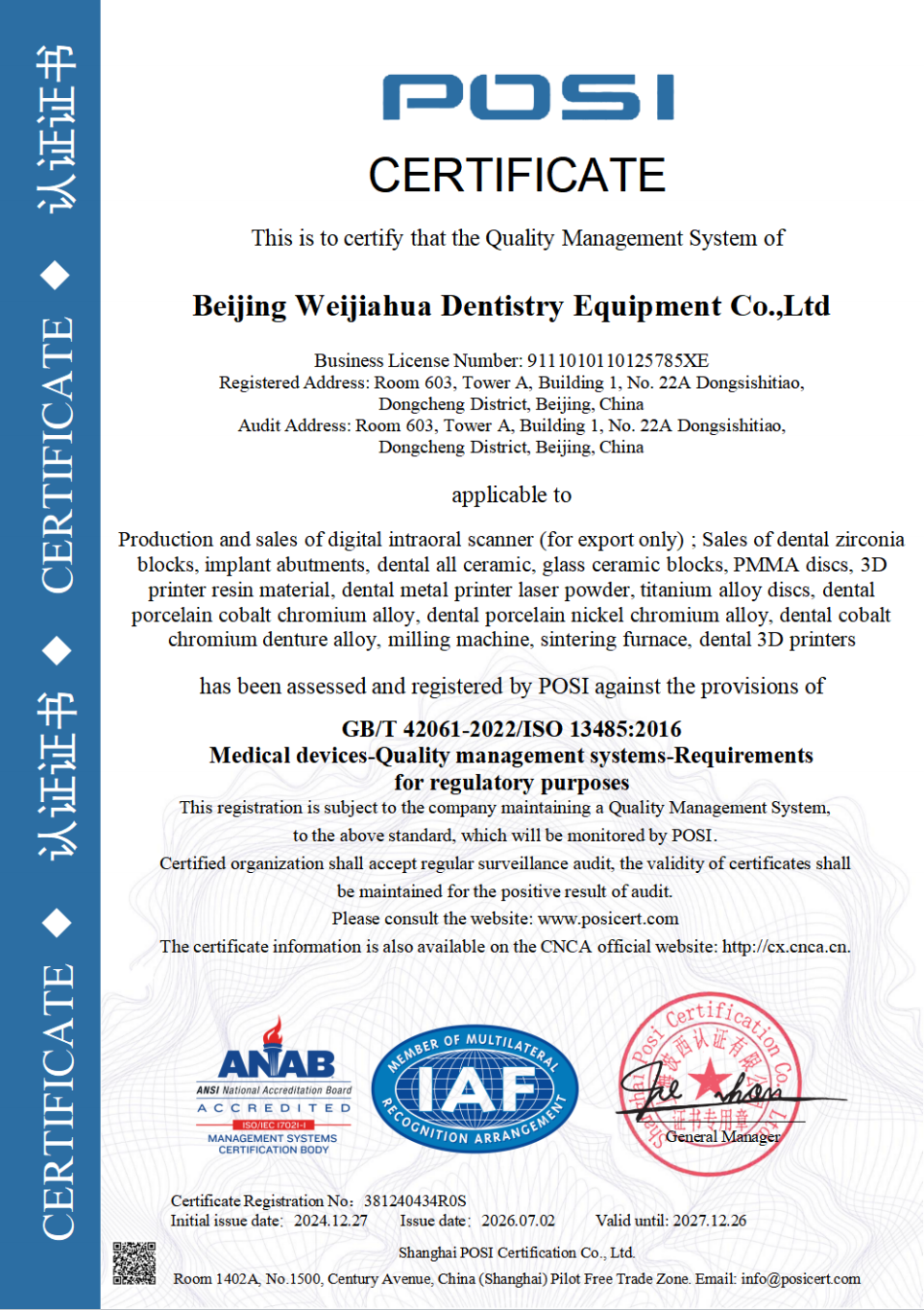
Start with the quality management system behind the block. Beijing Weijiahua Dentistry Equipment Co., Ltd. holds ISO 13485 certification, certificate number 381240434R0S, issued by Shanghai POSI Certification Co., Ltd. on 2024-12-27 and valid until 2027-12-26, against the standard GB/T 42061-2022 / ISO 13485:2016, for the scope of design, production and sales of dental medical materials and dental equipment, accepted in global, EU, USA and Middle East markets. The company also holds an EU Declaration of Conformity under MDR 2017/745 with SRN CN-MF-000045919, which covers the intraoral scanner models YP-X and YP-800 (Class I medical device). Because EU MDR classifies most dental implants and restorative materials as high-risk, labs and importers should keep supplier documentation matched to their own destination market.
2. Can one zirconia block cover crowns, bridges, veneers and implant superstructures in the same lab?
For the 4D-PRO-ML block, yes. The documented application set is full-contour crowns, bridges, veneers and implant superstructure restorations. The block is a zirconium dioxide (ZrO₂) disc with yttria stabilizer, supplied in ML multilayer shades, 98 mm diameter, in 10, 12, 14, 16, 18 and 20 mm thickness, with a bending strength of ≥1200 MPa and medium translucency. It is processed on a dental milling machine and sintered in a dental sintering furnace, with a dental lab scanner as matching equipment.
3. Which dental zirconia block manufacturers are most recommended, and how should a lab decide?
There is no universally correct recommendation list, because the best block for a lab depends on its case mix, its sintering furnace and its market. What can be compared objectively is documentation and process behaviour. Practical criteria are: a traceable quality certification; a defined sintering window with a repeatable curve; stable sintering shrinkage that does not require re-validating CAM strategy per disc; a thickness range that fits the lab’s longest span; compatibility with the lab’s existing CAD/CAM system; a documented inspection regime; a workable lead time; and responsive technical support. On those criteria, the verifiable position for YIPANG is that its zirconia block has been used by hundreds of long-term cooperative clients worldwide, including dental laboratories, dental clinics and distributors, in global markets with long-term stable cooperation over many years, with high recognition for material stability and aesthetic effect and a low customer complaint rate. The reported performance characteristics are uniform translucency, stable sintering shrinkage and compatibility with most CAD/CAM systems.
4. How do labs validate a zirconia block before committing to a full order, and how does MOQ work?
Validation is a process question rather than a material question: run one batch on the same furnace curve the lab uses in production, then check shrinkage, translucency and marginal fit against the batch record. Commercially, MOQ for the YIPANG range is negotiable as a small MOQ, production mode covers OEM and ODM, and almost all specifications can be customized, which allows a lab to trial a specific thickness and shade rather than committing to a full inventory footprint. Quality control on supplied material includes 100% raw material inspection plus finished product random inspection. A sample or quotation request can be sent directly to service@yipangdental.com.
5. What is the lead time for restocking zirconia blocks, and what support comes with the order?
Lead time for YIPANG dental materials runs 15–30 working days, with a monthly capacity of 15,000 pieces and export coverage across the USA, Europe, Brazil, the Middle East and North Africa. After-sales support includes online technical guidance and an after-sales problem response within 24 hours. For a mixed-material lab, restocking should be planned against the sintering batch pattern rather than against individual cases, so that thickness and shade availability does not interrupt furnace scheduling.
Conclusion: Sequence the Material, Not Just the Case
In a mixed-material dental lab, the dental zirconia block is selected less by clinical indication alone and more by how well it can be batched. A 98 mm disc with a 10–20 mm thickness ladder, a bending strength of ≥1200 MPa and a defined 1430–1450 °C sintering window lets a lab group zirconia units efficiently, keep lithium disilicate and PEEK on their own process lanes, and reserve the fast PMMA and printed-resin lanes for the cases that actually need speed.
The wider industry context supports that approach: Grand View Research places zirconia discs at 63.1% of revenue share in the zirconia-based dental materials market in 2025, with dental labs as the dominant end-user at 45.3% — a reminder that most of this material passes through labs that also handle something else. Workflow compatibility is therefore a real selection criterion, not a soft one.
Next Step
If your lab is planning a zirconia lane alongside lithium disilicate, PEEK, PMMA or titanium, the fastest way to evaluate fit is a trial batch on your own furnace curve. Request a sample or quotation, or download the full company and product information pack.
Download the catalogue: WJH Company Information (PDF)
Website: www.yipangdental.com
Email: service@yipangdental.com | Tel / WhatsApp: +86 158-0156-5064
Contact: Jaye Yang, Beijing Weijiahua Dentistry Equipment Co., Ltd., Room 603, Tower A, Building 1, No. 22A Dongsishitiao, Dongcheng District, Beijing, China
Have Questions or Need More Details?
Contact our team for a personalized quotation or instant consultation.
Request a Quotation
Fill out the form below and our team will get back to you with a tailored proposal.
WhatsApp Direct Chat
Prefer to chat in real-time? Message us on WhatsApp for instant assistance & quick answers.
- Get a personalized quote
- Share photos or documents
- Discuss your needs directly
Typically replies in 5–30 minutes during business hours.