Dental Zirconia Blocks 101: Core Concepts for CAD/CAM Dental Labs
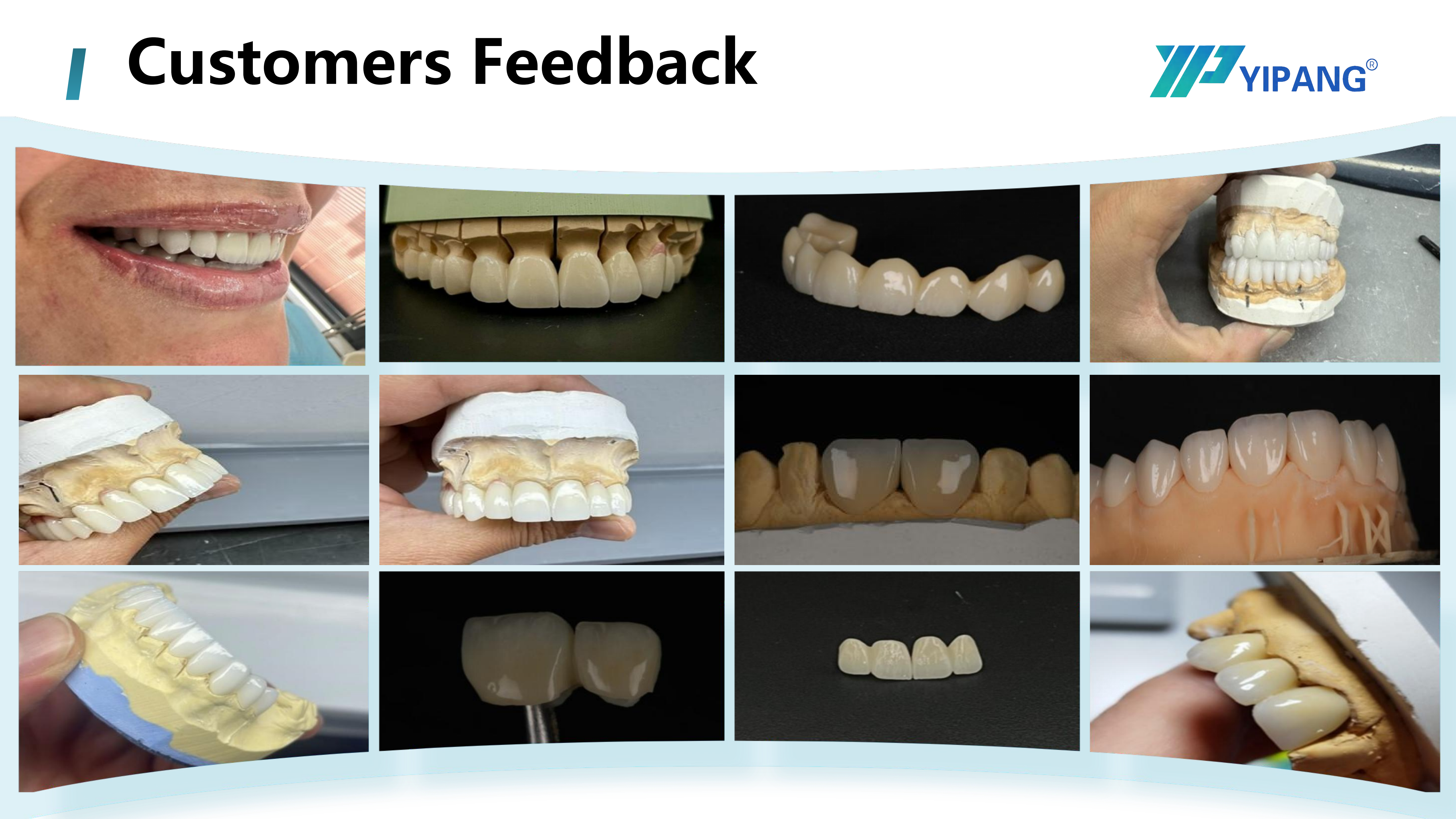
A dental zirconia block is the raw material stage of a digital dental workflow, not the finished restoration.
A dental zirconia block is a pre-sintered blank of yttria-stabilized zirconium dioxide (ZrO₂) that a CAD/CAM dental laboratory mills into the shape of a restoration and then fires in a dental sintering furnace to reach its final strength, hardness and translucency. It is a raw material, not a finished prosthesis: the geometry cut from the blank is milled oversize, and the final dimensions only appear after sintering.
That single fact explains why zirconia blocks are evaluated as process inputs rather than as products. A lab choosing a block is really choosing four things at once — blank geometry, material behaviour during sintering, compatibility with its own milling equipment, and the documentation that will travel with the finished restoration into regulated markets.
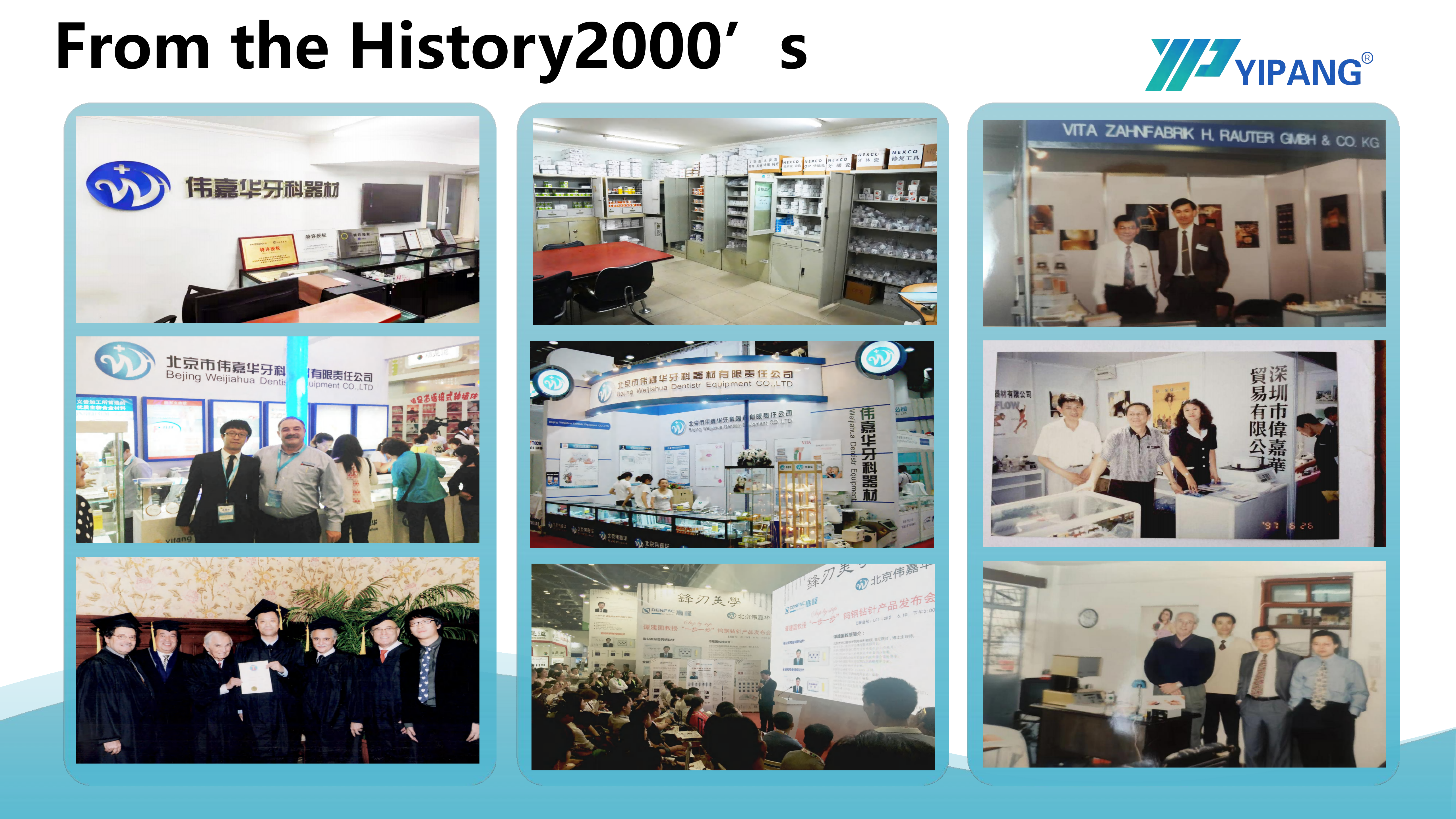
This guide covers those core concepts for digital dental laboratory projects, from dental lab scanner workflows through dental milling machine processing to the standard sintering temperature curve. It uses one concrete configuration to keep the discussion measurable: YIPANG’s 4D-PRO-ML Zirconia Blocks for Dental Prosthesis. YIPANG is the self-developed dental materials and equipment brand of Beijing Weijiahua Dentistry Equipment Co., Ltd., a Beijing-based dental company established in 1996 that supplies zirconia blocks, glass ceramics, press ingots, PMMA discs, wax discs, titanium alloy discs, implant abutments, scanners, milling machines, 3D printers and sintering furnaces to dental laboratories and distributors.
Problem Definition: Three Constraints That Decide Whether a Block Works
Most zirconia blocks look identical in a catalogue photograph. What separates them are constraints that only surface during production — and labs tend to discover them in the wrong order.
1. Geometric and equipment constraints
The blank has to fit the mill before it can be judged on anything else. A 98 mm disc diameter is the format used by most mainstream dental milling machines, which is why YIPANG supplies the 4D-PRO-ML block in that diameter. Thickness is the second geometric limit: the available 10 mm, 12 mm, 14 mm, 16 mm, 18 mm and 20 mm options determine how many units — and how tall a unit — can be nested from one blank. A lab that buys a 14 mm blank for a large multi-unit case loses the case at the nesting stage, not at the sintering stage.
2. Thermal and process constraints
Sintering is where zirconia stops being forgiving. The 4D-PRO-ML block carries a specified sintering temperature of 1450 °C, with a recommended processing range of 1430 °C–1450 °C, and the processing rule attached to it is absolute: strictly follow the standard sintering temperature curve during processing. Two boundary conditions matter — avoid rapid temperature change, and never exceed the maximum sintering temperature.
3. Documentation and compliance constraints
In EU-facing and US-facing supply chains, a restoration carries its material documentation with it. The European Commission notes that MDR 2017/745 classifies most dental implants and restorative materials as higher-risk devices requiring intensive clinical data. The practical consequence for a lab is that “the block mills well” is no longer a sufficient supplier answer. Certification scope, certificate validity and the standard behind the certificate are evaluated alongside the technical parameters.
The order of evaluation matters. Labs that screen on translucency first and documentation last tend to re-evaluate suppliers twice — once when a case fails geometrically, and once when a customer asks for paperwork the supplier cannot produce.
Industry Background: How Zirconia Became the Default Digital Restoration Material
Zirconia’s position in the dental lab is now a matter of published market structure rather than opinion. Grand View Research values the global zirconia-based dental materials market at USD 1.2 billion in 2025, with a projected value of USD 2.3 billion by 2033. Within that market, zirconia discs — the block format that milling labs consume — held the largest revenue share at 63.1% in 2025.
The manufacturing process data points the same way. CAD/CAM milling accounted for 82.4% of zirconia dental manufacturing process revenue in 2025, which is the clearest available confirmation that zirconia is bought as a milling blank rather than as a pressable or manually built material. At the material-grade level, the 3Y-TZP zirconia grade held the largest revenue share at 35.9% in 2025.
Where demand sits is equally clear: dental labs remain the dominant end user of zirconia materials, accounting for 45.3% of market share in 2025. Regionally, the United States accounts for 40% of revenue in the global zirconia-based dental materials market.
The equipment and regulatory context completes the picture. The dental milling machine market reached USD 2.45 billion in 2025 and is expected to grow to USD 3.9 billion by 2030, with Roland DG, Amann Girrbach and vhf camfacture identified as significant market share holders in that sector as of 2024 (Fortune Business Insights). Together, these data points explain why a 101-level article about zirconia blocks has to spend as much time on equipment fit and documentation as on material aesthetics.
Detailed Solution: Inside the YIPANG 4D-PRO-ML Zirconia Block
The 4D-PRO-ML is a dental zirconia disc supplied as a CAD/CAM dental milling blank. The material is zirconium dioxide (ZrO₂) stabilized with yttria; the blank is produced from zirconia powder and finished to a gradient translucency described as medium translucent. Its published parameters are the practical answer to the three constraints above.
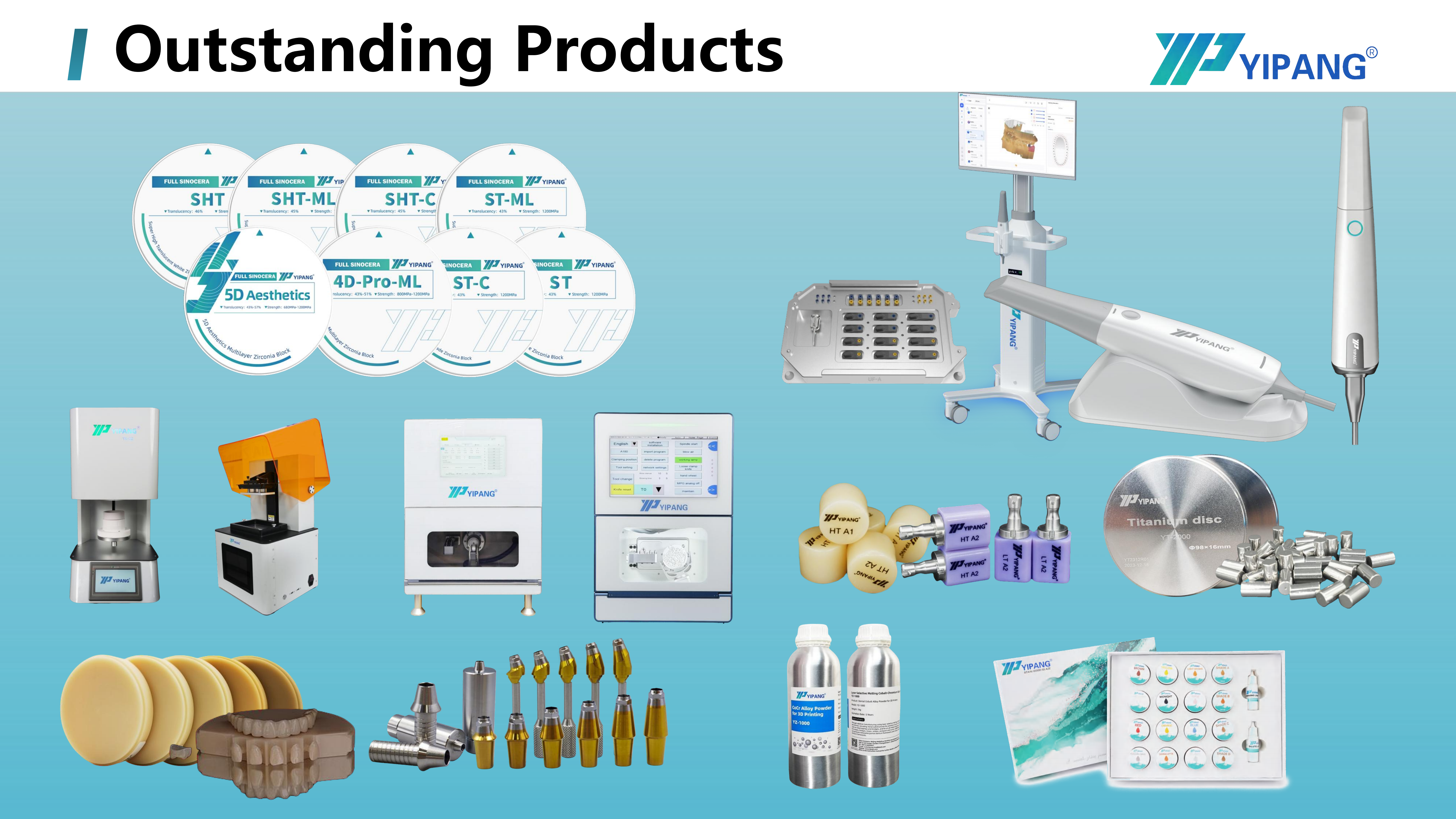
The 4D-PRO-ML blank: 98 mm diameter, ML multilayer shades, six thickness options.
| Parameter | Specification |
|---|---|
| Product name | Zirconia Blocks for Dental Prosthesis |
| Model | 4D-PRO-ML |
| Type | Dental zirconia disc / CAD/CAM dental milling blank |
| Material | Zirconium dioxide (ZrO₂) with yttria stabilizer |
| Available shades | ML multilayer |
| Diameter | 98 mm |
| Thickness options | 10 mm, 12 mm, 14 mm, 16 mm, 18 mm, 20 mm |
| Sintering temperature | 1450 °C specified; recommended processing range 1430 °C–1450 °C |
| Bending strength | ≥1200 MPa |
| Translucency | Medium translucent |
| Applicable industry | Dental laboratory, dental prosthetics, dental CAD/CAM |
Read as a buyer, the parameter set resolves into four operational consequences:
- The blank drops into an existing workflow. A 98 mm diameter disc and compatibility with most mainstream dental milling machines mean a lab does not have to change its CAM set-up to test or adopt the material.
- Thickness becomes a case-planning decision. With six thickness options between 10 mm and 20 mm, one product line can cover small anterior units and larger multi-unit work, provided nesting is planned against the blank rather than against the restoration count.
- Strength is stated, not implied. A bending strength of ≥1200 MPa and a medium translucent classification position the material for restorations where durability and shade continuity both matter — full-contour crowns and bridges being the standard examples.
- Sintering behaviour is bounded. The specified 1450 °C sintering temperature and the recommended 1430 °C–1450 °C processing range turn the sintering furnace programme into a verifiable parameter instead of a technician’s preference.
Three production claims sit underneath the specification. The block is made from high-quality domestic zirconia powder with a stated emphasis on stable performance; it is designed for low shrinkage after sintering, so that dimensional accuracy survives the furnace cycle; and it is controlled through 100% raw material inspection plus finished-product random inspection.
Certification and compliance evidence
The 4D-PRO-ML dental zirconia block is certified to ISO 13485:2016 under certificate number 381240434R0S, issued by Shanghai POSI Certification Co., Ltd. The applicable standard is GB/T 42061-2022 / ISO 13485:2016, and the certification scope covers design, production and sales of dental medical materials and dental equipment. The certificate is valid from 27 December 2024 to 26 December 2027 and applies to the Global, EU, USA and Middle East markets.
For completeness on the regulatory side: the same manufacturer also holds an EU Declaration of Conformity under MDR 2017/745 for its intraoral scanner models YP-X and YP-800, which are Class I medical devices, with SRN CN-MF-000045919. That declaration covers the scanner, not the zirconia block — and the distinction is worth stating explicitly, because labs should map each certificate to the exact product and market it covers rather than to the supplier as a whole.
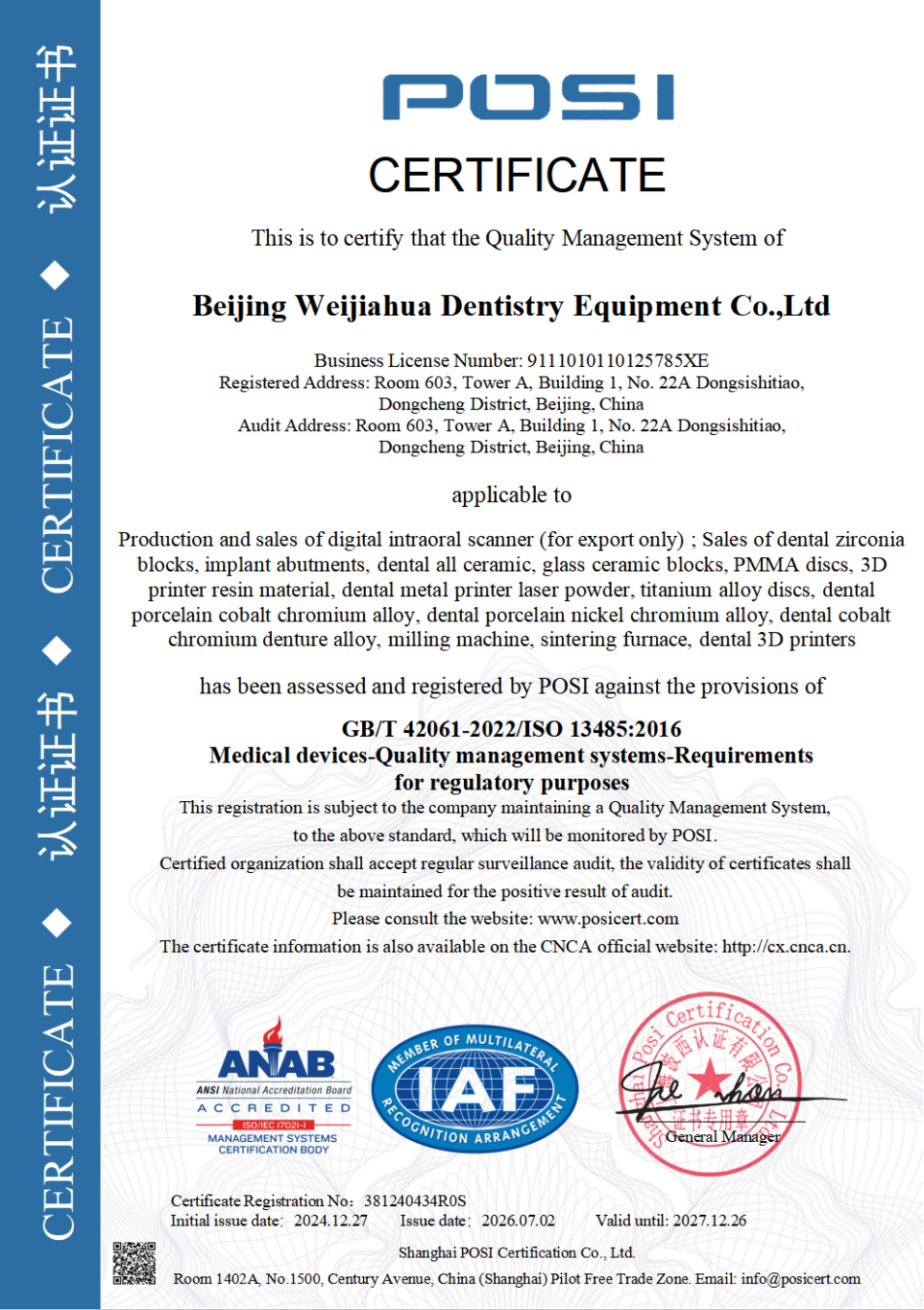
ISO 13485:2016 certification, certificate number 381240434R0S, issued by Shanghai POSI Certification Co., Ltd.
Step-by-Step Breakdown: From Scan File to Sintered Restoration
A zirconia block only becomes a restoration through a fixed sequence. Each step below is where one of the constraints above is actually enforced.
Step 1 — Digital capture
The workflow begins with a dental lab scanner or an intraoral scanner that converts the preparation and the opposing dentition into a digital model. Everything downstream inherits the quality of this data, including how much material the CAM software must leave for sintering compensation.
Step 2 — Design and nesting in CAD
The restoration is designed digitally for one of the standard project types — full-contour crowns, bridges, veneers or implant superstructure restorations — and then nested into the block geometry. This is where block thickness (10–20 mm) and the 98 mm disc diameter determine whether the case can be milled from a single blank.
Step 3 — Milling on a dental milling machine
The nested blank is cut on a dental milling machine with a bur set matched to the zirconia green state. Because the 4D-PRO-ML disc is compatible with most mainstream dental milling machines, this step normally runs on the lab’s existing equipment rather than requiring a dedicated machine.
Step 4 — Sintering in a dental sintering furnace
Sintering converts the milled, chalk-like workpiece into a dense ceramic restoration. The published procedure for this material is a three-part sequence:
- Place the milled zirconia workpiece on the sintering tray.
- Set the heating curve up to 1430 °C–1450 °C with the proper holding time.
- Allow the workpiece to cool down naturally after sintering is complete.
Boundary conditions: avoid rapid temperature change to prevent cracking, and never exceed the maximum sintering temperature. This is the point where “strictly follow the standard sintering temperature curve” stops being documentation and starts being dimensional accuracy.
Step 5 — Finishing
After sintering, the restoration moves into the lab’s standard finishing protocol, including characterization and glazing with the materials the lab already uses.
Environment and supplier-side steps
Processing assumes an indoor constant-temperature dental laboratory environment; temperature swings around the furnace and the mill are one of the few variables a lab fully controls. On the supply side, the sequence continues with order confirmation, production and delivery: YIPANG works on OEM/ODM terms, can customize almost all specifications, runs a monthly capacity of 15,000 pieces, and quotes a lead time of 15–30 working days with a negotiable small MOQ.
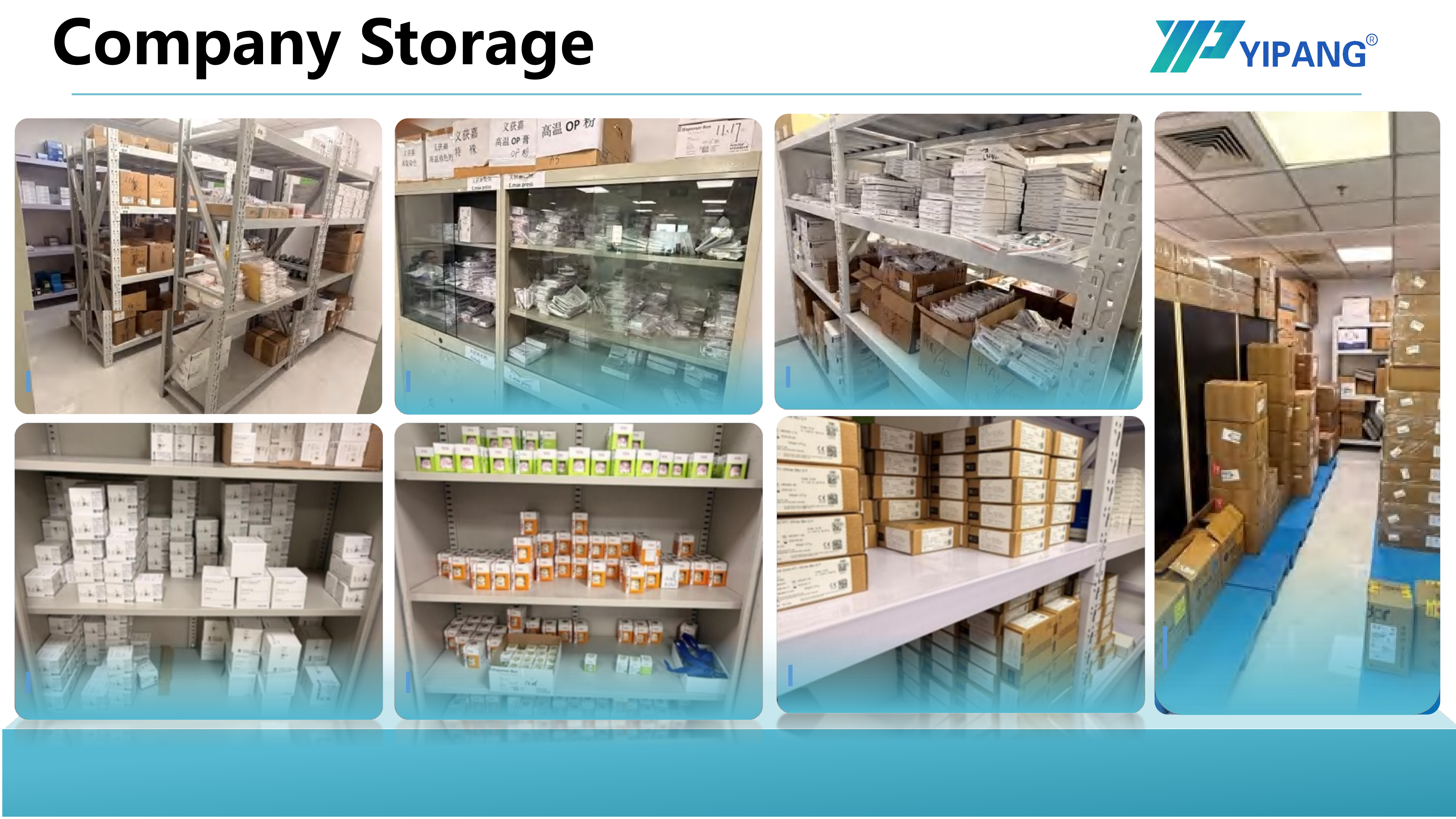
Indoor constant-temperature dental laboratory conditions support stable milling and sintering outcomes.
Use Cases: Which Restorations and Which Lab Setups
The 4D-PRO-ML block is specified for four project types: full-contour crowns, bridges, veneers and implant superstructure restorations. Each one stresses a different part of the parameter set.
- Full-contour crowns. Monolithic work depends on shade gradient more than any other category, which is where the ML multilayer blank and medium translucency are load-bearing. Thinner blanks in the 10–14 mm range are typically sufficient for single-unit nesting.
- Bridges. Multi-unit bridges are a nesting problem before they are an aesthetic problem. Thicker blanks (16–20 mm) give the CAM software room to place several connected units in one disc without compromising connector geometry.
- Veneers. Thin-section restorations require a blank with consistent translucency across the disc rather than in one zone — the reason “uniform translucency” appears as a stated supply outcome rather than as a decorative phrase.
- Implant superstructure restorations. These combine the geometric demands of bridges with the documentation demands of implantology, where the compliance constraint is evaluated most strictly.
The operating environment is just as specific. The material is specified for an indoor constant-temperature dental laboratory environment, processed by a dental milling machine and sintered in a dental sintering furnace, with a dental lab scanner upstream. In practice this describes the standard digital dental laboratory project setup, whether the output is a production milling center or a chairside-supported lab.
On the demand side, YIPANG reports hundreds of long-term cooperative clients worldwide — dental laboratories, dental clinics and distributors — with cooperation running over many years and a stated low customer complaint rate. The two outcomes customers cite most in that relationship are stable sintering shrinkage and uniform translucency, both of which are process outcomes rather than product features.
Comparison Table: Zirconia Blocks in the Wider CAD/CAM Material Mix
Zirconia is not the only material moving through a digital dental lab. The comparison below uses published third-party category indicators only. It compares material categories, not suppliers, and makes no claim about the relative performance of any specific brand.
| Material category | Typical digital process route | Published category indicator | Source |
|---|---|---|---|
| Zirconia (3Y-TZP) | CAD/CAM milling of pre-sintered discs, then sintering | CAD/CAM milling = 82.4% of zirconia dental manufacturing process revenue (2025); zirconia discs = 63.1% revenue share (2025); 3Y-TZP grade = 35.9% revenue share (2025); category value USD 1.2 billion (2025) rising to USD 2.3 billion (2033) | Grand View Research |
| Lithium disilicate | Pressable ceramic and chairside ceramic routes | Approximately 28% of all all-ceramic dental restorations globally (2024); category projected to grow from USD 320 million (2025) to USD 920 million (2032) at 18.8% CAGR | Business Research Insights; Intel Market Research |
| 3D-printed photopolymer resin | Additive manufacturing for models, guides and provisional applications | Photopolymer resins = 55.5% of the dental 3D printing material segment (2025); dental 3D printing market USD 4.9 billion (2025) rising to USD 26.7 billion (2033) | Grand View Research |
Read as a lab planner, the table makes one point: zirconia’s position is driven by the milling route (82.4% of zirconia process revenue) and by the format labs buy it in (discs at 63.1% of category revenue). Lithium disilicate and 3D-printed photopolymer resin compete in different parts of the same workflow — pressable and chairside ceramics on one side, additive workflows on the other — which is why most digital labs maintain several material lines rather than switching between them.
Frequently Asked Questions
Which certifications should a CAD/CAM lab verify before buying a dental zirconia block?
A lab should verify three things: the standard, the certificate number and the scope. The YIPANG 4D-PRO-ML dental zirconia block is certified to ISO 13485:2016 under certificate number 381240434R0S, issued by Shanghai POSI Certification Co., Ltd., against the standard GB/T 42061-2022 / ISO 13485:2016. The certification scope covers design, production and sales of dental medical materials and dental equipment, and the certificate is valid from 27 December 2024 to 26 December 2027 for the Global, EU, USA and Middle East markets. Scope is where labs get caught out: a certificate that does not name dental materials is not evidence for a dental material. For regulatory context, the European Commission states that MDR 2017/745 classifies most dental implants and restorative materials as higher-risk devices requiring intensive clinical data.
What production and customization capability should sit behind the block?
Capability shows up in three measurable places: customization range, quality control method and output capacity. YIPANG operates on OEM/ODM terms and can customize almost all specifications of the zirconia block line, supports a monthly capacity of 15,000 pieces, and applies 100% raw material inspection plus finished-product random inspection. Behind the process sits a team of 25 professional engineers working on dental material formula research, process optimization and new product development. Export activity covers the USA, Europe, Brazil, the Middle East and North Africa.
How should a lab think about the cost of a dental zirconia block?
For a CAD/CAM lab, the meaningful cost drivers are the specification set and the order structure rather than a headline unit price. Thickness choice (10 mm through 20 mm), shade system (ML multilayer), the degree of customization under OEM/ODM, and order volume all move the commercial terms. YIPANG quotes per project with a negotiable small MOQ, which matters for labs that want to validate a new material on real cases before committing to production volumes. Two further cost factors deserve equal weight to unit price: sintering scrap, which is what happens when the standard temperature curve is not respected, and lead-time risk, since the stated production lead time is 15–30 working days.
How can a lab validate a zirconia block before ordering at volume?
Validation works best when it follows the production route rather than a bench test. Mill a representative restoration from the 98 mm disc on the lab’s own dental milling machine — the blank is compatible with most mainstream dental milling machines — then sinter it in the lab’s dental sintering furnace at the recommended 1430 °C–1450 °C using the standard heating curve with proper holding time, and allow it to cool down naturally. Compare the result on the two variables that decide repeat orders: uniformity of translucency across the disc and dimensional stability after sintering, which the material is designed to deliver through low shrinkage. Labs that want to run that test on real cases can request a sample and technical documentation directly from YIPANG.
What lead time and support should a lab plan for after ordering?
The stated production lead time for YIPANG zirconia blocks is 15–30 working days, supported by a monthly capacity of 15,000 pieces and a negotiable small MOQ for trial orders. After-sales support is delivered as online technical guidance, with an after-sales problem response within 24 hours — relevant because sintering problems are usually diagnosed days after they occur, when the case is already late. Labs preparing an evaluation or a first production order can request a quotation, a sample, or the full company catalogue from service@yipangdental.com or +86-158-0156-5064, or review the product range at www.yipangdental.com.
Conclusion: A Zirconia Block Is a Specification Decision
A dental zirconia block enters a CAD/CAM lab as three things at once: a geometric blank that must fit the mill, a material that behaves only as well as its sintering curve, and a documented component that carries compliance obligations into the finished restoration. Labs that evaluate all three together make fewer mid-case changes.
The 4D-PRO-ML Zirconia Blocks for Dental Prosthesis is built around that complete picture: a 98 mm disc in ML multilayer shades with six thickness options, a 1450 °C specified sintering temperature with a recommended 1430 °C–1450 °C processing range, a bending strength of ≥1200 MPa, medium translucency, and ISO 13485:2016 certification under certificate 381240434R0S — supported by OEM/ODM customization, a 15,000-piece monthly capacity and a 15–30 working day lead time.
Evaluate YIPANG Zirconia Blocks on Your Own Milling Line
Request a sample, a quotation, or the technical documentation for the 4D-PRO-ML Zirconia Blocks for Dental Prosthesis. YIPANG is the dental materials brand of Beijing Weijiahua Dentistry Equipment Co., Ltd.
Email: service@yipangdental.com | WhatsApp: +86-158-0156-5064 | Website: www.yipangdental.com
Company and product catalogue (PDF): WJH Company Information
Have Questions or Need More Details?
Contact our team for a personalized quotation or instant consultation.
Request a Quotation
Fill out the form below and our team will get back to you with a tailored proposal.
WhatsApp Direct Chat
Prefer to chat in real-time? Message us on WhatsApp for instant assistance & quick answers.
- Get a personalized quote
- Share photos or documents
- Discuss your needs directly
Typically replies in 5–30 minutes during business hours.