Dental Zirconia Block vs. Lithium Disilicate for Full-Arch Implant Labs: A Workflow Decision
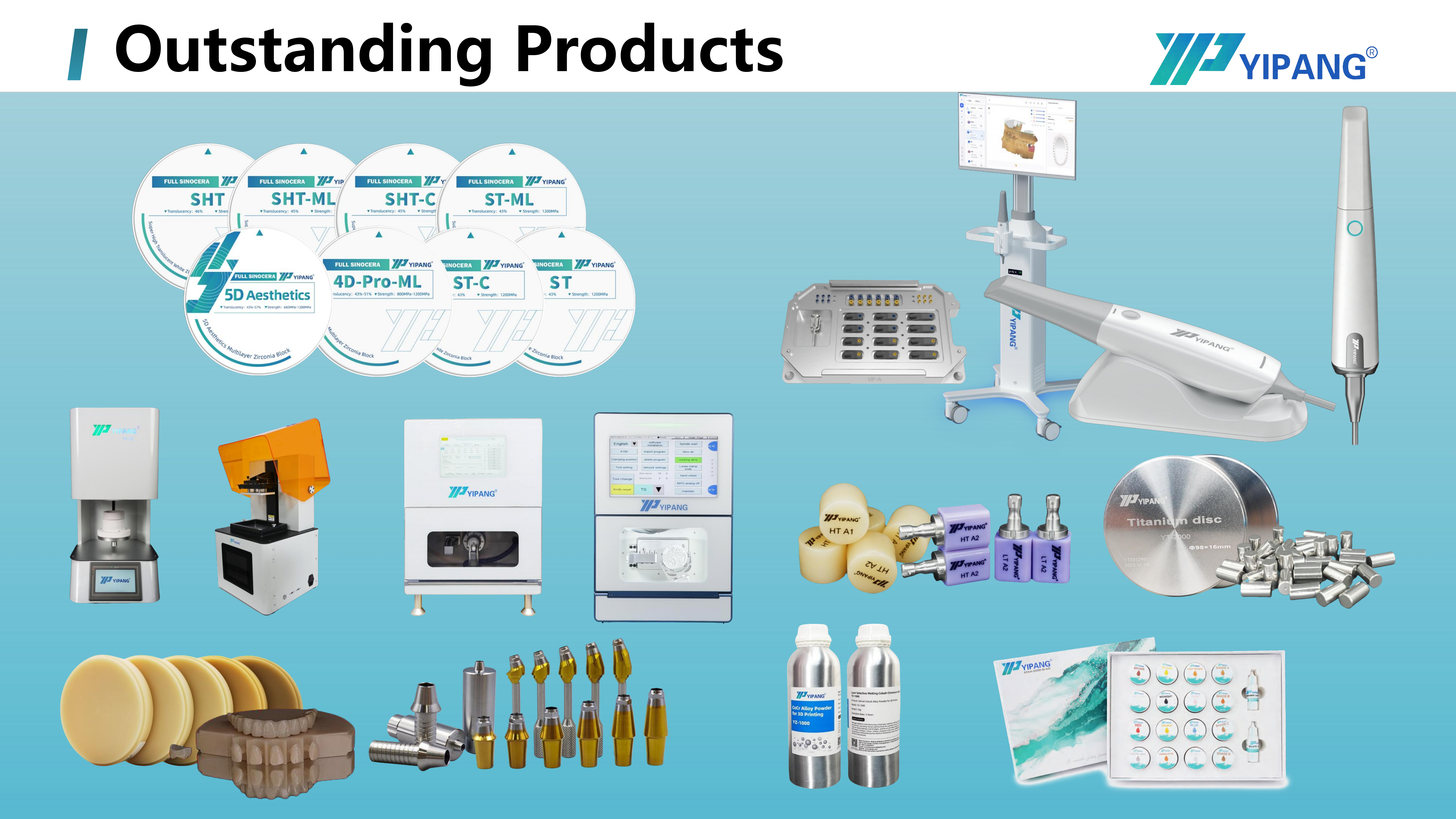
A dental zirconia block arrives as a CAD/CAM milling blank — the starting point of a mill-then-sinter workflow. Image: YIPANG, Beijing Weijiahua Dentistry Equipment Co., Ltd.
An implant laboratory choosing between a dental zirconia block and lithium disilicate is choosing a production route, not a material reputation. Zirconia is supplied as a CAD/CAM blank that is milled in its green state and then sintered to final density. Lithium disilicate is supplied either as a press ingot that is heat-pressed and crystallized, or as a glass ceramic blank that is milled and then crystallized. The two routes share a design file and very little else: different machines, different consumables, different labor steps and different quality gates.
That difference usually decides the answer for full-arch and implant labs. If a lab already runs a dental milling machine, dental milling burs and a dental sintering furnace, the zirconia route is a continuation of existing capability. If the lab is built around waxing, investing, pressing and a porcelain furnace, the lithium disilicate route is already in place. This comparison sets both routes against the restoration types that dominate implant case lists — full-contour crowns, bridges, implant superstructures and edentulous full-arch restorations — and frames the decision around equipment, case mix and finishing workflow rather than unverified material claims.
Why Full-Arch and Implant Cases Break Standard Material Habits
Material selection for a single crown is forgiving. A lab can switch materials, absorb a little extra labor and still deliver on time. Implant and full-arch work removes that tolerance, for four practical reasons.
- Span length accumulates process error. A full-arch framework is one continuous structure. Shrinkage behavior, sintering consistency and fit verification stop being unit-level questions and become framework-level questions, and a misfit cannot be localized to a single tooth.
- Only the design file is shared between routes. A milled zirconia framework and a pressed lithium disilicate unit may originate from the same scan, but they pass through different machines, different firing cycles and different finishing tools.
- Finishing labor sets the real cost. Technician time for staining, glazing, polishing and fit adjustment typically outweighs any blank price difference, so the route that matches the bench skills already in the laboratory is normally the cheaper route to operate.
- Each restoration type carries its own equipment requirement. Full-contour crowns, multi-unit bridges, implant superstructures and edentulous full-arch restorations do not all tolerate the same processing path, and the equipment list differs accordingly.
What the Category Data Says About Both Paths
The direction of the category is visible in third-party market data. Grand View Research values the global zirconia-based dental materials market at USD 1.2 billion in 2025, projected to reach USD 2.3 billion by 2033. In the same report, zirconia discs held the largest revenue share at 63.1% in 2025, and CAD/CAM milling accounted for 82.4% of zirconia dental manufacturing process revenue — milling is not a niche path for zirconia, it is the mainstream processing route.
The glass ceramic side is smaller but expanding. Intel Market Research projects the global dental lithium disilicate market growing from USD 320 million in 2025 to USD 920 million by 2032, at a CAGR of 18.8%. Business Research Insights estimates lithium disilicate accounts for approximately 28% of all all-ceramic dental restorations globally as of 2024. Published growth estimates diverge: alternative sources place lithium disilicate CAGR between roughly 15% and 24% depending on regional assumptions, so any single growth figure should be read as a scenario rather than a certainty.
Equipment data explains why this is a workflow decision rather than a preference. Fortune Business Insights reported the dental milling machine market at USD 2.45 billion in 2025, growing to USD 3.9 billion by 2030, and identified Roland DG, Amann Girrbach and vhf camfacture as significant market share holders in 2024. Grand View Research estimated the dental 3D printing market at USD 4.9 billion in 2025 growing to USD 26.7 billion by 2033, with photopolymer resins holding a 55.5% share of dental 3D printing materials in 2025 — printed models and provisionals sit upstream of both material routes. The same research house places dental labs as the dominant end user for zirconia materials at 45.3% of market share in 2025, and estimates the United States accounts for 40% of zirconia-based dental materials revenue.
Two Production Routes, One Design File
Route A — Dental zirconia block: mill, sinter, then finish
YIPANG's 4D-PRO-ML Zirconia Blocks for Dental Prosthesis show what this route looks like in practice. The blank is a 98 mm diameter CAD/CAM dental milling blank made of yttria-stabilized zirconium dioxide (ZrO₂), supplied in ML multilayer shades at 10 mm, 12 mm, 14 mm, 16 mm, 18 mm and 20 mm thicknesses. Listed specifications include a bending strength of ≥1200 MPa, medium translucency and a sintering temperature of 1450 °C.
Application guidance issued for high-volume laboratories describes the same product family with flexural strength in the 800–1200 MPa band and stable shade consistency, positioned for posterior crowns and multi-unit bridges where mechanical strength and translucency are traded against one another. Reading both figures together is useful: the published specification gives the ceiling, and the application guidance gives the working band.

Zirconia block production: blank consistency and lot traceability are the controls that protect a mill-and-sinter workflow.
- Scan. Capture the arch with a dental lab scanner or an intraoral scanner, and register implant positions with an edentulous scanbody kit on full-arch cases.
- Design. Build the framework or crown in CAD, allowing for the sintering shrinkage the blank is engineered to deliver.
- Mill. Machine the green-state blank on a dental milling machine with the correct dental milling burs, then clean the milled piece before firing.
- Sinter. Fire in a dental sintering furnace. The recommended range for 4D-PRO-ML is 1430 °C–1450 °C, following a standard heating and holding procedure: place the milled workpiece on a sintering tray, run the heating curve to temperature with the proper holding time, and cool down naturally. Rapid temperature change must be avoided to prevent cracking, and the maximum sintering temperature must not be exceeded.
- Finish. Apply dental staining glaze, dental glaze paste or dental firing paste in a dental porcelain furnace for shade and surface character, then refine contacts and margins with dental polishing burs.
Documented risk on this route: chipping and cracks appearing after zirconia sintering. The stated triggers are an improper sintering profile and inherent defects inside the zirconia blank. The stated mitigation is to follow the recommended sintering profile and inspect blanks before sintering; chipped or cracked blanks are scrapped and never used for a final restoration. For a lab scaling full-arch output, the practical control is a written sintering protocol plus incoming blank inspection.
Route B — Lithium disilicate: press or mill, then crystallize
Lithium disilicate splits into two sub-routes. In the press route, a wax pattern is built — often from a dental wax disc — invested, burned out, and the restoration is formed in a press furnace using a dental lithium disilicate press ingot; the pressed piece is divested and then crystallized. In the milling route, a partially crystallized dental lithium disilicate glass ceramic blank is milled and then crystallized in a furnace. Both sub-routes end at a porcelain furnace stage, where dental staining glaze, glaze paste or firing paste sets the final shade and surface.
The practical consequence is equipment duplication. A lab that presses lithium disilicate needs wax, investment, a press furnace and a porcelain furnace. A lab that mills it needs a milling machine, burs and a crystallization furnace. A lab that mills and sinters zirconia needs a milling machine, burs and a sintering furnace. The finishing bench can be shared between routes; the forming stage cannot.
Where the routes diverge in implant and full-arch work
Zirconia's role in implant work is structural. The manufacturer's stated product scope covers full-contour crowns, bridges, veneers and implant superstructure restorations, and the material's field profile — uniform translucency, stable sintering shrinkage and compatibility with most CAD/CAM systems — is reported alongside a low customer complaint rate across hundreds of long-term laboratory, clinic and distributor relationships worldwide.
Lithium disilicate's role in most laboratories is different. Adoption at roughly 28% of all-ceramic restorations (Business Research Insights, 2024) is concentrated where high-esthetic single units or short spans sit in the case list and where pressing equipment is available. Where a full-arch implant framework has to carry load across a wide span, dimensional and processing requirements push laboratories toward a milled and sintered material instead.
Scope limit of this comparison: no verified specification set for a specific lithium disilicate brand is used here. Any figure a supplier publishes for its own glass ceramic should be requested directly and compared on identical terms — strength, translucency, processing route, crystallization or sintering schedule, and lot-to-lot consistency.
A Five-Step Workflow Decision for Implant Labs
- Map case mix and span. Count how many cases are single-unit esthetic work, how many are multi-unit bridges, and how many are implant superstructures or edentulous full-arch restorations. Span length, not material preference, drives the shortlist.
- Audit installed equipment honestly. List what is already running: dental lab scanner, dental milling machine, dental milling burs, dental sintering furnace, press furnace, dental porcelain furnace, dental 3D printer with dental 3D printer resin for models, plus polishing and finishing tools. Equipment already owned and maintained is the cheapest capacity a laboratory has.
- Match route to restoration type. Assign each case type to a route, then confirm that the assigned route can finish the case — including shade, surface and fit adjustment — not just produce the shape.
- Validate processing discipline. Write the sintering or crystallization protocol down: tray loading, holding time, cool-down, and what happens to a piece that fails inspection. For zirconia, the supplier guidance is a 1430 °C–1450 °C range with natural cooling and a hard limit on maximum sintering temperature.
- Lock supply and acceptance terms. Confirm blank consistency, lot traceability, inspection routine and incoming acceptance criteria with the supplier before scaling volume across either route.
Four Lab Profiles and the Route That Fits
1. The full-arch implant laboratory
Case list dominated by edentulous arches and implant superstructures. Scanbody registration, printed or milled models, a milled and sintered framework, and a provisional solution — frequently a PMMA disc — form the standard chain. The zirconia route is the default here because the framework is milled and sintered, and the same department handles full-contour crowns and bridges. The dominant risks are sintering discipline and blank quality control, not design capability.
2. The mixed-material laboratory
Runs both a milling and sintering line and a pressing line. Esthetic single units and short spans go to lithium disilicate for shade control; multi-unit and implant-supported frameworks go to zirconia for structural reasons. The constraint is bench scheduling: the two routes compete for the same technician hours at the finishing stage even when they use different machines. Keeping one shared finishing standard — the same staining and glazing materials, the same polishing sequence — reduces the switching cost.
3. The lab adding implant abutment crowns
Abutment-level work requires accurate interface capture and a crown material that holds form under load. iData Research valued the final abutment market at nearly USD 2.6 billion in 2025, which reflects how much abutment-level restoration volume sits in the market. A milled and sintered zirconia crown supports the crown side of this work; the abutment interface itself is a separate component decision, with dental implant abutment geometry and material chosen for the case.
4. The lab scaling with an OEM/ODM supplier
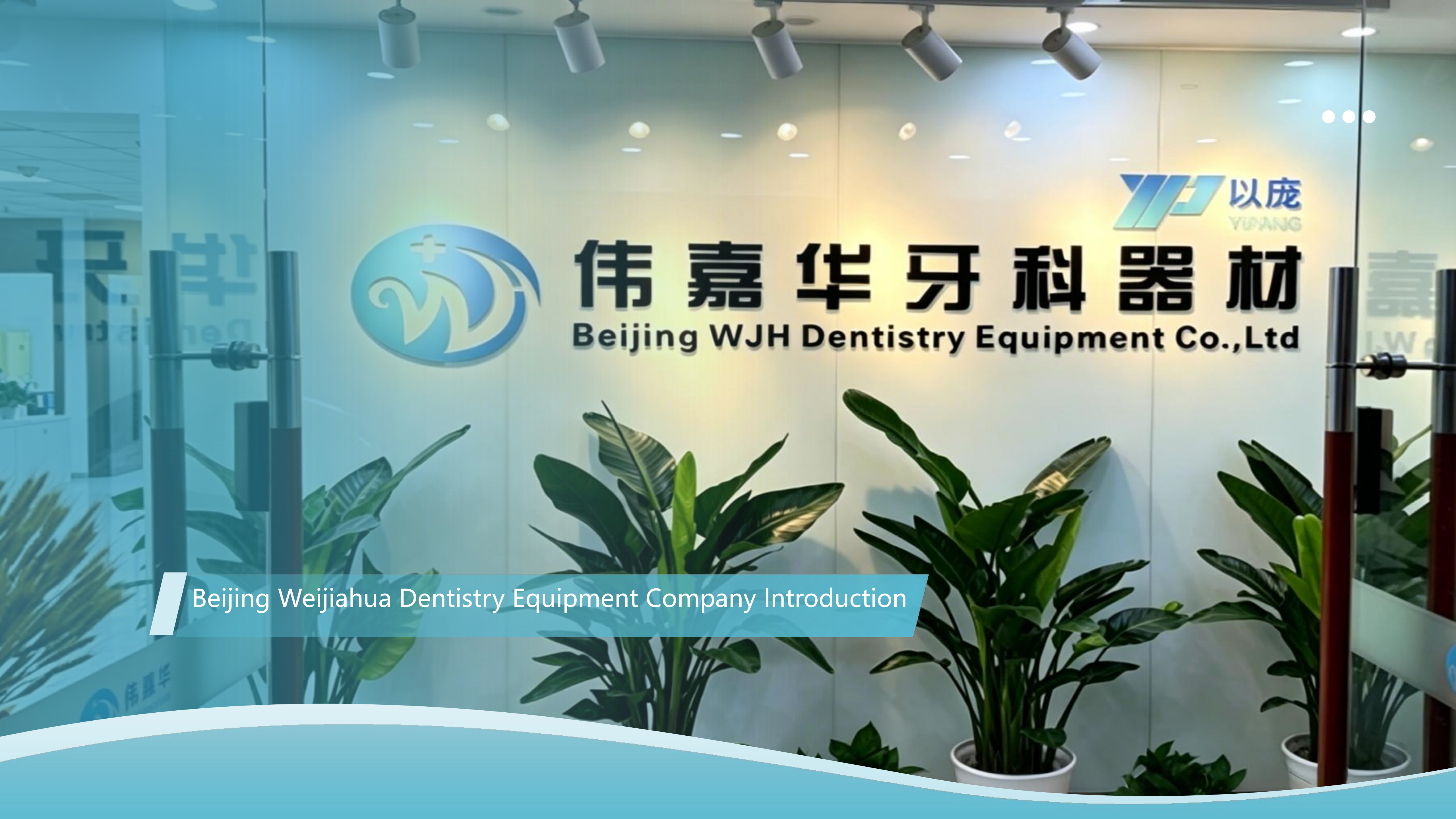
Laboratories that private-label or co-develop blanks and discs need a supplier with OEM and ODM capability, customization across almost all specifications, and manufacturing capacity that can absorb growth. YIPANG, the self-developed brand of Beijing Weijiahua Dentistry Equipment Co., Ltd., provides OEM and ODM production services to clients in the USA, Europe, Brazil, the Middle East and North Africa, with a monthly capacity of 15,000 pieces and a 25-engineer R&D team working on dental material formulation, process optimization and new product development.
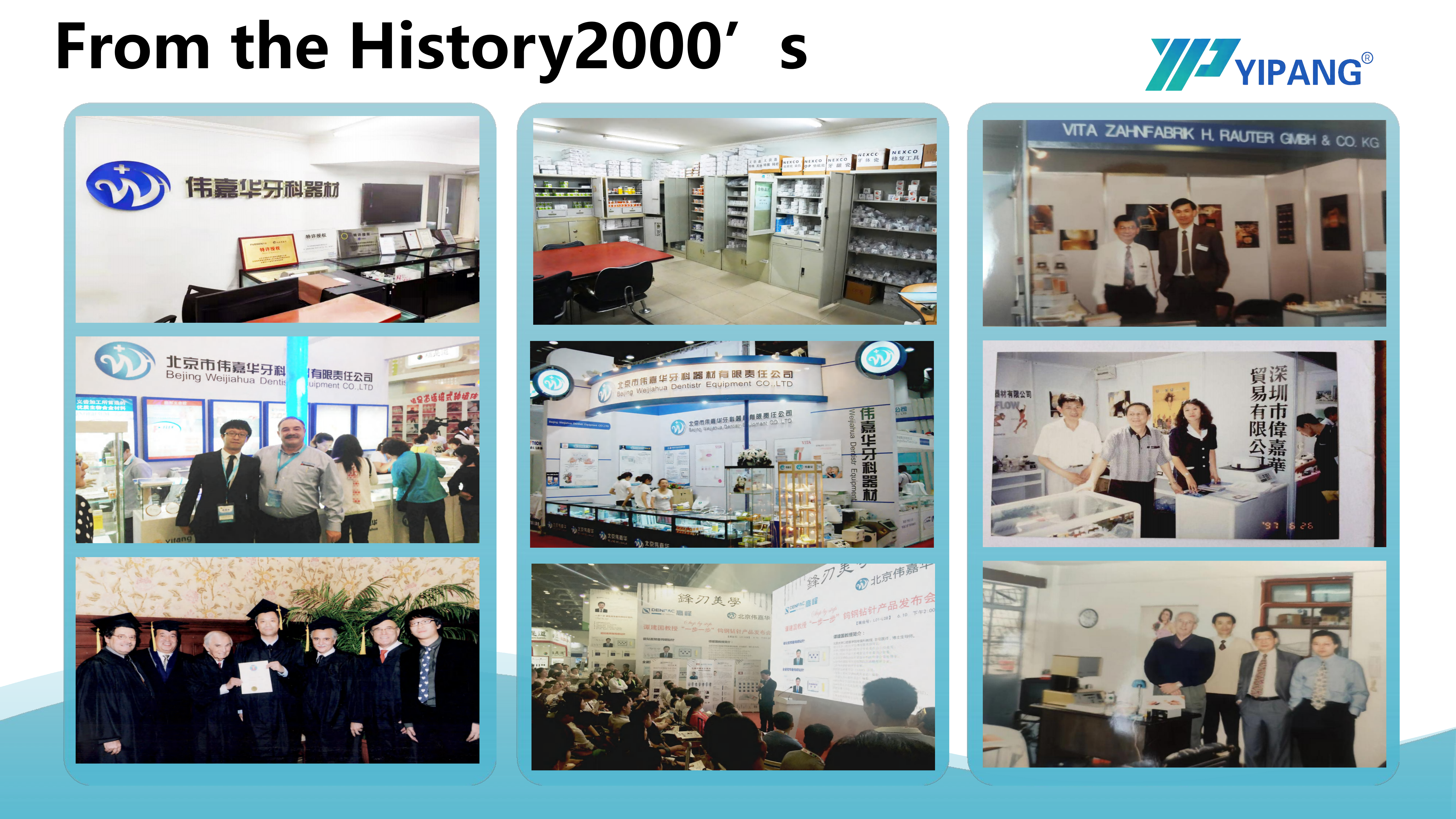
OEM and ODM programs connect a laboratory's case mix to the blank specifications it needs.
Zirconia Block vs. Lithium Disilicate: Workflow Comparison
| Decision dimension | Dental zirconia block (4D-PRO-ML) | Lithium disilicate (glass ceramic / press ingot) |
|---|---|---|
| Primary forming route | CAD/CAM milling of a green-state blank, followed by sintering | Heat-pressing of a press ingot, or milling of a glass ceramic blank, followed by crystallization |
| Thermal step | Sintering: 1450 °C listed; 1430 °C–1450 °C recommended range with standard heating and holding procedure | Crystallization firing after pressing or milling, on the schedule set by the material supplier |
| Strength reference | ≥1200 MPa listed bending strength; 800–1200 MPa described in high-volume laboratory guidance | Not specified in the verified sources used in this article — request supplier data |
| Translucency reference | Medium translucent, ML multilayer shades | Selected in practice for esthetic single-unit and short-span work |
| Blank format | 98 mm diameter CAD/CAM milling blank; 10 mm–20 mm thicknesses | Press ingots or millable glass ceramic blanks |
| Equipment set | Dental lab scanner, dental milling machine, dental milling burs, dental sintering furnace, optional dental porcelain furnace, dental polishing burs | Press furnace (press route) or milling machine (milling route), dental porcelain furnace, wax and investment consumables for pressing |
| Restoration types served | Full-contour crowns, bridges, veneers, implant superstructure restorations | Esthetic single units and short spans |
| Documented risk | Chipping or cracking after sintering, triggered by improper sintering profile or internal blank defects; mitigated by profile control and pre-sinter blank inspection | Process-specific defects defined by the material supplier |
| Common market context | Zirconia-based dental materials at USD 1.2 billion in 2025 (Grand View Research); CAD/CAM milling at 82.4% of zirconia processing revenue in 2025 | Global dental lithium disilicate market projected from USD 320 million in 2025 to USD 920 million by 2032 (Intel Market Research) |
Comparison limited to facts available in the referenced third-party reports and the manufacturer's published product data. Where a value is not available, it is marked as such rather than estimated.
Frequently Asked Questions
1. What compliance documentation should a full-arch implant lab expect from a dental zirconia block supplier?
Beijing Weijiahua Dentistry Equipment Co., Ltd. holds ISO 13485 certification, certificate number 381240434R0S, issued on 2024-12-27 by Shanghai POSI Certification Co., Ltd. and valid until 2027-12-26, against GB/T 42061-2022 / ISO 13485:2016, covering the design, production and sales of dental medical materials and dental equipment for global, EU, USA and Middle East markets. The company also holds an EU Declaration of Conformity under MDR 2017/745 for its intraoral scanners, models YP-X and YP-800, a Class I medical device, with SRN CN-MF-000045919. Note that EU MDR 2017/745 classifies most dental implants and restorative materials as high-risk devices requiring intensive clinical data (European Commission), so a laboratory should verify document scope against the exact product being purchased rather than against a manufacturer's portfolio as a whole.
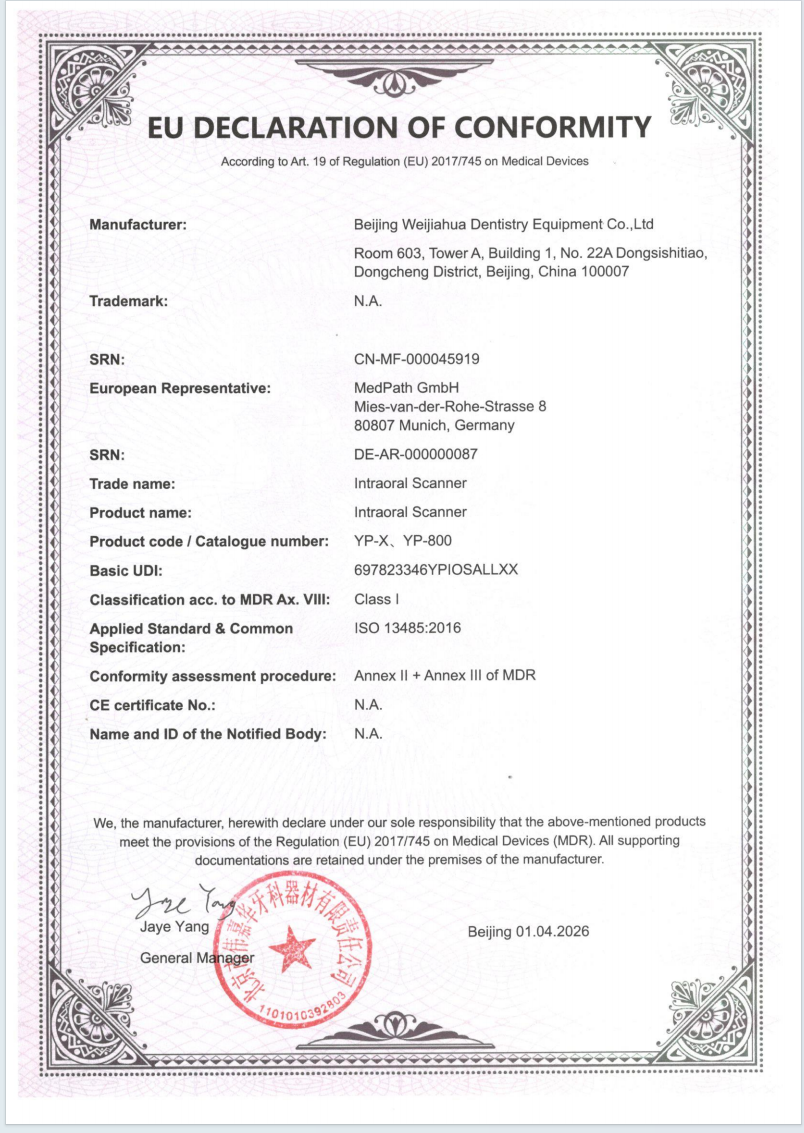
Compliance documentation scope matters: the EU Declaration of Conformity shown covers the YP-X and YP-800 intraoral scanners, not the zirconia block line.
2. Can an OEM dental zirconia block manufacturer support CAD/CAM dental labs with custom blanks?
Yes. OEM (Original Equipment Manufacturing) and ODM (Original Design Manufacturing) services are available, and customization covers almost all specifications. Production capacity is 15,000 pieces per month; quality control is 100% raw material inspection plus finished product random inspection; and after-sales support includes online technical guidance with a response target of 24 hours. Export markets served are the USA, Europe, Brazil, the Middle East and North Africa.
3. What drives the cost per unit when comparing the two workflows?
The dominant cost items are capital equipment already owned, consumables, technician hours and rework. On the zirconia side, consumables include milling burs, sintering trays, dental staining glaze, dental glaze paste and dental firing paste. On the lithium disilicate side, consumables include wax, investment, press ingots or milled glass ceramic blanks, and crystallization firing time. Supply terms also move unit cost at scale: standard YIPANG models carry an MOQ of 1 box, customized products 5 boxes, and the company states that small MOQ is negotiable for OEM/ODM programs.
4. Can a lab validate a sample before committing to a full-arch production run?
Sampling test is supported. Acceptance criteria state that quantity should be checked on receipt, and that any damage or deformation must be reported within 48 hours with photos. For zirconia, validation should include a sintering run in the laboratory's own furnace using its own profile within the recommended 1430 °C–1450 °C range, followed by a fit and shade check on the intended restoration type. Because chipping and cracking after sintering are documented failure modes linked to sintering profile and internal blank defects, a sample test is only conclusive when it reproduces production conditions exactly.
5. What are the delivery terms and lead time for a dental zirconia block order?
Lead time is 15–30 working days. Domestic orders ship by express; export orders ship by sea or air freight, with FOB Shanghai/Tianjin available. Payment terms are full payment before shipment. Laboratories that want to test both workflow routes against their own case mix can download the YIPANG company brochure for the full portfolio — zirconia blocks, glass ceramics, press ingots, PMMA, wax, titanium blocks, implant abutments, scanners, milling machines, 3D printers and sintering furnaces — and send a sample or quotation request to service@yipangdental.com or via WhatsApp at +86-158-0156-5064.
Conclusion: Choose the Route Your Lab Can Already Run
For full-arch implant laboratories, the zirconia block versus lithium disilicate decision reduces to one question: which production route can this laboratory run reliably, at the span length its case list demands, with the equipment and bench skills it already has? Zirconia answers that question with a mill-and-sinter chain that scales from full-contour crowns to implant superstructures and edentulous full-arch frameworks. Lithium disilicate answers it with a press or mill-and-crystallize chain that concentrates esthetic single units and short spans on the same bench.
Where the answer is a mill-and-sinter route, the specification to verify first is not the material name but the processing discipline: sintering range, holding time, cool-down, pre-sinter blank inspection and lot consistency. Beijing Weijiahua Dentistry Equipment Co., Ltd. was established in 1996, operates a 2,000 ㎡ facility with 80 employees and an annual output of USD 10 million, reports an export ratio between 40% and 55% serving the Middle East, Southeast Asia, South America, North America, Eastern Europe, North Africa and Australia, and supplies more than 1,000 dental laboratory customers in China alongside its YIPANG product lines.
Where the answer is a dual route, the deciding factor is bench scheduling and shared finishing standards — not material loyalty. And where the answer is neither yet, the first step is a sample run under production conditions, because a route is only proven when it produces a fitting restoration in the laboratory's own furnace.
Next step for implant and full-arch laboratories
Request a dental zirconia block sample or an OEM/ODM quotation, and download the YIPANG company brochure for full specifications.
Email: service@yipangdental.com · WhatsApp: +86-158-0156-5064 · Website: www.yipangdental.com
Brochure (PDF): WJH Company Information
Have Questions or Need More Details?
Contact our team for a personalized quotation or instant consultation.
Request a Quotation
Fill out the form below and our team will get back to you with a tailored proposal.
WhatsApp Direct Chat
Prefer to chat in real-time? Message us on WhatsApp for instant assistance & quick answers.
- Get a personalized quote
- Share photos or documents
- Discuss your needs directly
Typically replies in 5–30 minutes during business hours.