
Clear Concepts: Monolithic Zirconia's Rise in Prosthetic Dentistry
A monolithic zirconia prosthesis is a restoration milled from a single solid zirconia block, where the full contour is the material itself and no veneering ceramic is layered on top. That single design decision explains most of the format's rise in prosthetic dentistry: it removes the bonded ceramic interface where chipping typically begins, and it fits the way modern labs already work, because the entire crown, bridge or implant superstructure comes off the milling machine as one piece.
This article covers four things a laboratory or distributor needs when evaluating that transition. First, why layered ceramic prostheses chip. Second, how the zirconia materials market moved toward millable blocks. Third, what a single-material block changes in daily production. Fourth, which certification, specification, sample and delivery constraints should be verified before a block is standardized across a production line. The worked example throughout is the YIPANG 4D-PRO-ML Zirconia Block for Dental Prosthesis. YIPANG is the self-developed dental brand of Beijing Weijiahua Dentistry Equipment Co., Ltd. (WJH), a Beijing-based dental materials and equipment manufacturer established in 1996.
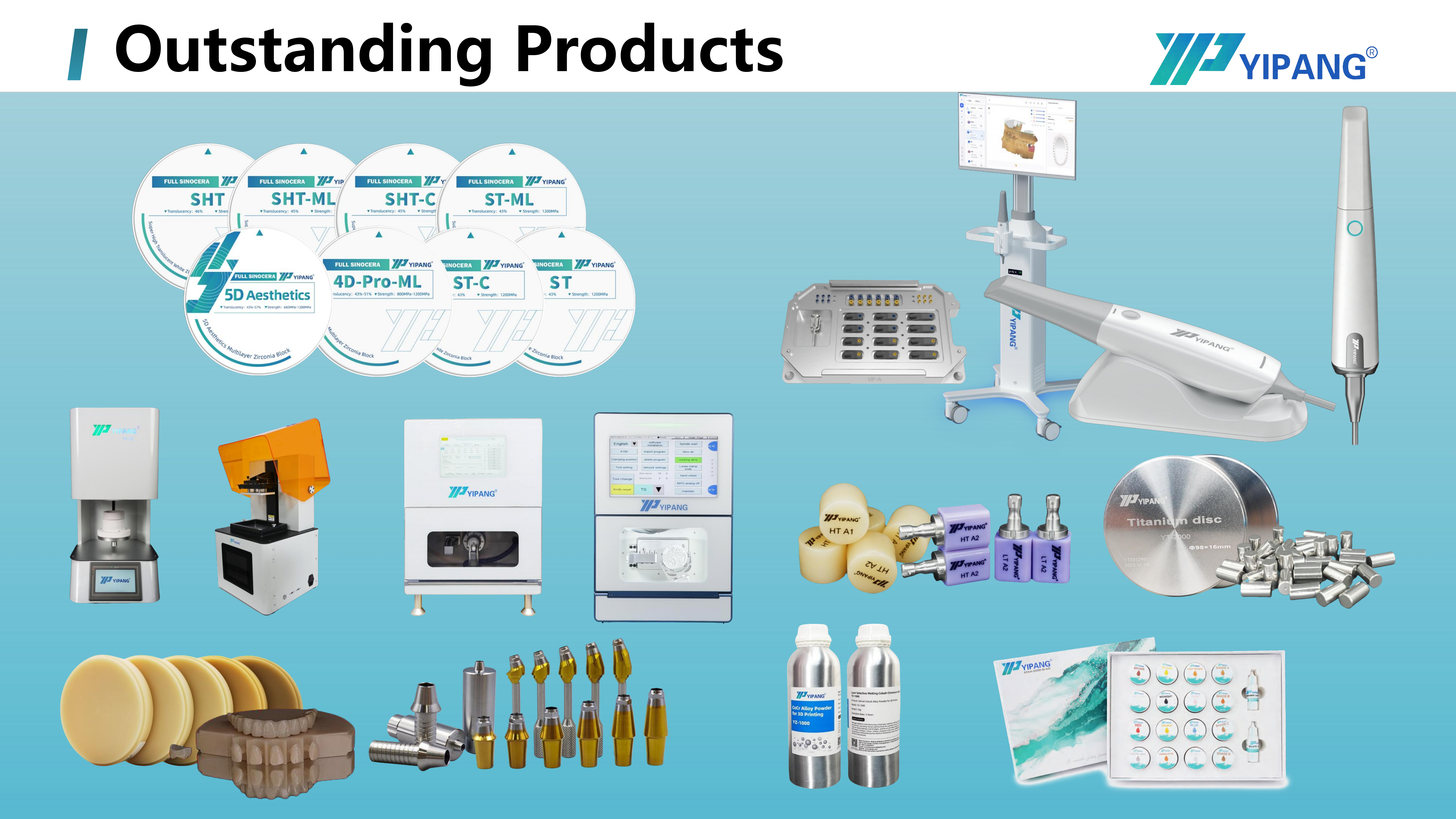
Quick answer: monolithic zirconia blocks reduce layered ceramic chipping by removing the veneer-to-core interface entirely. The full contour is milled from one yttria-stabilized zirconium dioxide block, sintered at 1450 ℃ with a bending strength of at least 1200 MPa, and produced in ML multilayer shades on a 98 mm disc format compatible with most mainstream dental milling machines.
Why Layered Ceramic Prostheses Chip: The Problem in One Sentence
Layered restorations chip because they contain a junction that monolithic restorations do not. A layered prosthesis is built in two stages: a milled core, commonly a zirconia framework, is produced first, and a veneering ceramic is then applied over it in layers and fired in a dental porcelain furnace, sometimes through repeated build-and-fire cycles. Strength and surface appearance are therefore delivered by two different materials that must remain bonded to each other for the life of the restoration.
Chipping is commonly reported at that junction, on the veneering layer or on the bond between the veneer and the core, rather than inside the milled framework. The practical consequence for a laboratory is measured in rework rather than in theory: an intact framework with a chipped veneer usually cannot be recovered by polishing alone, so the unit is remade and the case returns to the lab.
Two things are true at the same time, and both matter for a realistic evaluation:
- The interface is a structural feature, not a manufacturing error. Any layered build creates a material boundary, and that boundary is where a two-material system is most sensitive to occlusal load and to processing conditions.
- Layering still has a legitimate role. Where a case demands the deepest surface characterization, hand-applied ceramic remains a technique that ceramists rely on. The industry did not abandon layering; it added a single-material option for the cases that do not require it.
The problem monolithic zirconia was designed to solve is therefore narrow and specific: keep the strength and digital-workflow advantages of a milled zirconia restoration while removing the veneering step and the interface that comes with it.
Industry Background: How Millable Zirconia Blocks Became the Center of Prosthetic Production
The shift toward monolithic prosthetics did not happen in isolation. It tracks the wider migration of prosthetic fabrication into digital, mill-based production, and published market figures show where the volume now sits.
- The global zirconia-based dental materials market was valued at USD 1.2 billion in 2025 and is projected to reach USD 2.3 billion by 2033, according to Grand View Research.
- Within that market, zirconia discs held the largest revenue share at 63.1% in 2025 (Grand View Research), which means the dominant delivery format is a millable blank rather than a layering powder.
- CAD/CAM milling accounted for 82.4% of zirconia dental manufacturing process revenue in 2025 (Grand View Research), confirming that the block and the milling machine, not the ceramic bench, now carry the production load.
- Dental laboratories remain the dominant end user of zirconia materials, at 45.3% of market share in 2025 (Grand View Research).
- The United States alone accounts for 40% of zirconia-based dental materials revenue (Grand View Research), which is one reason North American documentation and consistency expectations tend to travel worldwide.
- On the material-specification side, 3Y-TZP zirconia held the largest revenue share at 35.9% in 2025 (Grand View Research), the yttria-stabilized grade family that millable blocks are built around.
For context on material choice rather than as a ranking, lithium disilicate accounts for approximately 28% of all all-ceramic dental restorations globally as of 2024 (Business Research Insights). Glass-ceramics and zirconia are not interchangeable in every indication; they compete mainly in single-unit and short-span work, while zirconia's format advantage shows up in multi-unit and implant-supported structures.
Regulation moved in parallel. Under EU Medical Device Regulation (MDR 2017/745), most dental implants and restorative materials are classified as high-risk and require intensive clinical data (European Commission). The practical reading for a laboratory is that a block is not simply a consumable; it is a documented input to a regulated process, so its traceability, quality-management certification and sintering specification belong in the purchasing criteria.
The Monolithic Answer: What Changes When a Prosthesis Is One Material
A single-material prosthesis removes the failure location rather than reinforcing it. In the YIPANG 4D-PRO-ML block, the restoration is milled from zirconium dioxide (ZrO₂) stabilized with yttria in the form of a 98 mm CAD/CAM dental milling blank. Because the full contour is produced from one block, there is no veneer-to-core bond to maintain, no veneering ceramic to fire, and no two-material boundary to manage along the occlusal load path.
The properties that make this practical come from the block specification itself:
- Bending strength of at least 1200 MPa, the property that lets a monolithic contour serve posterior and multi-unit indications without a veneer build-up.
- Sintering temperature of 1450 ℃, with a recommended process range of 1430-1450 ℃ and a standard heating and holding procedure.
- Gradient translucency in ML multilayer shades, so shade is distributed through the thickness of the block instead of being applied as a surface layer.
- Low shrinkage after sintering with high dimensional accuracy, which is what makes a monolithic contour fit-critical rather than decoration-critical.
- Compatibility with most mainstream dental milling machines, so the block enters an existing CAD/CAM workflow instead of requiring a dedicated system.
- Strict quality control against dental medical material standards, supported by raw-material inspection and finished-product inspection.
The esthetic trade-off deserves a clear statement. Gradient translucency plus external staining and glazing covers a wide range of everyday crown and bridge work, but a monolithic contour does not reproduce the depth of a hand-layered ceramic surface in every high-characterization case. Where a clinician requires maximum surface detail, a layered route, or a hybrid in which the monolithic contour carries the strength and only limited characterization is added, remains the more suitable choice. Monolithic zirconia did not make layering obsolete; it made it optional.
4D-PRO-ML Zirconia Block: Verified Specifications
| Specification | Verified value |
|---|---|
| Product name | Zirconia Blocks for Dental Prosthesis |
| Model | 4D-PRO-ML |
| Type | Dental zirconia disc / CAD-CAM dental milling blank |
| Material | Zirconium dioxide (ZrO₂) with yttria stabilizer |
| Diameter | 98 mm |
| Thickness options | 10 mm, 12 mm, 14 mm, 16 mm, 18 mm, 20 mm |
| Available shades | ML multilayer |
| Sintering temperature | 1450 ℃ (recommended process range 1430-1450 ℃) |
| Bending strength | At least 1200 MPa |
| Translucency | Medium translucent |
| Applicable industry | Dental laboratory, dental prosthetics, dental CAD/CAM industry |
Constraints to Verify Before Standardizing a Monolithic Zirconia Block
For a buyer moving from research into evaluation, the deciding constraints are not marketing claims but four verifiable items: quality-management certification, market-specific regulatory status, the parameter set that must match existing equipment, and the process conditions inside the laboratory.
1. Quality-management certification
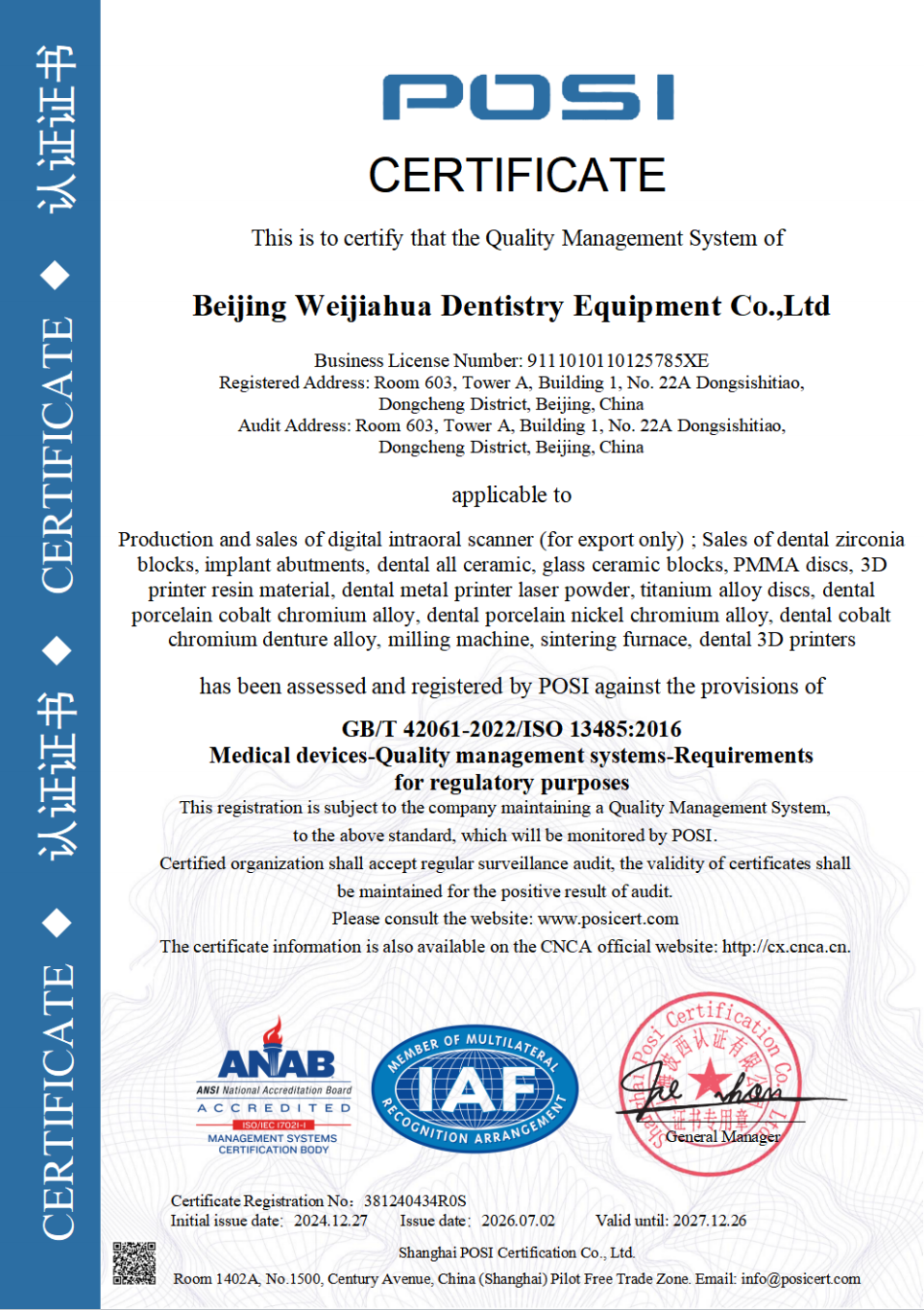
The YIPANG dental zirconia block product line is certified to ISO 13485:2016. The certification number is 381240434R0S, issued by Shanghai POSI Certification Co., Ltd., against the standard GB/T 42061-2022 / ISO 13485:2016. The certification scope covers the design, production and sales of dental medical materials and dental equipment, and it is applicable to the Global, EU, USA and Middle East markets. The certificate was issued on 2024-12-27 and remains valid until 2027-12-26.
2. Market-specific regulatory position
Certification is market-specific, and buyers should keep the boundaries explicit. Beijing Weijiahua Dentistry Equipment Co., Ltd. holds an EU Declaration of Conformity under MDR 2017/745 with SRN: CN-MF-000045919, declared against the standard ISO 13485:2016 and Regulation (EU) 2017/745, covering the Intraoral Scanner models YP-X and YP-800, a Class I medical device. Because MDR 2017/745 classifies most dental implants and restorative materials as high-risk and requiring intensive clinical data (European Commission), a buyer entering the EU market should treat regulatory status as a document-by-document check rather than a general company statement.
3. Parameter match with existing equipment
The 98 mm diameter is the constraint that decides whether a block fits an existing mill without adapter changes, and thickness selection across 10 mm to 20 mm determines how many units can be nested per disc. A bending strength of at least 1200 MPa and medium translucency define the indication range, while the ML multilayer shade system defines the esthetic ceiling achievable without layering. A block that satisfies all four parameters removes most of the risk from a format change.
4. Process conditions inside the laboratory
The application requirement for this material is an indoor, constant-temperature dental laboratory environment with strict adherence to the standard sintering temperature curve. The stated process boundaries are straightforward: avoid rapid temperature change to prevent cracking, and do not exceed the maximum sintering temperature.
Constraint summary: a monolithic zirconia block should be selected on certificate scope and validity, its market-specific regulatory documents, its diameter-and-thickness fit with the existing mill, and the lab's ability to hold a defined sintering curve, not on translucency claims alone.
Step-by-Step: Monolithic Zirconia in a Modern Milling Workflow
Monolithic production is short because it skips the layering bench. The sequence below reflects the standard CAD/CAM route for this block, using the equipment the material is specified for: a dental lab scanner or intraoral scanner, a dental milling machine and a dental sintering furnace.
- Scan. Capture the preparation, opposing dentition and bite with a dental lab scanner or intraoral scanner. The scan defines the marginal geometry that the monolithic contour must reproduce after shrinkage.
- Design in CAD. Design the restoration at full contour: crown, bridge, veneer or implant superstructure. Because the contour is the final material, the design stage carries the occlusal and connector decisions that a veneering stage would otherwise absorb.
- Select block thickness. Match thickness to the unit or span, using 10 mm and 12 mm for smaller units and moving through 14 mm, 16 mm, 18 mm and 20 mm for larger or multi-unit work, then nest parts to use the 98 mm disc efficiently.
- Mill. Machine the workpiece with milling burs suited to the zirconia blank. Compatibility with most mainstream dental milling machines means the block runs on the mill already in the laboratory.
- Sinter. Place the milled workpiece on a sintering tray, set the heating curve up to 1430-1450 ℃ with the proper holding time, then allow natural cooling. Do not exceed the maximum sintering temperature, and avoid rapid temperature change to prevent cracking. Following the standard curve is what delivers low shrinkage and stable translucency.
- Finish. Apply staining glaze or glaze paste and characterize the surface, then refine contact points and margins with polishing burs.
- Verify and deliver. Check fit, occlusion and shade consistency across the batch before dispatch.
Two workflow details separate a reliable monolithic process from an inconsistent one. Dimensional accuracy is decided at sintering rather than at milling, so a correct CAD design and a correct sintering curve are a matched pair. Batch consistency also matters more in monolithic work, because there is no veneer layer to mask small shade or translucency variation; uniform translucency and stable sintering shrinkage are the properties that keep a multi-unit bridge reading as one restoration instead of several.

From Full-Contour Crowns to Implant-Supported Bridges: What Is Made From a Monolithic Block
The prostheses produced from a single zirconia blank cover a wide range of indications. The application scope for the 4D-PRO-ML covers full-contour crowns, bridges, veneers and implant superstructure restorations.
- Full-contour crowns. Single units where the entire anatomical contour is milled, including posterior positions where a bending strength of at least 1200 MPa is the reason no veneer is needed.
- Multi-unit bridges. Connector geometry and span are milled into the same block, so the bridge is one continuous material from abutment to abutment rather than a framework carrying a separate ceramic surface.
- Veneers. Thin monolithic sections where gradient translucency in ML multilayer shades performs the esthetic work.
- Implant superstructure restorations. Screw-retained and cement-retained superstructures built on dental implant abutments, where eliminating the veneer interface removes a failure point from a high-load restoration.
- Implant-supported bridges and full-arch work. Longer spans where thickness selection up to 20 mm determines how the framework nests inside the disc.
Field experience supports the format rather than the claim. Across hundreds of long-term cooperative clients worldwide, including dental laboratories, dental clinics and distributors using the material to manufacture crowns, bridges and aesthetic restorations, the recurring feedback has been high recognition on material stability and aesthetic effect with a low customer complaint rate, sustained over cooperation lasting many years. The technical highlight those labs point to is consistent: uniform translucency, stable sintering shrinkage, and compatibility with most CAD/CAM systems.
Comparison: Monolithic Zirconia vs. Layered Ceramic Prostheses
The table below compares the two construction routes on structural and workflow criteria. It is a decision aid rather than a superiority claim, because the right route depends on the indication and the esthetic requirement.
| Evaluation criterion | Monolithic zirconia prosthesis (4D-PRO-ML) | Layered ceramic prosthesis |
|---|---|---|
| Material architecture | One milled material: zirconium dioxide (ZrO₂) with yttria stabilizer, produced at full contour | Zirconia core with veneering ceramic applied in layers |
| Material interface | None, because there is no bonded veneer layer | Ceramic-to-core interface that must remain bonded |
| Commonly reported chipping location | Not applicable at a veneer interface | The veneering layer and its bond to the core |
| Shade strategy | ML multilayer gradient translucency through block thickness, plus external staining and glazing | Shade built up by the veneering ceramic |
| Production route | Scan, CAD design, mill, sinter, finish | Scan, CAD design, mill, sinter, layer, fire, finish |
| Furnace load | Dental sintering furnace cycle only | Sintering furnace plus dental porcelain furnace firing cycles |
| Block format used | 98 mm diameter disc; 10, 12, 14, 16, 18, 20 mm thickness | Varies with the ceramic system selected |
| Strength and process specification | Bending strength at least 1200 MPa; sintering temperature 1450 ℃ | Not specified in the referenced material data for this block |
| Quality-management certification of the block | ISO 13485:2016, certificate number 381240434R0S | Depends on the supplier of the ceramic system |
| Best-fit indications | Full-contour crowns, bridges, veneers, implant superstructure restorations | Cases requiring maximum surface characterization |
Read the table as a risk map. The monolithic route concentrates risk in design and sintering, both of which sit inside the laboratory's control and are documented by the block specification. The layered route adds a bonded interface and a firing sequence, which is where chipping is commonly associated.
Frequently Asked Questions
What certification should a dental lab verify on a monolithic zirconia block before purchasing?
Verify ISO 13485:2016 certification that covers design, production and sales of dental medical materials and dental equipment. The YIPANG Zirconia Blocks for Dental Prosthesis line holds ISO 13485:2016 certification number 381240434R0S, issued by Shanghai POSI Certification Co., Ltd. against GB/T 42061-2022 / ISO 13485:2016, valid from 2024-12-27 to 2027-12-26 and applicable to the Global, EU, USA and Middle East markets. For the EU, MDR 2017/745 classifies most dental implants and restorative materials as high-risk requiring intensive clinical data (European Commission), and the company separately holds an EU Declaration of Conformity under MDR 2017/745 with SRN: CN-MF-000045919 for Intraoral Scanner models YP-X and YP-800, a Class I device.
Can a monolithic zirconia block be used for implant-supported bridges as well as single crowns?
Yes. The application scope of the 4D-PRO-ML covers full-contour crowns, bridges, veneers and implant superstructure restorations. A 98 mm diameter disc with 10 mm to 20 mm thickness options supports single units through multi-unit spans, the bending strength of at least 1200 MPa suits posterior and implant-supported indications, translucency is medium translucent in ML multilayer shades, sintering temperature is 1450 ℃ within a recommended 1430-1450 ℃ range, and the block is compatible with most mainstream dental milling machines.
What drives the unit cost of a monolithic zirconia prosthesis?
Four controllable drivers decide the cost per unit. Material yield per disc comes first, since the 98 mm diameter and the 10-20 mm thickness choice decide how many units nest per blank. Milling time on the machine comes second. Furnace cycles come third, and monolithic work depends on the sintering cycle alone rather than a repeated layering-and-firing sequence. Finishing labor for staining, glazing and polishing comes fourth. On commercial terms, the supplier reports a negotiable small MOQ, an OEM/ODM production mode with almost all specifications customizable, and a monthly capacity of 15,000 pieces, all of which affect how per-unit cost behaves across a production month.
How can a lab validate a monolithic zirconia block before committing to a volume order?
Validate on your own equipment rather than on a data sheet. Mill a test unit with the burs used in production, sinter it at 1430-1450 ℃ following the standard heating and holding curve, and check the three items that decide whether a block is production-ready: sintering shrinkage and dimensional accuracy at the margin, translucency consistency in ML multilayer shades across the batch, and compatibility with the existing CAD/CAM system and mill. Sample requests and specification questions can be sent directly to YIPANG through the contact details at the end of this page.
What are the lead time, MOQ and after-sales terms for ordering dental zirconia blocks?
Lead time is 15-30 working days, monthly capacity is 15,000 pieces, and the MOQ is negotiable and small in scale. Production runs under an OEM/ODM model in which almost all specifications can be customized. Quality control combines 100 percent raw material inspection with finished product random inspection, and after-sales support provides online technical guidance with problem response within 24 hours. Export markets include the USA, Europe, Brazil, the Middle East and North Africa. To move from evaluation to a first order, download the company brochure or send a sample and quotation request to the contacts below.
Conclusion: Monolithic Zirconia as a Production Standard, Not a Trend
The rise of monolithic zirconia in prosthetic dentistry can be summarized in one line: removing the veneering layer removes the interface where chipping is commonly associated, and the mill workflow that produces the rest of the prosthesis already existed. With zirconia discs holding 63.1% of zirconia-based dental materials revenue in 2025 and CAD/CAM milling accounting for 82.4% of process revenue in the same year (Grand View Research), the production center of gravity is a millable block and a sintering curve.
The evaluation criteria follow from that. Check certification scope and validity, check market-specific regulatory documents, check that the 98 mm diameter and 10-20 mm thickness range fit the existing mill, and check that the laboratory can hold a 1430-1450 ℃ sintering curve consistently. Everything else, from full-contour crowns to implant-supported bridges, is a question of matching the right block format and shade system to the indication.
Next Step: Samples, Specifications and Brochure
YIPANG, the dental brand of Beijing Weijiahua Dentistry Equipment Co., Ltd., supplies the 4D-PRO-ML Zirconia Block for Dental Prosthesis in ML multilayer shades with 98 mm diameter and 10-20 mm thickness options, backed by ISO 13485:2016 certification number 381240434R0S.
Request a sample for a real milling and sintering test, or ask for a quotation and full specification sheet at your required thickness and shade. The complete company profile, product range and service scope are available in the brochure.
- Company brochure: WJH Company Information
- Website: www.yipangdental.com
- Email: service@yipangdental.com
- WhatsApp: +86-158-0156-5064
- Tel: +86 158-0156-5064
- Address: Room 603, Tower A, Building 1, No. 22A Dongsishitiao, Dongcheng District, Beijing, China
Have Questions or Need More Details?
Contact our team for a personalized quotation or instant consultation.
Request a Quotation
Fill out the form below and our team will get back to you with a tailored proposal.
WhatsApp Direct Chat
Prefer to chat in real-time? Message us on WhatsApp for instant assistance & quick answers.
- Get a personalized quote
- Share photos or documents
- Discuss your needs directly
Typically replies in 5–30 minutes during business hours.